
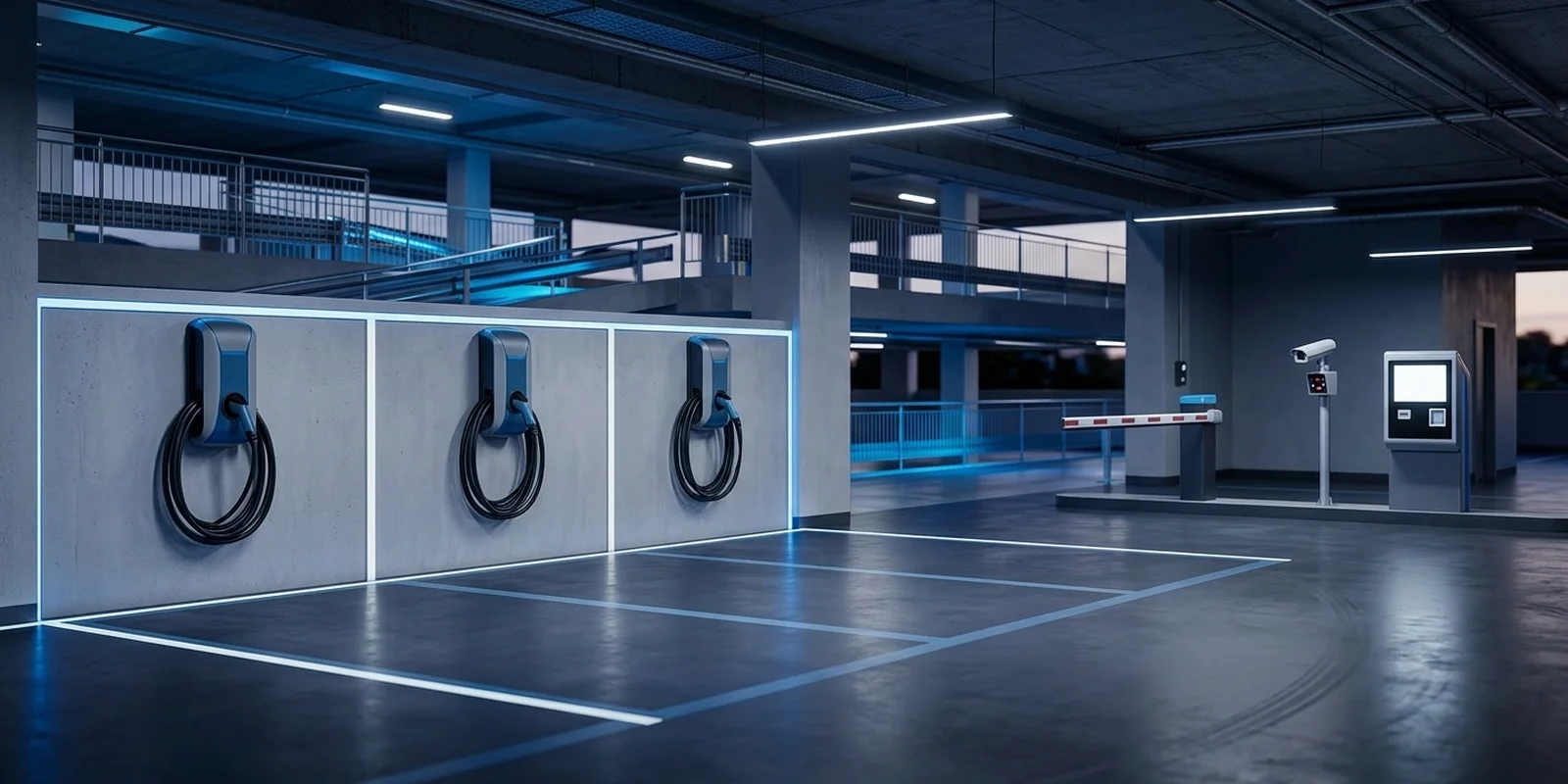
Charging Inside A Parking Operation
💡 Parking Management System And EV Charging: Key Highlights
- The charger is the guest system. The site’s parking management system already controls entry, exit and payment.
- Integration has four points: identity (plate, RFID or app), access (barrier and validations), billing (who is merchant of record) and occupancy (one live bay map).
- OCPP has no number-plate token, so the plate-to-account match lives in the backend.
- Idle fees pay on DC bays: a 60 kW bay sells roughly ₹800 of energy an hour, a 7.4 kW AC bay about ₹85.
- Without an API, integration falls back to webhooks, file drops or a barrier relay, which can open a gate but not post a validation.
Most urban chargers do not stand on their own land. They sit in malls, office parks, airports and municipal lots, where a parking management system already decides who enters, how long they stay and what they pay at the exit. The charger is the guest system. Left unconnected, the driver pays twice, waits at a barrier that will not lift, or finds a bay marked free with a petrol car in it.
The IEA counted more than 5 million public charging points worldwide at the end of 2024 (Global EV Outlook 2025), and many land on sites someone else runs. In India, the Model Building Bye-Laws amendment assumes charging for 20% of a building’s parking capacity. At a 1,000-bay mall, that is 200 charging bays inside one parking operation.
This post is written for mall, office-park, airport and municipal parking operators, and for the charge point operators (CPOs) who deploy inside their sites. Where their incentives differ, we say so. Bundling (EV charging service bundles), reservations and no-show fees and charging bay layout have their own posts; this one covers the integration.
The Four Integration Points Between A Parking Management System And A Charging Platform
There are four connections, and each fails in a way drivers notice.
| Integration point | What has to connect | What breaks without it |
|---|---|---|
| Identity | Plate read, charging token and driver account | Two accounts per driver; no way to tie the energy bill to the parking stay |
| Access | Session status, exit barrier logic and validations | Driver held at the exit; free-parking validation applied by hand or not at all |
| Billing | Parking fee and energy charge, one merchant of record | Two payments, disputed charges, invoices that mix two services |
| Occupancy | Bay sensors, charger status and the driver app | App shows free bays that are blocked or held by a finished EV |
Identity: ANPR, RFID or app, and where Autocharge fits
A parking system knows a car by its plate. A charging platform knows a driver by a token: an RFID card, an app login or, on DC chargers with Autocharge, an identifier the vehicle sends over the cable. OCPP 2.0.1’s token types cover RFID cards, MAC addresses, eMAIDs and central tokens, but not number plates. So the match happens in the backend: the ANPR (automatic number plate recognition) camera reads the plate at entry, the parking system passes it on, and the charging platform matches it to an account and authorises the session centrally.
Autocharge identifies the car at the plug, but only on DC and for compatible vehicles. ANPR identifies it at the gate, for AC and DC alike, and alone links the charging session to the parking stay. Its weak point is read accuracy on dirty or non-standard plates (India’s high-security plates, fitted to new vehicles since 2019, help). Keep a QR or app start as the fallback.
Access: barriers, validations and the car that stays
In a barriered garage, the parking system opens the exit barrier, and it needs three facts the charging platform holds: was there a session on this plate, is it paid, and does it earn a parking validation? A typical validation is two hours’ free parking with a minimum charge, and it only works if the charging platform posts it to the ticket when the session ends. Rather than holding the barrier over an unpaid charging fee, add it to the exit ticket or a stored card.
Billing: one ticket or two, and who is merchant of record
The driver wants to pay once; the two businesses want separate books. With a combined ticket, the parking operator is merchant of record, collects both amounts at the exit and settles the energy share to the CPO. Or the charging platform is merchant of record and remits the parking fee. Or the site runs two transactions: simplest to build, worst for the driver.
Whoever collects, parking and energy appear as separate lines, because they are different services that may be taxed differently. In India, plan for GST invoices showing separate supplies and confirm the rate treatment with your tax adviser. Splitting, settling and reconciling both lines daily is the job of the payment and billing software, not the parking ticket printer.
Occupancy: one map for bays and chargers
A charger reports connector status (Available, Charging, Finishing, Faulted), which describes the plug, not the bay. A petrol car in front of an idle charger still shows as Available on every app. Bay sensors or the ANPR camera tell the parking system whether the space is occupied. Together the two give four states: free, EV charging, EV finished but parked, and blocked by a car that is not charging. Only the first should show as free in the driver app.
Overstay And Idle Fees: The Utilisation Arithmetic
An idle fee is hard to defend without numbers, so start from what the bay earns per hour. An illustrative India example: a 60 kW DC bay averaging 45 kW sells about 45 kWh an hour; at ₹18/kWh, that is about ₹810 of energy revenue per hour in use. A mall’s parking fee is a few tens of rupees an hour. A finished EV left there for an hour displaces about ₹800 of charging revenue, if another driver is waiting.
A 7.4 kW AC bay sells about 7 kWh an hour; at ₹12/kWh that is roughly ₹85 an hour, close to the parking fee. Three rules follow:
- Charge idle fees on DC bays. After a 10–15 minute grace period, ₹5–10 a minute (₹300–600 an hour) stays below the revenue it protects but changes behaviour.
- Be careful on AC bays. At a mall, a two- to three-hour stay is the business model; an idle fee there costs more goodwill than it earns unless bays are regularly full.
- Link the fee to demand. Switch idle fees on when site occupancy crosses a threshold. A fee charged when no one is waiting only penalises the driver.
In a barriered garage, enforcement is simple: the fee joins the exit ticket. In an open lot, the only lever is a payment method stored or pre-authorised at session start; without one, an idle fee is a request.
Who Owns The Driver And The Money
Most sites fall into one of three arrangements. Operator-led: the parking operator owns the customer, the ticket and the tariff, and pays the CPO a fee or per-kWh share. CPO-led: the CPO owns the chargers and tariff and pays the host rent or a revenue share. Hybrid: the energy margin is split according to who funded hardware and civil works.
In India, the Ministry of Power’s 2024 charging guidelines offer public land to government entities at a revenue share of ₹1.0/kWh for 10 years, with the same figure as the floor price when private operators bid (PIB summary of the guidelines). A charger selling 200 kWh a day pays the land-owning agency about ₹73,000 a year. Incentives also diverge: a retail host wants long stays, while a CPO wants fast turnover on DC bays.
Three clauses decide which arrangement you are really in:
- Merchant of record: whose name is on the receipt, and who handles refunds and chargebacks.
- Data ownership: who holds the match between plate and payment account. A plate linked to an account is personal data under GDPR and India’s Digital Personal Data Protection Act, 2023, so write down consent and retention.
- Tariff control: who sets the energy price and idle fee, and who funds parking validations.
When The Parking System Has No API
Many parking systems were bought for ticketing, not integration. Four routes, best to worst:
Whichever route the site supports, the charging side needs one backend holding session, identity and tariff together, the job of a charging management platform. Split them across systems and spreadsheets, and every integration point needs manual work.
ICE-ing, Signage And Enforcement
No integration helps when a petrol car takes a charging bay (ICE-ing). Signage makes the rule visible; ANPR makes it provable, because a plate in a charging bay with no session for 15 minutes is a recordable event the parking system can charge at exit where local rules allow. Track the ICE-ing rate per bay monthly: high at a few bays means signage, high everywhere means too few general bays.
Frequently Asked Questions
Integrating EV charging with a parking management system
Sources: IEA — Global EV Outlook 2025 | MoHUA — Amendments in Model Building Bye-Laws 2016 for EV Charging Infrastructure (2019) | PIB — Status of implementation of the National Electric Mobility Mission Plan, 13 Feb 2025 (summarising the Ministry of Power’s EV charging guidelines dated 17.09.2024)
Make Charging Part Of Your Parking Operation
See how YoCharge’s tariffs, idle fees, host settlement reports and tax-compliant invoices fit alongside the parking system already running your site.