
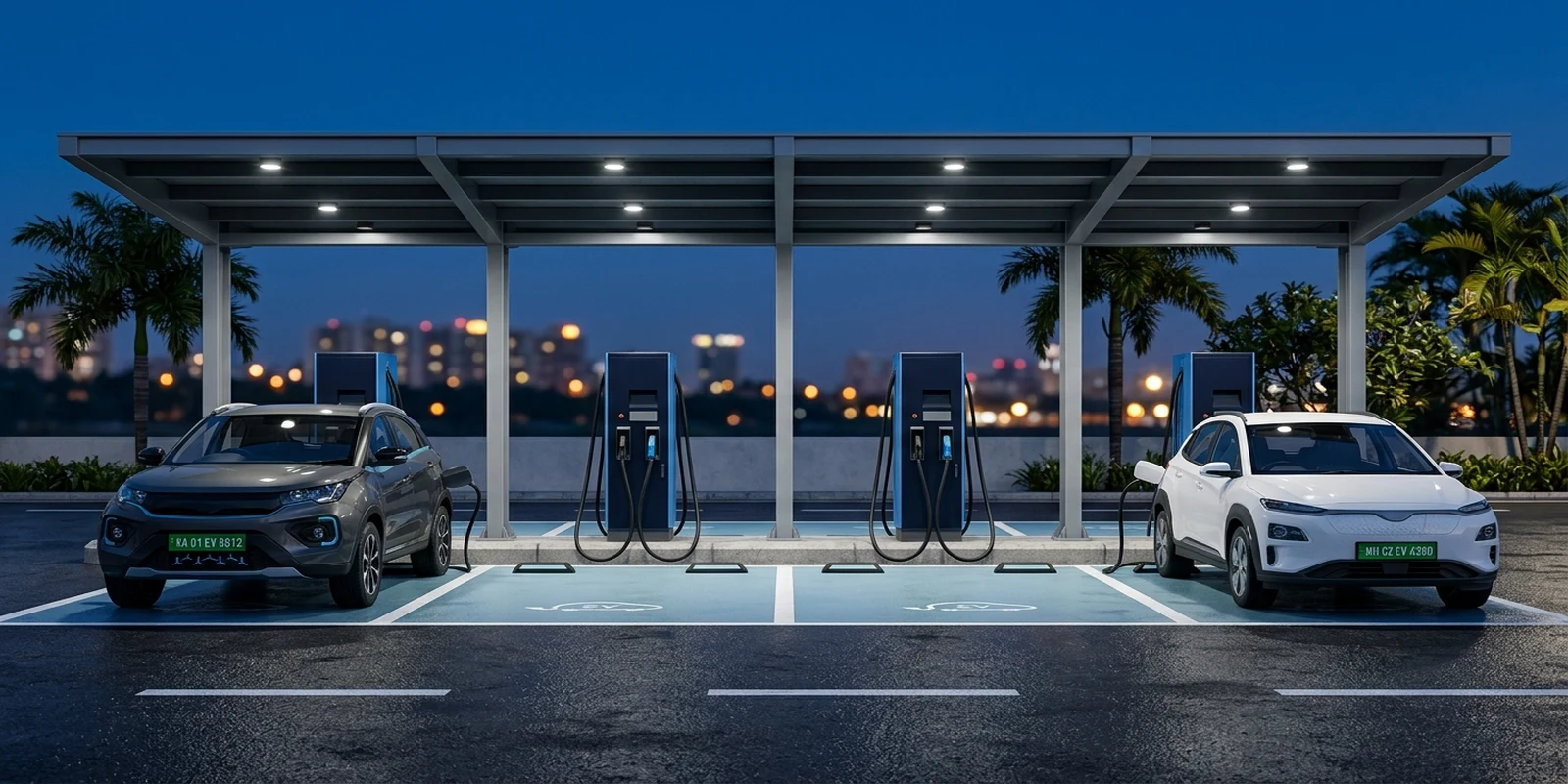
EV Charging Station Design
💡 EV Charging Station Design: Key Highlights
- Five metres is the whole cable budget. CEA’s 2023 safety regulations cap dispenser-to-vehicle distance at five metres and ban adaptors and extensions.
- Upstream works can cost more than the charger. BEE benchmarks: ₹14.80 lakh upstream at 100 kW against ₹11.68 lakh for the CCS-II unit.
- Splitting power changes queues, not throughput. Two 60 kW guns beat one 120 kW gun where dwell is long — and lose on a highway.
- Trenching is permanent. Cables run a metre deep and never cross a buried oil tank — dig once, for the year-five count.
- Signage is a compliance item. Charger specs, per-unit rates, pictorial instructions in three languages, 112 and 1091 must all be displayed.
Most EV charging station design goes wrong in the twenty minutes between “we have the site” and “send it to the contractor”. The location is signed, the load sanctioned, capex released — and then bay lines, connector mix and canopy get settled on one sheet by whoever stands closest to the plot. Those decisions set utilisation for a decade, because almost none can be undone without breaking concrete.
This is for CPOs, fuel retailers and real-estate site owners at the drawing-board stage. Choosing where to build is a different question — see our guides to EV charger site selection and to data-driven site selection. This post starts inside the site boundary.
EV Charging Station Design Starts With Bay Geometry, Not Chargers
The Central Electricity Authority’s Measures relating to Safety and Electric Supply Regulations, 2023 set the constraint everything bends around. Regulation 124(5) caps the distance between the charging point and the connection on the vehicle at five metres during charging, and 124(3) and (4) close the escape routes: no extension sets, no second supply lead, no adaptors. That is the whole cable budget, measured to a charge port whose position you do not control.
Port position is the failure nobody models
Indian EVs carry inlets front-left, front-right, rear-quarter or at the tail, so a bay laid out for one strands the others at the far corner. The fix is trivial on paper and impossible in concrete: put the dispenser on a kerb island between two bays, not at the head of one, so a single unit reaches both from the middle of the envelope. Regulation 124(2) adds the vertical dimension — socket outlets at least 800 mm above finished ground level — deciding kerb and plinth heights before the pour.
Pull-in, pull-through, and the vehicles that fit neither
Pull-in bays with island dispensers suit cars. Anything long or articulated — e-buses, e-trucks, L5 cargo three-wheelers — needs pull-through lanes, because reversing beside a live 240 kW cable is how dispensers get destroyed. Two-wheelers invert the problem: one car bay of roughly 2.5 m × 5 m holds four to six of them around a low-power AC bank, so mixing them in wastes the site’s best square metres — see our guide to two-wheeler EV charging station networks.
Connector Mix And Power Split: Fewer-But-Faster Or More-But-Slower
The Ministry of Power’s 2024 guidelines fix the menu: Light EV AC and DC up to 7 kW and 12 kW for 2W and 3W, park-bay AC at 11 kW or 22 kW for cars, and CCS-II (IS 17017-2-3) from 50 kW to 250 kW, rising to 500 kW for buses and trucks. On highways the rule hardens — stations serving heavy-duty EVs need two chargers of minimum 240 kW each, and under PM E-DRIVE every e-bus or e-truck gun must be at least 120 kW.
The split is a queueing decision, not a spec preference
Within a fixed grid connection, splitting power does not change how many kilowatt-hours the site can sell — it changes who waits. One 120 kW gun serves a vehicle fast and queues the next; two 60 kW guns serve both at once, each taking twice as long. On a highway the driver is buying time, so concentrate power. At a mall or office park, where dwell is already forty minutes for unrelated reasons, more connectors at lower power fill more bays and lose fewer sessions. Power-sharing cabinets keep both behaviours on one site, provided the load management layer is specified before the switchgear.
The Electrical Footprint Is The Part You Cannot Retrofit
Operators under-budget the half of the site that never appears in a brochure. The Bureau of Energy Efficiency benchmarks used to size PM E-DRIVE subsidies put upstream infrastructure at ₹14.80 lakh up to 100 kW and ₹24.00 lakh above 150 kW, against charger benchmarks of ₹7.25 lakh at 50 kW and ₹11.68 lakh at 100 kW. At 100 kW the transformer, cabling, protection gear, structures and civil works cost more than the charger.
Trench once, for the final charger count
Regulation 124(17) says cables through a charging area should be avoided and, where unavoidable, must sit at least one metre below finished ground level. Regulation 125(1) gives every charging point its own dedicated sub-circuit at a switchboard — so the panel, not the charger, caps your connector count. Size the pad, switchgear and ducts for year five and lay spare conduit on the first dig; the sanctioned load behind them is covered in our post on EV demand charge management.
The fuel forecourt has two extra rules
For anyone converting a retail outlet into a forecourt EV energy hub, Regulation 124(16) is absolute: underground cables must not cross a buried oil tank or pipeline, and 124(14) mandates a clearance between any fuel dispenser and a charging point. Together they push chargers to the forecourt’s outer edge, which decides entry flow, canopy extent and cable run — settle both before charging station installation is scoped.
Canopy And Lighting: What They Cost And What They Buy
A canopy is visible capex against a benefit that shows up only in the utilisation curve. What is not optional, per the Ministry of Power’s commissioning checklists, is weather protection to Clause 12.4 of IS 17017 (Part 1), lightning and Type-1/Type-2 surge protection, and a well-lit station — all achievable without a roof if the equipment’s ingress rating is right. A canopy earns its money on monsoon-belt sites, at 2W and 3W stations where the rider waits with the vehicle and on highways carrying night traffic.
Signage And Findability: The In-App To On-Site Handoff
A driver who cannot find the entrance, or cannot tell which bay the app reserved, produces the same result as a broken charger. The 2024 guidelines ask fuel retailers to advertise charging on forecourt signage and want directional signs on approach roads; inside buildings, chargers belong near entrances, exits or well-lit lift lobbies. On site, stations must display pictorial instructions in English, Hindi and the local language, charger specifications on the EVSE, per-unit rates and service charges, and the customer care number alongside 112 and 1091. Bays must be marked, unobstructed and reserved — at least one wide enough for a wheelchair transfer.
Paint the same numbers your software uses
The cheapest fix in site design is the one most often skipped: bay numbers painted on the ground must match the connector IDs your platform shows in the driver app. Fix the scheme at drawing stage and load it into a charging management system like YoCharge at commissioning.
The Pre-Freeze EV Charging Station Design Checklist
Hand this to the architect before the layout is frozen.
Cable reach. Every bay within five metres, for a port on either side.
Circulation. Entry and exit proven for your largest vehicle; pull-through lanes for buses.
Segment split. Two- and three-wheeler charging on its own bank, not in car bays.
Power plan. Connector count and ratings set by expected dwell; power sharing specified early.
Phase two. Pad, panel and spare ducts sized for year five, trenched on the first dig.
Forecourt clearances. No cable route over a buried tank; dispenser clearance in writing.
Cover and light. Weather and lightning protection resolved; even light across bays.
Numbering. Bay numbers, app connector IDs and signage agreed as one scheme.
Frequently Asked Questions
No bay dimension is notified nationally; the guidelines specify outcomes — manoeuvring space, easy entry and exit, marked unobstructed bays — and leave dimensions to state bye-laws. The binding constraint is the five-metre cable limit.
Let dwell time decide. Where drivers are doing something else, more connectors at lower power lose fewer sessions; where they are buying time, concentrate power. Highway stations serving heavy-duty EVs need two chargers of minimum 240 kW each.
No. Mandated items are weather protection per Clause 12.4 of IS 17017 (Part 1), lightning and surge protection, and a well-lit station — all met by correctly rated equipment without a roof. The canopy is an economic choice.
Pictorial instructions in English, Hindi and the local language; charger specifications on the EVSE; per-unit rates and service charges; and the operator’s customer care number alongside 112 and 1091.
Sources: Ministry of Power — EV Charging Guidelines, 2024 | CEA — Safety and Electric Supply Regulations, 2023 | PM E-DRIVE — EV Charging Station Guidelines | BIS — Transport Engineering
Design the site around how it will be run
See how bay numbering, connector IDs and power sharing come together in one platform, on your own site plan.
Get a Demo