
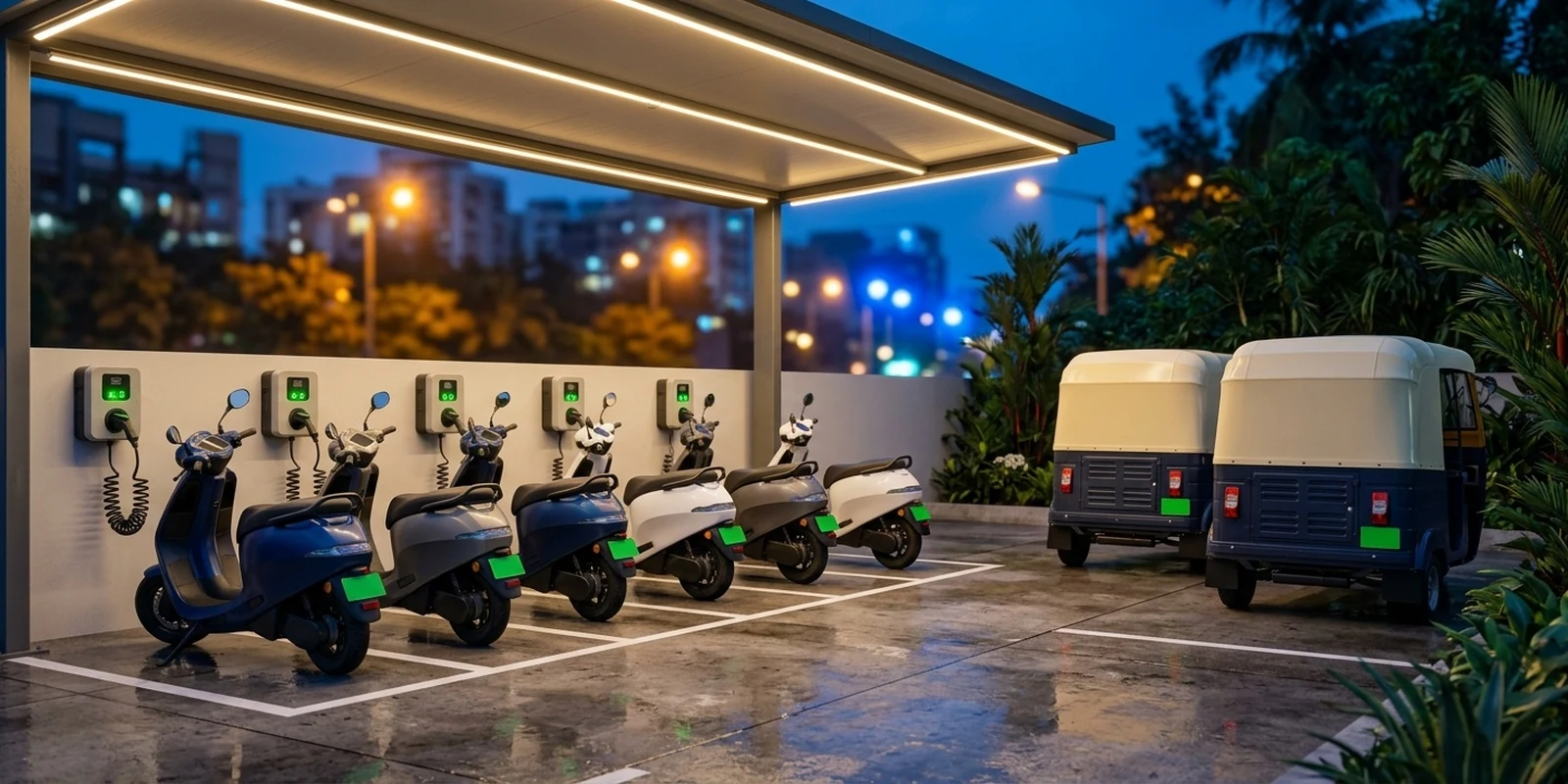
Two Wheeler EV Charging Stations
💡 Two Wheeler EV Charging Station: Key Highlights
- Roughly nine in ten EVs registered in India are 2W or 3W. FY2026 added about 1.4 million electric two-wheelers and 830,819 electric three-wheelers — cars were under 10% of registrations.
- The margin per session collapses by roughly 30×. At MoP’s capped service charge, a 2.5 kWh AC session earns the operator ₹7.50–₹10; a 25 kWh DC car session earns ₹275–₹325. The cost to serve both is almost identical.
- Footprint and load flip in your favour. Five to six two-wheeler bays fit where one car parks, and twenty 3.3 kW LEV AC points draw about the same connected load as a single 60 kW DC gun.
- Dwell time is 4–5× charge time. An e-rickshaw needs ~1.5 hours of energy inside an 8-hour overnight window — slack a DC car site simply does not have, and the reason scheduled charging is bankable here.
- The public network is still built for the other 10%. PM E-DRIVE targets 48,400 chargers for e-2W and e-3W against 22,100 for cars, but deployment has barely begun.
Almost everything a charge point operator learns from car charging actively misleads them when they build a two wheeler EV charging station. The instincts invert: fewer big guns become many small sockets; a 35-minute stop becomes a four-hour one; a ₹500 ticket becomes a ₹50 one; and what you are selling stops being kilowatt-hours and becomes bay-hours. Port the 4W playbook across and you build a site that is technically fine and commercially dead.
This is written for CPOs planning light-EV capacity, for fleet and gig-mobility operators charging riders rather than vehicles, and for site hosts — society parking, retail forecourts, transport nagars — weighing whether a two wheeler EV charging station earns more per square metre than a car bay.
Why 2W And 3W Charging Economics Invert
India’s EV market is not a car market. FY2026 registered about 1.4 million electric two-wheelers, up 22% year on year, and 830,819 electric three-wheelers, up 19% — close to nine out of every ten EVs sold. Cars took under 10%. Yet the country’s 52,718 public charging stations, 16,561 of them carrying fast chargers for cars, were largely designed around that smaller tenth.
The hesitation is arithmetic. A car takes 20–30 kWh a session. An electric scooter takes 2–3 kWh — packs run 2.2 to 5.3 kWh across the popular models — and an e-rickshaw 4–6 kWh, with 61% of the e-3W market still below a 3 kWh pack. Now apply the Ministry of Power’s 2024 guidelines, which cap the operator’s service charge (the margin over the electricity tariff) at ₹3/unit for AC in solar hours and ₹4/unit outside them, against ₹11 and ₹13/unit for DC, until 31 March 2028.
| Per session | e-2W (AC) | e-3W (AC) | e-4W (DC fast) |
|---|---|---|---|
| Energy delivered | 2–3 kWh | 4–6 kWh | 20–30 kWh |
| Point power | 0.65–3.3 kW | 1–3.3 kW | 30–120 kW |
| Time on the bay | 45 min – 6 h | 4–8 h | 30–45 min |
| Capped service charge | ₹3–4/unit | ₹3–4/unit | ₹11–13/unit |
| Operator margin at the cap | ₹6–12 | ₹12–24 | ₹220–390 |
| Cost to serve a session | Effectively identical — one authentication, one payment, one CDR, one connector cycle, one support risk | ||
Margin at the cap uses MoP’s 2024 service-charge ceilings (excluding GST and land cost); state tariff orders vary.
That final row is the whole problem. It takes roughly thirty light-vehicle sessions to earn what one busy DC car session earns, and every one of the thirty carries its own authentication, payment, charge detail record, connector cycle and chance of a support call. Ticket size is not a lever — the ceiling sets it. What is left is sessions per point per day and cost per session, and every design decision below serves one or the other. For the comparison set, see our breakdown of EV charging station profit margin by site type.
Hardware And Site Design For A Two Wheeler EV Charging Station
Start from what the vehicle accepts, because it is not what a CCS2 mindset expects. Most electric scooters ship with an off-board charger — a 650–950 W brick that plugs into an ordinary 15 A three-pin socket; an Ather 450X takes about 5 hours 45 minutes from empty on its 700 W unit. The rider already owns the charger. What they lack is a safe, metered, weather-protected socket and somewhere to leave the vehicle.
The connector landscape is genuinely fragmented
Four things coexist on Indian sites. LEV AC points — 240 V, 16 A single-phase, roughly 3.3 kW, built to the IS 17017 conductive-charging series — are the volume workhorse and the cheapest point you can install. Type 6 (LEVDC), defined in IS 17017-2-6:2021, covers 20–120 V DC at 15–125 A for 3–12 kW fast charging and is used by Ola’s S1 Pro, Tork, Ultraviolette and Simple Energy, and by Altigreen and ETO Motors on 3W. Type 7, published as IS 17017 (Part 2/Section 7):2023, is India’s own combined AC-plus-DC light-EV connector. And FAME-era Bharat AC-001 units — three 3.3 kW AC points in one enclosure — are still live on older sites. Layered over all of it are proprietary OEM sockets that fit nobody else.
The operational consequence: on a light-EV site, identity and metering belong to the socket, not the vehicle — there is no ISO 15118-style handshake to lean on. Whatever you install must authenticate the rider, energise the socket, meter it and cut it off on its own, which is why the backend matters more here than the hardware brand. Our explainer on BIS standards for EV chargers in India covers certification in full.
Density is the advantage — design for it
A two-wheeler bay occupies roughly 2 m² against about 12.5 m² for a car, so five to six riders park where one car does. Twenty LEV AC points at 3.3 kW draw about 66 kW — comparable to a single 60 kW DC gun, at a fraction of the cost, with no liquid cooling and far cheaper civil work. Build banks of 8–20 points with short retained cables, overhead cable management and physical bay separation, then size the supply deliberately rather than by addition, for the reason two sections down.
Tariff Design That Survives A ₹50 Ticket
Pricing is where most light-EV sites quietly lose money: operators copy the per-kWh structure that works for cars, then discover it prices the wrong scarce resource. On a two wheeler EV charging station, energy is not scarce. The bay is.
Transparent, regulator-friendly and capped. It yields ₹6–24 of margin per session, so it only works where a point turns ten or more sessions a day. Keep it as the published reference rate.
Baseline, not the whole modelEasy for riders to understand, but packs range from 2.2 kWh to 8 kWh — a single flat fee overcharges the scooter and subsidises the e-rickshaw, and still has to reconcile against a per-unit ceiling.
Use only in single-vehicle depotsCharging in 15- or 30-minute blocks prices bay occupancy, which is the constraint that actually binds when dwell runs 45–90 minutes on a 3.3 kW point. It self-regulates queueing without a reservation system.
Strongest fit for public 2W banksA full charge takes four to six hours; a working top-up takes forty-five minutes. Whether a point turns six sessions a day or twelve is decided almost entirely by how quickly a finished vehicle leaves. This is not a punitive add-on here — it is half the revenue model.
Non-negotiable on shared baysGig riders already buy energy as a monthly line item. Rental-plus-unlimited-swap bundles sell at ₹120–₹170 a day including the vehicle, insurance and maintenance, which sets the mental reference price — a charging-only pass has to sit far below the energy share of that number to read as a saving.
Converts occasional users into base loadAt a ₹45–₹60 average ticket, payment friction and failed transactions cost more than the margin they protect. One ₹300 top-up replaces six payment events, six reconciliation lines and six chances to fail mid-session.
The cheapest cost-per-session win availableIn practice they combine: a published per-kWh rate for walk-ins, time blocks on contested bays, an idle fee after a grace period, and wallet-funded subscriptions. That is a billing-engine requirement, not a spreadsheet exercise — it needs a payment and billing software layer that can hold several price structures against one connector and settle them correctly.
Predictable Demand Is What Makes Load Management Bankable
Public car charging demand is traffic-shaped and hard to forecast. Light-EV demand is shift-shaped, which changes what you can promise a lender. Gig riders work concentrated lunch and dinner peaks and charge in the gap between them and after the last drop; e-rickshaws run a daytime shift, take a mid-afternoon lull and charge overnight. These are duty cycles, not traffic patterns — you can write them into a schedule and hold to it.
The consequence is a slack ratio a DC car site cannot match. An e-rickshaw needs roughly 5 kWh — about 1.5 hours at 3.3 kW — so its duty inside an eight-hour overnight window is under 20%, while a 25 kWh car session at 50 kW occupies nearly all the time a driver will wait. On a twenty-point bank with 66 kW connected, staggered scheduling lets you sanction perhaps 25–30 kW and still send every vehicle out full: smaller connection, lower demand charges, smaller capex. Because the vehicles are captive and repeat, that is a saving you can underwrite before you build.
The tariff side rewards the same discipline. Under MoP’s 2024 guidelines the DISCOM charges 0.7× the average cost of supply in solar hours and 1.3× outside them, so overnight e-rickshaw charging sits squarely in the expensive window and every unit you shift into the mid-day lull pays twice. That is the job of EV charging load management software; the mechanics are in our guide to EV charging load management basics.
The trap: sizing by addition
The most common light-EV design error is sanctioning load equal to the sum of every point at full power. On a bank where dwell exceeds charge time four- to five-fold, that buys a connection you will never use and demand charges you will pay every month. Size to the schedule, and let the software enforce it.
Charging Or Swapping: Deciding Site By Site
This is a real fork, settled per site rather than per network, and the decision rule is about whose time the charge consumes. Swapping wins where vehicle downtime is lost income — high-kilometre gig delivery, two-shift e-rickshaws, anything where an hour parked is an hour unpaid; swap operators run networks in the thousands of stations with ninety-second exchanges, and that speed is the product. Charging wins where the dwell is already free — overnight depots, residential and society parking, workplaces, transport nagars, and any fleet that owns its packs rather than renting them back as a service.
Two constraints belong in the decision. Swapping still has no mandated interoperable pack — IS 17855:2022 specifies swappable lithium-ion packs for 2W and 3W at 48 V, 60 V and 72 V, but adoption is voluntary, so a swap network commits you to one ecosystem. And MoP’s January 2025 guidelines cover swapping and charging stations together, so one site can host both. We have argued the full comparison in battery swapping vs charging station; for network planning, most serious light-EV operators run both, and the real question is whether one platform can price, bill and report across the two.
What The Software Has To Do Differently
A twenty-point bank running eight to ten sessions per point per day produces 160–200 sessions daily; a four-gun DC car site earning several times the revenue produces around forty. A two wheeler EV charging station is therefore a high-transaction, low-value business wearing a charging business’s clothes, and most platforms are sized for the opposite. Four capabilities decide whether it works.
Per-rider identity and credit, not per-vehicle
The billable party is the rider, who may change vehicles weekly and often has no card. That means RFID and app identity tied to a wallet balance, hard credit limits, automatic cut-off at zero, and the ability to move a rider between fleet accounts without orphaning their history.
Aggregator and fleet account hierarchies
Aggregators and rental operators want one monthly invoice covering hundreds of riders, a per-rider breakdown underneath it, and a cap on individual spend. That is an account tree — aggregator, sub-fleet, rider — with tariffs assignable at any level. Bolt it on afterwards and you will be reconciling in spreadsheets within a quarter.
Reporting at rider level, not charger level
Charger-level reporting tells you a point delivered 26 kWh yesterday. A fleet buyer is asking what energy costs per rider per day, per 100 km and per delivery. Only rider-level attribution answers that, and it is the number that renews the contract.
OCPP resilience on cheap, flaky hardware
Light-EV points are low-cost devices on consumer 4G in crowded locations, so dropped connections are routine and the backend has to tolerate reconnects, replay cached meter values and rebuild charge detail records after the fact. Lose the CDR and you lose the session outright — survivable once on a ₹300 car session, a structural leak across two hundred ₹50 ones.
Together these separate a deployment that scales from one that stalls at the first hundred riders. A charging management system like YoCharge is built to carry that transaction volume with per-rider accounts, multi-structure tariffs and fleet reporting in one place, and for mixed rider and corporate demand it connects to the same EV fleet charging management stack rather than sitting beside it.
The segment is not waiting for permission. PM E-DRIVE has earmarked 48,400 chargers for e-2W and e-3W against 22,100 for cars out of a ₹2,000 crore infrastructure outlay, and that deployment has barely started. Operators who build for two- and three-wheelers on their own economics — many small sessions, priced on time, scheduled against a predictable duty cycle, billed to riders — will take the nine-tenths of India’s EV fleet that nobody has properly served yet.
Frequently Asked Questions
Common questions from operators and site hosts planning 2W and 3W charging capacity.
Sources: Ministry of Power — Guidelines for Installation and Operation of EV Charging Infrastructure, 2024 | Ministry of Heavy Industries — PM E-DRIVE scheme portal | Autocar Professional — India’s electric three-wheeler retails cross 800,000 in FY2026 (Vahan data) | Type 6 (LEVDC) connector — IS 17017-2-6:2021 | The Tribune — India’s public EV charging station count, July 2026
Size Your 2W And 3W Charging Network With Our Team
Tell us the sites, the rider volumes and the vehicle mix you are planning for, and we will model the sessions, the tariff structure and the sanctioned load with you before you order hardware.
What happens next ?
Discovery call on your 2W/3W site mix and rider volumes
Tariff model built around time blocks, idle fees and rider subscriptions
Sessions-per-point and sanctioned-load projection for your bank sizing
Rider, fleet and aggregator account structure configured before go-live