
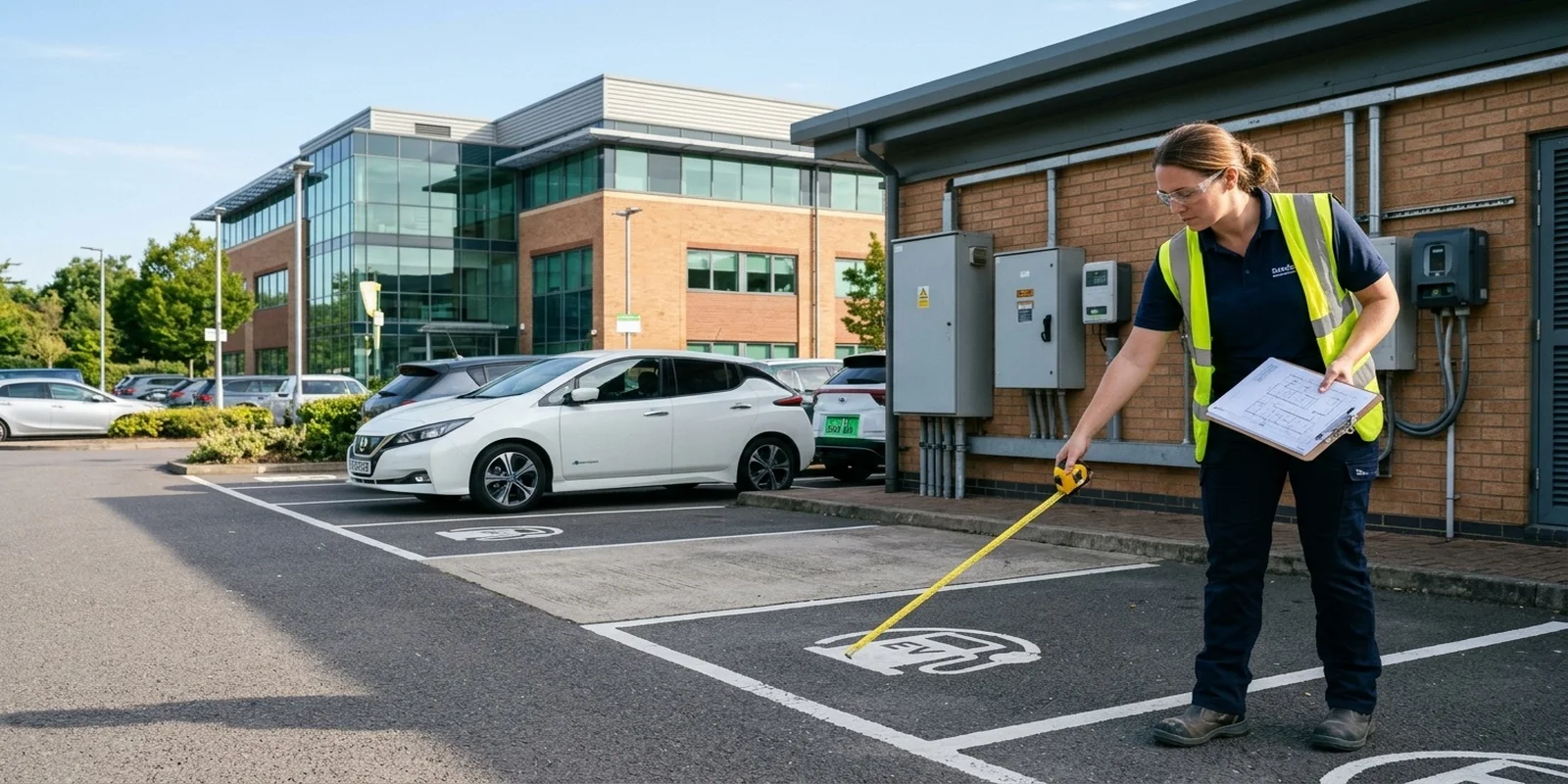
What Gets Checked Before Chargers Go In
ud83dudca1 EV Charger Site Survey: Key Highlights
- A site survey is the first physical step after a commercial property has been chosen for EV charging u2014 it determines what the site can deliver electrically, structurally and logistically before any design or procurement begins.
- The survey report should hand back available spare capacity in kW, a cable-route plan with measured lengths, a bay layout, a connectivity check per proposed charger location, a permissions list and a set of dated site photographs.
- Load management can unlock more charger bays than the raw spare capacity suggests, because dynamic load management shares a fixed supply across chargers rather than sizing each at full draw.
- Common surprises include zero spare capacity on the main incomer, dead cellular signal in basement car parks, cable runs that exceed 50 metres and landlord consent clauses that delay the project by weeks.
- Regional electrical standards differ u2014 NEC Article 625 (US), BS 7671 Section 722 and the IET Code of Practice (UK), IEC 60364-7-722 (international), and CEA safety regulations with Indiau2019s MoP 2024 guidelines all apply at the survey stage.
An EV charger site survey is the structured assessment that sits between choosing a commercial property and designing the charging installation. If site selection decides where chargers should go across a portfolio, and station design decides how many bays and what connector mix the site will carry, the site survey decides whether the chosen property can physically deliver what the design needs u2014 and at what cost.
This post is for facility managers at offices, retail sites, hotels and car parks, and for CPO site-acquisition teams running surveys at scale. It covers what a competent survey should check, what it should hand back, and what usually goes wrong.
What The Survey Must Deliver
A site survey is not a quick walk-around. It is a structured inspection, usually lasting half a day for a 20-bay car park and up to two days for a multi-storey or campus site, that produces a report the design engineer and the commercial team can both act on. The deliverables should include:
- Available spare capacity in kW u2014 the difference between the main incomer or transformer rating and the siteu2019s recorded maximum demand, stated as a number, not an opinion. This sets the ceiling for how many chargers the site can take without an infrastructure upgrade.
- A single-line diagram or electrical mark-up showing the main incomer, distribution boards, spare ways and the proposed point of connection for the EV supply.
- Cable routes and measured lengths from the distribution board to each proposed charger location, including any obstacles (structural walls, drainage, existing services) that affect routing.
- A bay plan identifying which parking bays are proposed for chargers, their dimensions, accessibility compliance and proximity to the cable route.
- A connectivity check at each proposed charger location u2014 cellular signal strength (4G/LTE) tested at the charger mounting height, plus available wired network or Wi-Fi options. Basements and multi-storey car parks frequently have dead spots that only appear when measured on site.
- A permissions list u2014 landlord consent, utility or DNO/DISCOM application requirements, planning permissions, building-management approvals and any fire-safety reviews the installation will trigger.
- Cost drivers and site photographs u2014 anything that will push the installation cost above the baseline: long cable runs, ground-breaking through reinforced concrete, the need for a new sub-board or transformer, bollard requirements, drainage modifications and signage.
If the survey report does not contain all of these, the design that follows is built on assumptions u2014 and assumptions at the survey stage become change orders at the installation stage.
The Site Survey Checklist
The checklist below groups the items a surveyor should inspect and record. Use it as a briefing document before the survey and a verification list when the report comes back.
| Category | Check item | What to record |
|---|---|---|
| Electrical | ||
| Main incomer / supply rating | Amps, voltage, single- or three-phase | |
| Maximum-demand records | Peak kW or kVA from the last 12 months (request from the utility or read from interval meters) | |
| Spare ways in distribution boards | Count of unused MCB/RCBO positions, board rating | |
| Earthing arrangement | TN-S, TN-C-S (PME), TT u2014 affects protective measures | |
| Three-phase availability at the charger location | Yes/no; if no, cost of extending | |
| Civil | ||
| Trenching route and surface type | Tarmac, concrete, paving, grass u2014 each has a different reinstatement cost | |
| Obstructions and existing services | Water, gas, telecoms, drainage u2014 mark on a plan | |
| Bollards, wheel stops, kerbs | Need for physical protection of wall-mounted or pedestal chargers | |
| Drainage near charger locations | Risk of standing water at charger base or cable entry | |
| Parking and access | ||
| Bay count and dimensions | Confirm bays fit the charger footprint and cable entry without blocking adjacent spaces | |
| Accessible bays | At least one bay must meet local accessibility requirements (e.g. wider bay, level access) | |
| Lighting | Adequate for evening use; note if the car park is unlit | |
| Signage positions | Where EV-only or charging-in-progress signs will go | |
| Connectivity | ||
| Cellular signal (4G/LTE) at each bay | Measured signal strength in dBm, noting dead spots u2014 especially in basements | |
| Wired Ethernet availability | Distance to the nearest network point; cost of a cable pull | |
| Wi-Fi (if offered by the site) | SSID type u2014 captive portal and password-rotated Wi-Fi typically fail for chargers | |
| Usage | ||
| Typical dwell times | Office (8+ hours), retail (1u20132 hours), hotel (overnight) u2014 sets the AC/DC charger mix | |
| Expected EV share of parking | Percentage of bays to provision now and in a future phase | |
| User groups | Staff only, visitors, tenants, public u2014 affects access control and payment setup | |
| Permissions | ||
| Landlord or freeholder consent | Required before any electrical or civil work in a leased property | |
| Utility / DNO / DISCOM application | Whether a new connection, service upgrade or load increase application is needed | |
| Planning or building-management approval | Local authority planning consent, strata/body corporate approval, fire-safety review | |
Who Does The Survey And How Long It Takes
A site survey should be carried out by a qualified electrical engineer or an experienced EV charging installer u2014 not a salesperson. The surveyor needs to open distribution boards, read maximum-demand data, assess earthing arrangements and measure cable routes, none of which a non-technical visit can do reliably.
For a single commercial site with a surface car park of 10u201350 bays, a competent survey typically takes half a day on site plus one to two days for the report. Multi-storey car parks, campuses with multiple buildings or sites with complex electrical topologies (dual supplies, on-site generation, tenant sub-metering) take longer u2014 one to two days on site and up to a week for the report.
CPO site-acquisition teams running surveys at volume u2014 evaluating dozens of host sites for a network rollout u2014 often use a standardised survey template and a go/no-go scoring matrix so that each siteu2019s report is comparable and the pipeline moves without waiting for bespoke analysis. The full commercial installation path from survey through design, procurement, installation and commissioning typically runs 4u201312 weeks depending on site complexity and utility lead times.
Common Surprises And How To Handle Them
Even experienced teams encounter problems that only surface during a physical survey. Four come up repeatedly:
No spare electrical capacity
The main incomer is already close to its rated capacity at peak, leaving no room for additional charger load. Before concluding that an expensive service upgrade is the only option, assess whether dynamic load management can share the existing supply across chargers by capping total draw to the available headroom. Under IEC 60364-7-722, the diversity factor for EV supply equipment is taken as 1 (every connector assumed in use simultaneously) unless load control is included upstream u2014 meaning the standard itself recognises that load management changes the capacity arithmetic.
Dead signal spots
Chargers need a continuous data connection to the backend for session authorisation, billing and remote management. Basement and multi-storey car parks frequently show adequate signal at the entrance but drop to unusable levels at the charger mounting position. If cellular is weak, the options are a multi-operator M2M SIM (which can roam to whichever network has signal), a wired Ethernet backhaul from a site gateway, or a dedicated access point. Host-site Wi-Fi with a captive portal or rotating password is almost never reliable enough. For a deeper look at connectivity design, see the connectivity and M2M SIM guide.
Long cable runs
When the distribution board is far from the proposed charger bays u2014 runs of 50 metres or more are common in car parks with the switchroom at the opposite end of the building u2014 cable costs rise steeply and voltage drop becomes a design constraint. The survey should measure the actual route, not the straight-line distance, and note any sections that require trenching through reinforced concrete or penetrations through fire-rated walls.
Landlord consent
In leased commercial property, the tenant usually needs the freeholderu2019s written consent before any electrical or civil work begins. This is not a formality u2014 consent clauses can restrict the type of installation, require the landlordu2019s own contractor, impose reinstatement obligations on lease expiry, or take weeks to process through the landlordu2019s surveyor. The survey should identify whether consent is needed and flag it as a critical-path item so the project is not held up after procurement has started.
Regional Electrical Standards That Apply At The Survey Stage
The site survey is where compliance begins. The surveyoru2019s report should reference the applicable standard and confirm that the proposed installation can meet it. The table below summarises the key standards by region:
| Region | Standard | What it governs at survey stage |
|---|---|---|
| United States | NEC Article 625 and Article 220 | EV supply equipment classified as a continuous load (125% branch-circuit sizing); NEC 220.57 sets the service-load calculation at the larger of 7,200 VA or nameplate rating. Each EVSE requires a dedicated branch circuit. |
| United Kingdom | BS 7671 Section 722 and the IET Code of Practice for EV Charging | Earthing arrangement determines protective measures u2014 PME (TN-C-S) earthing cannot be used for outdoor chargers unless specific protections (open-PEN detection or a separate earth electrode) are in place. Each connecting point requires an individual 30 mA RCD. |
| International (EU, Asia-Pacific, Middle East) | IEC 60364-7-722:2018 | Dedicated circuit per connecting point, 30 mA RCD, TN-S final circuit in TN systems, diversity factor of 1 unless load control is installed upstream, and overvoltage protection for publicly accessible installations. |
| India | CEA (Measures Relating to Safety and Electric Supply) Regulations 2010; MoP Guidelines for Installation and Operation of EV Charging Infrastructure, 2024 | DISCOM connection and sanctioned-load application; BIS-certified EVSE per IS 17017; OCPP backend connectivity; power utilities must provide connections within specified timelines (3 to 90 days depending on area). |
The surveyor does not need to design the installation to these standards u2014 that is the engineeru2019s job u2014 but the survey report should flag any condition (PME earthing, inadequate fault current, absence of three-phase supply) that will constrain or complicate compliance.
From Survey To Installation
A thorough site survey prevents the two most expensive outcomes in a commercial EV charging project: a mid-installation discovery that sends the contractor back to the drawing board, and a completed installation that underperforms because the siteu2019s constraints were not understood before the chargers were specified.
The survey report feeds directly into the next steps in the commercial installation path: electrical design, charger procurement, utility applications and workplace charging policy decisions. If the survey is done well, those steps proceed on facts. If it is rushed or skipped, every subsequent step carries the risk of a costly assumption.
For properties where the survey reveals limited spare capacity, a charging management platform with built-in load management lets the site deploy more charger bays than the raw electrical headroom would suggest u2014 sharing a fixed supply intelligently across vehicles rather than sizing each bay at full continuous draw.
Frequently Asked Questions
For a surface car park with 10u201350 bays at a single commercial building, a site survey typically takes half a day on site and one to two days for the written report. Multi-storey car parks, campuses or sites with complex electrical arrangements (dual supplies, on-site generation, sub-metered tenants) can take one to two days on site and up to a week for the report.
The surveyor should be a qualified electrical engineer or an experienced EV charging installer who can open distribution boards, read maximum-demand data, assess earthing arrangements and measure cable routes. In the UK, this means someone registered with a competent-person scheme; in the US, a licensed electrician familiar with NEC Article 625; in India, a licensed electrical contractor who understands CEA safety regulations and DISCOM procedures.
Zero spare capacity does not necessarily mean zero chargers. Dynamic load management can share a limited supply across multiple chargers by capping aggregate draw to the available headroom, letting more bays operate than a static allocation would allow. If even managed load exceeds the headroom, the options are a service upgrade (new transformer or higher-rated supply) or phasing the installation to match planned capacity increases.
Not usually. The survey establishes what the site can deliver (available capacity, cable routes, connectivity, permissions). The charger specification u2014 power level, connector type, number of sockets u2014 is a design decision that follows the survey, informed by its findings and by the usage profile (dwell times, user groups, AC/DC mix).
It depends on the installeru2019s model. Some full-service providers include the survey in their overall project fee; others charge it separately. If the survey is free but the quote is locked to that installeru2019s proprietary hardware, the cost is built in elsewhere. A paid, independent survey that you can share with any installer or charging platform often gives better value and flexibility.
Sources: IEC 60364-7-722:2018 u2014 Low-voltage electrical installations, EV supply | IET Wiring Regulations (BS 7671) | MoP Guidelines for Installation and Operation of EV Charging Infrastructure, 2024
Researched and drafted with AI assistance; facts checked against the sources linked above and reviewed by the YoCharge team.
From load management that stretches your existing supply to OCPP connectivity across 60+ charger brands, YoChargeu2019s platform turns your survey findings into an operating charging site. Talk to us.
Get a Demo