
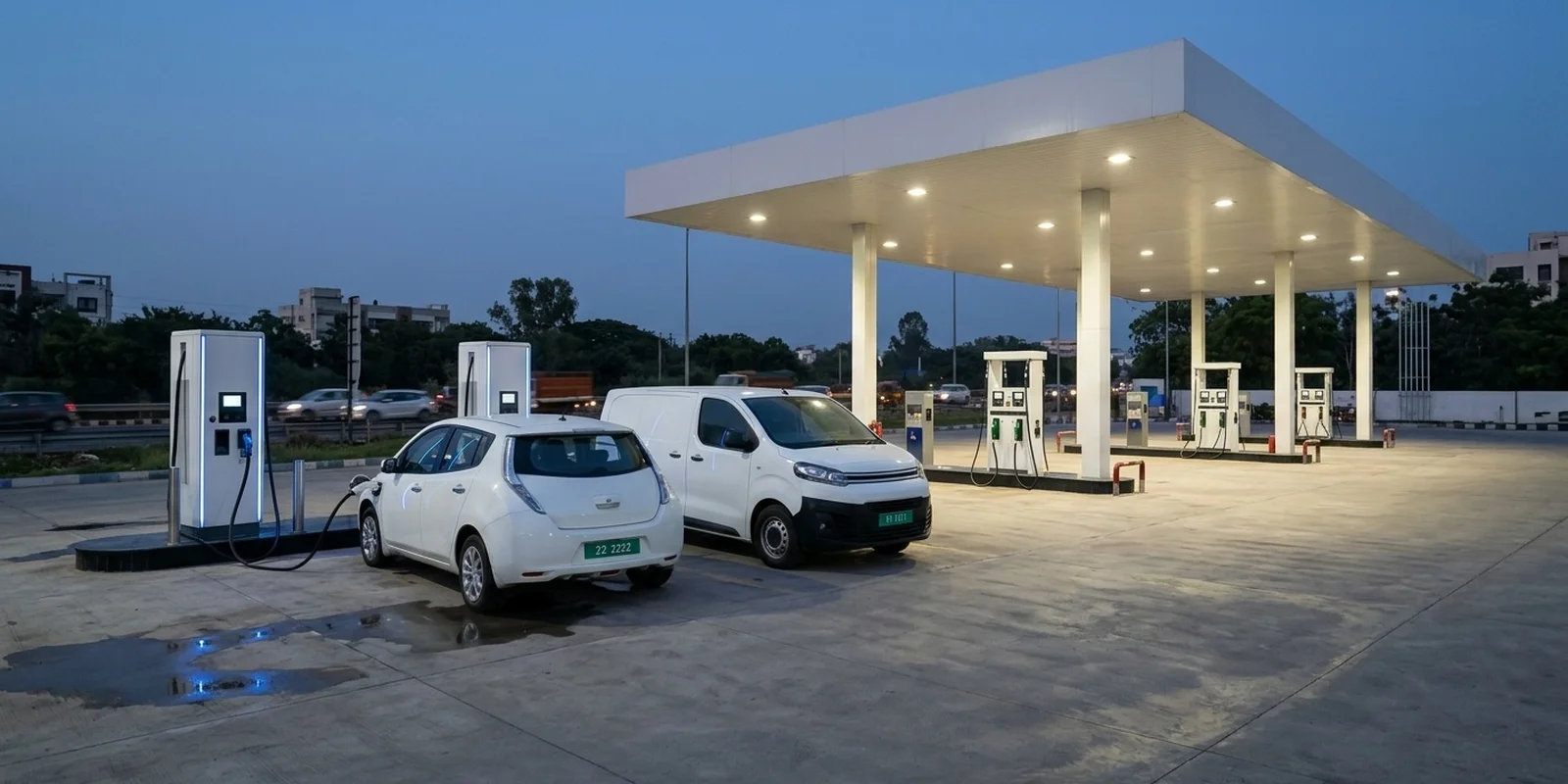
COCO, CODO Or DODO: Who Owns The EV Charger At The Pump?
- Fuel is symmetric across the three models; electricity is not. The power for a charger comes from the DISCOM, on a connection in someone’s name, and that one fact decides who funds, bills and earns.
- COCO is the simple case: the oil company funds, prices, invoices and keeps the revenue. CODO and DODO need a written split between the oil company and the dealer.
- Oil marketing companies have 8,932 charging stations at retail outlets under FAME-II, plus over 18,500 more of their own (PIB, January 2026): about 27,432 in all.
- India had 1,00,266 fuel retail outlets on 30 November 2025 (PPAC data), so charger ownership at dealer sites is a scale problem, not an edge case.
- The software has to show an oil-company view and a dealer view of the same charger, settle revenue per site and survive a change of dealer.
Whether a fuel station is a COCO petrol pump, a CODO outlet or a DODO outlet sounds like a question about the forecourt’s paperwork. Once an EV charger goes in, it becomes a question about money. The ownership model decides who pays for the charger, whose name sits on the electricity connection, who sets the price per kWh, who issues the tax invoice and how the revenue is split between the oil marketing company (OMC) and the dealer. Get it wrong and a profitable charger produces a monthly argument instead of a monthly statement.
This post is written for two readers: the retail and new-energy teams at OMCs, and the dealers who run their outlets. The answer differs depending on who owns the forecourt, so each section says which side it applies to. It deliberately leaves three neighbouring topics to their own posts: our petrol station EV charging strategy guide covers the journey from pilot to energy hub, EV charging POS integration for fuel retailers covers fleet cards and loyalty, and EV charging station franchise vs dealership covers how a charge point operator (CPO) expands its own network. The terms here are Indian industry shorthand, but the same three-way split exists wherever an oil company sells through dealers, so the structure carries over to other markets with local names swapped in.
What COCO, CODO And DODO Mean At A Petrol Pump
The three labels describe two things: who owns the site, and who runs it.
- COCO (Company-Owned, Company-Operated): a COCO petrol pump is one where the OMC owns the land and the assets and runs the outlet with its own staff or a contracted operator. Every rupee of fuel revenue is the OMC’s.
- CODO (Company-Owned, Dealer-Operated): the OMC owns the land and the assets; a dealer runs the outlet under a dealership agreement and earns a margin on every litre sold.
- DODO (Dealer-Owned, Dealer-Operated): the dealer owns or leases the land, builds the outlet to the OMC’s standards and sells only that OMC’s fuel under its brand. BPCL’s dealer page, for example, publishes a separate DODO brochure for applicants.
For fuel, the models are tidy. The OMC owns the product in all three, sets the pump price and pays the dealer a margin. An EV charger breaks that symmetry, because electricity does not arrive in the OMC’s tanker. It comes from the DISCOM on a connection that is sanctioned to a named consumer, and the bill goes to that consumer. Everything else in the next section follows from that.
COCO Petrol Pump vs CODO vs DODO: Who Funds, Runs And Bills The EV Charger
The table shows the default each model points to. It is not a rulebook: no ministry prescribes how an OMC and a dealer split an EV charger, so the dealership agreement, or a side letter to it, decides. Where the default is genuinely open, the table says so.
| Question | COCO | CODO | DODO |
|---|---|---|---|
| Who funds the charger | OMC | OMC, as owner of the site | Open: OMC-funded on dealer land, or dealer-funded with OMC consent |
| Whose name is on the DISCOM connection and sanctioned load | OMC | Open: OMC if the asset is the OMC’s; dealer if the outlet’s existing connection is extended | Usually the dealer, unless the OMC takes a separate EV connection |
| Who sets the tariff | OMC | OMC, network-wide | OMC for an OMC charger; dealer for a dealer charger, within brand rules |
| Merchant of record and tax invoice | OMC | OMC if payment runs through the OMC’s app; dealer if collected at the dealer’s counter | Whoever owns the charger |
| Who maintains it | OMC, through the OEM’s maintenance contract | OMC’s contract; dealer does first-line care | The charger’s owner; dealer does first-line care either way |
| How revenue splits | 100% OMC | OMC keeps revenue; dealer earns a handling fee or commission | Host fee to the dealer, or full revenue to a dealer-owned charger |
Default arrangements for an EV charger by fuel-station ownership model. “Open” means the dealership agreement must settle it.
Funding the charger
At a COCO or CODO outlet, the OMC owns the land, so it owns what is bolted to it, and any central subsidy flows to the OMC as the applicant. At a DODO outlet the charger can belong to either party. An OMC-funded charger on dealer land makes the dealer a host; a dealer-funded charger makes the dealer an operator, and that usually needs the OMC’s written consent, since dealership agreements typically restrict what else can be sold on a branded outlet. Check the agreement before quoting a single charger.
The power connection and sanctioned load
This is the row that causes the most disputes. A 60 kW or 240 kW DC charger usually needs a load enhancement or a separate connection, and whoever holds that connection pays the electricity bill. If a CODO dealer’s existing connection is extended to feed an OMC-owned charger, the dealer is now paying for the OMC’s raw material and needs to be reimbursed per kWh, monthly, against the meter. The 2024 guidelines already require a separate metering arrangement for each charging station, and allow DISCOMs to provide a sub-meter behind an existing HT connection, so the meter exists either way; the question is only whose account it bills. A separate EV connection in the OMC’s name avoids the reimbursement entirely, at the cost of a second DISCOM application.
Tariff, merchant of record and the invoice
The Ministry of Power’s 2024 charging guidelines say a CPO’s charging fee is built from the electricity tariff, a per-kWh service charge, a per-kWh land cost and applicable GST (Mercom summary of the guidelines). The service charge is capped: for DC fast charging, ₹11 per kWh in solar hours and ₹13 outside them, excluding GST and land cost, until 31 March 2028 (Stated, MoP 2024 guidelines). Whoever sets the components under that cap is the price-setter. The merchant of record is the party the driver legally pays and the party that issues the tax invoice. For a brand-wide OMC network, that should be the OMC, because a driver paying different legal entities at two outlets of the same brand gets two kinds of receipts and two refund processes.
Maintenance and the revenue split
Maintenance follows ownership: the asset owner holds the OEM’s comprehensive maintenance contract, while the dealer’s staff do first-line care such as cable handling, resets and keeping the bay clear. The revenue split mirrors fuel. At CODO the dealer earns a handling fee or commission per kWh or per session, as a fuel dealer earns a margin per litre; at a DODO host site the dealer earns a host fee; a dealer-owned charger keeps its full revenue and carries its own costs.
What India’s Oil Marketing Companies Have Actually Built
The public record shows the OMCs acting as asset owners: they fund the charger, procure it and contract its maintenance. Every figure below is labelled Stated (published by the source) or Derived (our arithmetic on Stated figures).
| Figure | Value | Register and source |
|---|---|---|
| FAME-II sanction to IOCL, BPCL and HPCL (March 2023) | ₹800 crore for 7,432 public fast chargers at retail outlets | Stated, PIB (MHI), 28 March 2023 |
| Split by OMC | IOCL 3,438 · BPCL 2,334 · HPCL 1,660 | Stated, PIB (MHI), 28 March 2023 |
| Share of sanctioned chargers at 50/60 kW | 76% (5,662 of 7,432; the other 1,770 at 100/120 kW) | Derived from PIB figures |
| Charging stations at retail outlets under FAME-II | 8,932 | Stated, PIB backgrounder, 27 January 2026 |
| Additional charging stations set up by OMCs | Over 18,500 | Stated, PIB backgrounder, 27 January 2026 |
| Total OMC charging stations | About 27,432 | Derived: 8,932 + 18,500 |
| Integrated energy stations commissioned | 1,064 as of 1 November 2025 | Stated, PIB backgrounder, 27 January 2026 |
| Fuel retail outlets in India | 1,00,266 as of 30 November 2025 | Stated, PPAC data via Business Standard |
| Charging stations per fuel outlet | About 1 for every 3.7 outlets | Derived: 1,00,266 ÷ 27,432 (a ratio of counts, not the share of outlets with a charger) |
Public figures on OMC-owned EV charging in India, with their register.
The 2023 sanction is explicit about why OMCs were chosen. The Ministry of Heavy Industries release says CPOs struggle to find land, and that the OMCs “have sufficient land in the premises of their ROs”. It also extended support to up to 80% of upstream infrastructure, such as transformers and cabling, alongside the existing 70% subsidy on charging equipment. The OMC was the applicant and the owner in every case.
Procurement in 2026 has the same shape. Under PM E-DRIVE, HPCL’s GeM bid GEM/2026/B/8107746 sought 240 kW chargers with installation and comprehensive annual maintenance (CAMC) and closed on 22 October 2026. IOCL’s bid GEM/2026/B/8036457 sought CCS2 chargers at 60 and 240 kW, with an estimated bid value of ₹23.48 crore, and closed on 15 October 2026 (both Stated, from the GeM bid documents). Both bids have closed and are cited here only as an example. The point is the structure: the OMC is the buyer, the asset owner and the maintenance counterparty, whoever runs the outlet day to day. That is COCO economics for the charger, even at a dealer-run site.
What Each Model Demands From The Charging Software
A network made only of COCO petrol pump sites is a standard CPO operation. The moment an OMC runs chargers across company-run and dealer-run outlets, the platform has to model the relationship between the OMC and each dealer, not just the chargers. That is the operating problem behind EV charging for fuel retailers, and four requirements decide whether it works.
Two views of the same charger
Head office needs every site: utilisation by region, uptime against the maintenance contract, tariff control and revenue. A dealer needs only their own outlet: today’s sessions, faults, and what they will be paid this month. The dealer must never see another dealer’s numbers, and must not be able to change a network-wide tariff.
Settlement per site
Each dealer site needs its own settlement: commission or host fee calculated per kWh or per session, energy reimbursed where the connection is in the dealer’s name, a monthly statement both sides accept, and a payout. Running this from spreadsheets across thousands of outlets is how disputes start. Payment and billing software that produces host settlement reports and tax-compliant invoices per site removes the monthly reconciliation argument.
Brand control
A driver should see the OMC’s brand on the app, the receipt and the charger screen, at a COCO outlet and a DODO outlet alike. That argues for a white-label charging platform running under the OMC’s brand, rather than each dealer choosing an app.
When the outlet changes hands
Dealerships change, and a CODO outlet can be re-awarded. The charger, its OCPP identity and its session history should stay with the site. The software needs to close the outgoing dealer’s settlement on a cut-off date, revoke their access, and onboard the new dealer without recommissioning the charger. A platform like YoCharge’s charging management platform handles these pieces: per-site tariffs (per kWh, per minute, per session or time-of-day), host settlement reports, branded apps and 60+ integrated charger brands. It is live in 25+ countries, because the same OMC-and-dealer structure exists well beyond India.
The Dealer’s Decision: Host, Own Or Lease The Bay
For a dealer, especially at a DODO outlet, there are three options.
- Host the OMC’s charger. No capital at risk; income is a host fee or commission; the OMC carries utilisation risk and maintenance. The trade-off is a small, fixed share of the upside.
- Install your own. The dealer keeps the full charging margin and carries capex, the power connection and utilisation risk. This needs OMC consent and a clear answer on whose brand the driver sees.
- Lease the bay to a third-party CPO. Fixed rent or a per-kWh share, with no operating load. For public land the Ministry of Power’s guidelines set a revenue share of ₹1 per kWh to the land-owning agency, paid quarterly, and allow private landowners the same model by bidding with ₹1 per kWh as the floor (Stated, MoP 2024 guidelines). For a dealer, it is a floor, not a ceiling.
Which option pays depends on throughput, power cost and dwell time at that specific outlet. Rather than recompute it here, use our EV charging profit margin by site type breakdown, which works through the arithmetic for highway and urban fuel sites.
Four Clauses To Settle Before The First Charger Goes In
Exclusivity: can the outlet host a second charging network, or a third-party CPO, alongside the OMC’s? Signage: whose brand goes on the charger, the canopy and the app screen. Data ownership: who owns session and customer data, and what the dealer can still access after leaving. Exit: who buys the charger, who takes over the power connection, and on what notice, if the dealership ends.
Frequently Asked Questions
Sources: PIB, India’s Expanding Role in the Global Energy Transition (27 Jan 2026) | PIB (MHI), Rs 800 crore under FAME-II for 7,432 public fast charging stations (28 Mar 2023) | Business Standard, PPAC data on India’s fuel retail network (Dec 2025) | Mercom, Ministry of Power EV charging infrastructure guidelines 2024 | BPCL, dealer models | GeM bids GEM/2026/B/8107746 (HPCL) and GEM/2026/B/8036457 (IOCL)
Tell us how your outlets split between company-run and dealer-run. We will show you per-site tariffs, host settlement and a branded driver app on the YoCharge platform, and how a change of dealer is handled without recommissioning a charger.
Talk to Sales