
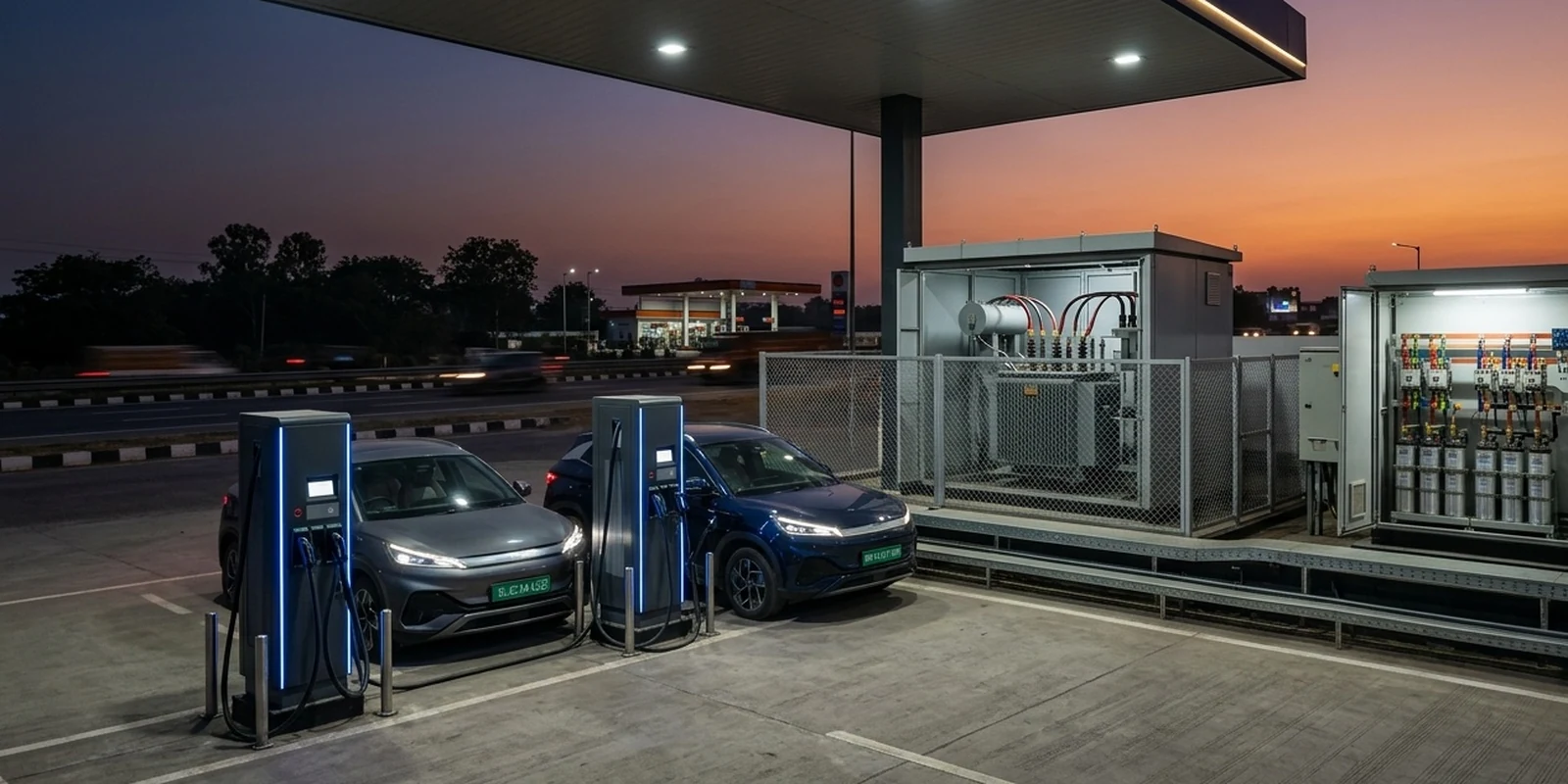
Power Quality at EV Fast Charging Sites
💡 Power Quality at Fast Charging Sites: Key Highlights
- Under kVAh billing there is no power factor penalty line — at 0.92 power factor you are billed about 8.7% more units for the same energy delivered.
- Where a surcharge applies it is steep: Punjab charges 1% of energy charges per 0.01 below 0.90, doubling below 0.80.
- CEA’s connectivity standards point at one instrument: IEEE 519, which caps voltage THD at 8% below 1 kV and 5% from 1–69 kV, with current limits scaling 5% to 20% TDD by grid strength.
- A DC charger above roughly 50 kW draws over 75 A per phase — outside IEC 61000-3-2 and 61000-3-12 alike, so compliance becomes your site’s problem.
Power quality is the one line of a charging site’s energy cost almost nobody models. Demand is modelled, tariff is modelled, utilisation is modelled to the third decimal — then what a bank of DC rectifiers does to the supply arrives as a DISCOM notice, a stalled connection, or a bill above the spreadsheet.
This is for CPOs and fuel retailers running DC fast charging at scale, and the site engineer handed that letter. Demand charge management owns capacity charges and load management basics owns scheduling; this post owns a third line — what a non-linear load does to the supply, and what the utility bills for it.
Three ways poor power quality turns into money
It reaches the business through three doors — the energy bill, the connection agreement and the maintenance budget — each owned by a different person, which is why the total never gets added up.
1. Power factor: a penalty in some states, invisible in others
Two billing designs coexist in India. A growing number of states bill commercial energy in kVAh — Punjab prices an EV charging station connection at ₹6.28 per kVAh, no fixed charge. Since kVAh is kWh divided by power factor, poor power factor is never a line item; it inflates every unit. A four-bay 60 kW site dispensing 18,000 kWh a month:
| Site power factor | Units billed (kVAh) | Energy cost at ₹6.28/kVAh |
|---|---|---|
| 0.98 | 18,367 | ₹1,15,347 |
| 0.92 | 19,565 | ₹1,22,870 |
| Cost of the 0.06 drop | +1,198 kVAh | +₹7,523 per month |
Same 18,000 kWh delivered. The only variable is power factor.
Roughly ₹90,000 a year on one small site, invoiced without ever being named — which reduces the correction decision to one division: equipment price over ₹7,523 gives the payback in months. A ₹2 lakh panel repays in about 27 months here.
Where energy is billed in kWh the penalty is explicit: Punjab requires a monthly average power factor of 0.90 and levies 1% of energy charges per 0.01 below it, 2% below 0.80. Thresholds differ by state — and ask how your meter computes kVAh, since one derived from kWh and kVArh captures displacement only.
2. The harmonic limits your connection agreement already imposes
For nearly two decades CEA’s connectivity standards have required that a connecting facility not cause harmonics exceeding IEEE Standard 519, with measurement written into the connection agreement as a recurring obligation. The draft CEA Connectivity Regulations, 2026 sharpen that: clause 186 sets harmonic current limits per the latest IEEE 519, clause 184 fixes measurement to IEC 61000-4-30 Class A, and clause 183 installs filters at the user’s cost wherever the system study requires. It also obliges a bulk consumer — supplied at 33 kV or above — to hold unity power factor at the interconnection point, and creates a category, the inverter-interfaced bulk consumer, that a 33 kV charging hub sits inside.
Know the numbers before a consultant quotes them at you: IEEE 519 caps voltage distortion at the point of common coupling at 8% THD below 1 kV and 5% from 1 kV to 69 kV. Current limits scale with the ratio of short-circuit current to maximum demand load current — 5% total demand distortion on a weak connection, 20% on a stiff one — so the identical charger array can pass at one site and fail at another on transformer size and feeder length alone. Grid strength belongs in EV charging station design, not a post-commissioning argument.
3. The equipment bill nobody sends you
Distortion is paid for in hardware too. Harmonic currents raise transformer losses without raising delivered energy, so the transformer is derated or specified for harmonic duty — capacity you buy and cannot sell. Triplen harmonics from banks of single-phase AC chargers add rather than cancel in the shared neutral, the classic overheated-neutral case on destination sites. The costliest error, though, is fixing the wrong problem: a plain capacitor bank added to lift power factor can resonate near a dominant harmonic and worsen distortion. Charging sites need detuned reactors — free to specify in the tender, expensive to discover later.
Why fast chargers are the source — and why partial load is the real problem
Every DC charger is electrically a rectifier. Modern units use an active front end that draws near-sinusoidal current and holds power factor near unity by design; cheaper designs lean on passive rectification and behave materially worse. That is a procurement variable, not physics — the cheapest point in the chain to intervene.
And here is the gap most specifications miss. IEC 61000-3-12 limits harmonic emission for equipment drawing 16 A to 75 A per phase; IEC 61000-3-2 covers everything below 16 A. A 22 kW AC charger sits inside that window; a DC charger above roughly 50 kW at 415 V draws more than 75 A per phase and sits outside both, with no product-level harmonic limit applying at all. The duty relocates to your site under IEEE 519 — so a vendor can be fully compliant with every standard that applies to it while your site breaches its connection agreement.
Partial load then matters more than any headline figure. Power factor and current THD are quoted at rated output, and a public charger lives well below it — tapering packs, small batteries, shared cabinets. Because current distortion is a ratio to the fundamental, identical absolute distortion reads as a larger percentage as the fundamental falls; IEEE 519 works in total demand distortion for exactly that reason. Ask for measured figures at 20%, 50% and 100% of rated output, with the IEC 61000-4-7 report attached.
What to specify, and what to measure at the point of common coupling
Three clauses belong in every charger purchase specification:
- A distortion limit across the load range — input current THD at 20%, 50% and 100% of rated output, evidenced by a test report.
- A power factor floor across that range — displacement and true power factor, so a unit cannot pass on displacement while injecting heavy distortion.
- A site-level compliance undertaking — that at a stated short-circuit level the array will not push the site outside IEEE 519. This clause decides who pays for the filter.
Then measure. Log a full week with an IEC 61000-4-30 Class A instrument at the point of common coupling — IEEE 519 is assessed statistically across a recording period, so a clamp-meter reading at three in the afternoon proves nothing either way. Capture background distortion before the chargers are energised, or you cannot show which share is yours. That matters doubly on forecourts, where pumps and lighting already sit on the meter: settle it early in any EV charging for fuel retailers rollout.
Mitigation then follows the data. A DC-only site with good active front ends on a stiff connection often needs nothing. Where power factor is poor but distortion is within limits, a detuned APFC panel is the right instrument; where distortion exceeds the limit, an active harmonic filter is, sized on measured harmonic currents rather than connected kilowatts. Anyone proposing equipment before a week of data exists is handing you a sales document.
What a charging platform can and cannot do about power quality
This boundary gets oversold, so be clear about it: no software changes a rectifier’s harmonic signature, because distortion is made inside the charger’s power electronics and only hardware alters it. What a platform controls is when and how much the site draws, which is why dynamic load management moves demand charges but leaves THD where it was. Its other contribution is visibility — meter and session data in one place, so a rise in billed kVAh per delivered kWh surfaces in a monthly review rather than a DISCOM notice, which is the reporting a charging management platform like YoCharge exists to provide.
Frequently Asked Questions
Power factor, harmonics and grid compliance at DC fast charging sites.
Sources: IEEE Std 519-2022 | Draft CEA Connectivity Regulations, 2026 | IEC 61000-3-12 | PSERC Schedule of Tariff, PSPCL
See what every site costs you per unit delivered
Power quality is hardware. Knowing what each site is billed per unit delivered is software.
Get a Demo