
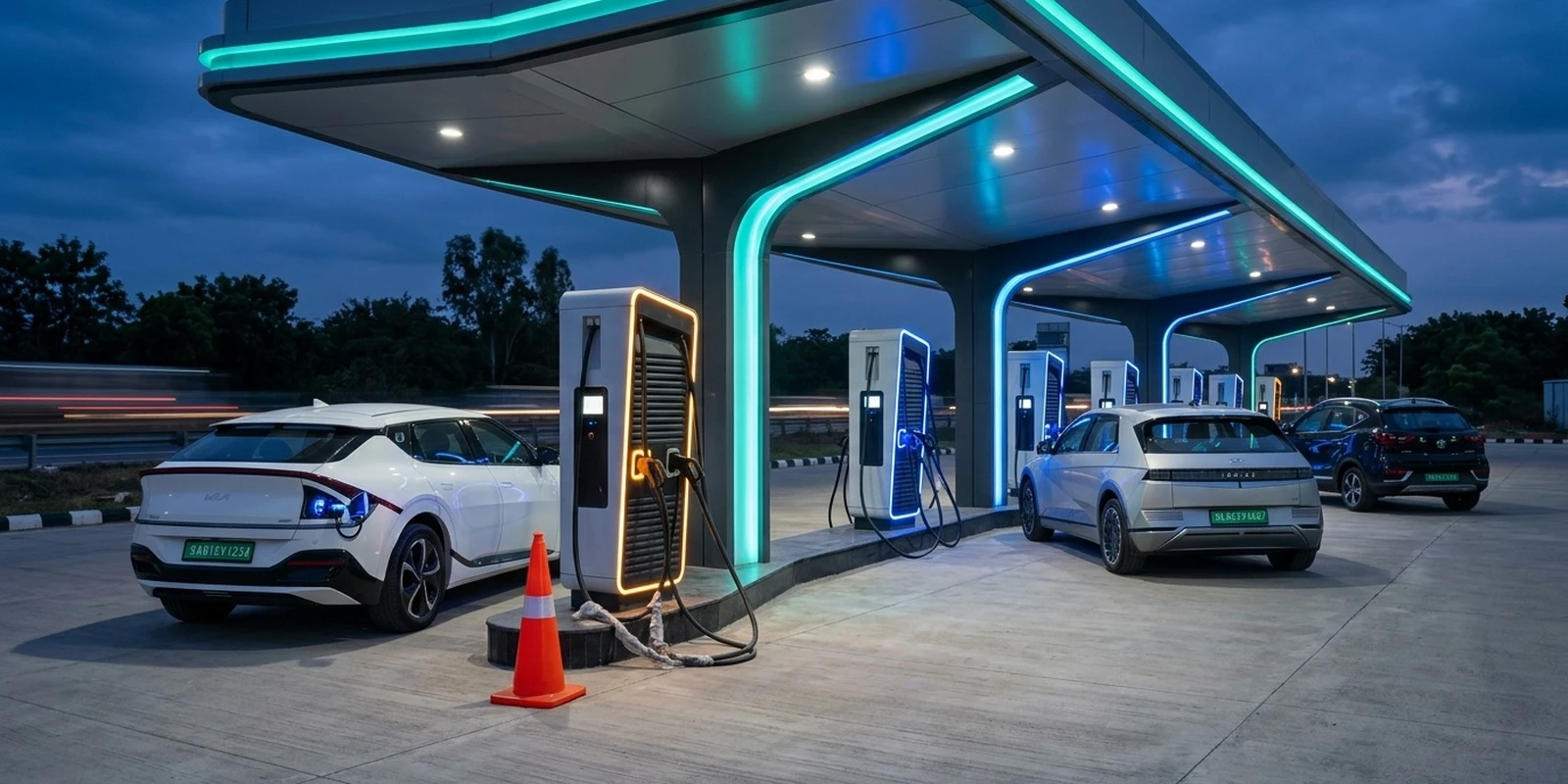
Turning EV Charger Downtime Into a Trust Signal
💡 EV Charger Status Communication: Key Highlights
- Public charging success rates rose to 84% in Q1 2025, up from roughly 80% in 2021 — but 14% of EV owners still left a public station without charging in the past year (J.D. Power, 2025).
- Uptime below 98% correlates with immediate churn spikes; below 98.5%, driver trust and revenue capture both erode measurably.
- 60% of failed charging attempts trace back to one root cause — the charger being out of service or malfunctioning, not driver error.
- OCPP defines nine standard connector states — only three (SuspendedEVSE, Unavailable, Faulted) are genuine driver-facing outages; the rest are normal session states that shouldn’t trigger alarm messaging.
- A network’s first-time charge success rate typically decays from 85% at launch to under 70% by year three — without proactive status communication, drivers read that decline as broken trust, not normal wear.
EV charger status communication — how clearly and how fast a network tells a driver that a specific charger is down, delayed, or under maintenance — has quietly become one of the highest-leverage, lowest-cost levers a charge point operator (CPO) has for protecting revenue. This is written for CPOs, eMobility service providers (eMSPs), and real estate/retail site hosts running driver-facing charging infrastructure at scale — not for an individual driver picking a charger for tonight’s trip. Enterprise fleet operators managing shared depot chargers face a narrower version of the same problem: a driver who can’t trust the status screen starts building slack into every schedule. The data below makes the business case: reliability is improving industry-wide, yet driver trust stays fragile enough that unclear status messaging costs a network more in churn than the outage itself ever cost in downtime.
EV Charger Status Communication as a Business Decision, Not a Support Script
Reliability is genuinely improving — J.D. Power’s 2025 EVX study puts first-time public charging success at 84%, up from roughly 80% in 2021. It’s also not the whole story: the U.S. federal NEVI program requires 97% uptime, yet real networks range from 98–99% (Tesla Supercharger) down to 72–80% on some third-party networks, and 60% of failed visits trace to one cause — the charger was simply out of service.
What matters commercially is the gap between “the charger is down” and “the driver knew about it.” First-time charge success rate (FTCSR) — a more honest driver-experience metric than uptime — starts at 85% for a new station and decays to 69.9% by year three. Status communication is the variable that decides whether drivers read that decay as “a well-run network having an off week” or “an unreliable network I’m done trusting.”
84%
first-time public charging success rate, Q1 2025 (up from ~80% in 2021)
14%
of EV owners left a public station without charging in the past year
<98%
uptime threshold below which driver churn spikes almost immediately
60%
of failed charging visits are simply a charger reported out of service
The framing changes by segment. A multi-city CPO treats this as a network-wide retention and NPS lever — one confused driver becomes a review that costs sessions across every site, not just the broken one. A fuel retailer or oil & gas forecourt loses dwell time and basket spend: a driver who gives up on a dead charger doesn’t buy coffee either. A real estate or retail host is judged on an amenity it didn’t build. A fleet operator running a depot gets padded schedules and idle drivers waiting on a bay that was never coming back online. Different segment, same fix: tell the driver the truth, fast, in language they don’t have to decode.
Mapping OCPP Status Codes to Plain-Language Driver Messages
Most networks already have the raw data. OCPP — the protocol governing communication between a charger and its management platform — reports connector state in near real time through StatusNotification messages: Available, Preparing, Charging, SuspendedEVSE, SuspendedEV, Finishing, Reserved, Unavailable, and Faulted. Detection is largely solved. The gap is translation — raw protocol states are written for engineers, not drivers standing at a plug, and treating all nine as equally alarm-worthy trains drivers to either panic at normal states or ignore alerts entirely.
SuspendedEVSE vs SuspendedEV — the same blank screen, two different apologies
SuspendedEVSE means the charger isn’t delivering power for a charger-side reason — that’s on the network, and the message should point to the nearest working bay. SuspendedEV means the vehicle isn’t accepting power — a locked port, a battery-management limit — and the message should send the driver to their vehicle, not an apology. Sending the same “charging paused” banner for both trains drivers to blame the network for faults it didn’t cause.
Unavailable vs Faulted — “we paused it” vs “it broke”
Unavailable is admin-set — a technician or the platform took the connector offline, usually for scheduled maintenance, no fault reported. Faulted is unplanned — the charger itself reported an error. Unavailable supports a calm, scheduled message with a return time; Faulted needs a faster response — a rough ETA and a redirect to the nearest working bay.
| OCPP Status | What It Actually Means | Driver-Facing Label | Recommended Channel |
|---|---|---|---|
| Faulted | Charger reported a hardware/software fault | “Temporarily out of service” | App banner + on-site signage; push if the driver has a reservation |
| Unavailable | Taken offline by an admin, usually for maintenance | “Under scheduled maintenance until [time]” | App banner + signage; push only if scheduled <24 hours out |
| SuspendedEVSE | Vehicle plugged in, charger not delivering power | “Charging paused — station issue, try bay [X]” | In-session app alert |
| SuspendedEV | Vehicle plugged in, vehicle not accepting power | “Charging paused — check your vehicle’s charge settings” | In-session app alert |
| Available / Preparing / Charging / Finishing / Reserved | Normal session progression | No alert needed | Map pin colour only |
Notification Patterns: What to Send, When, and Through Which Channel
Once the status is translated, the next decision is delivery — and getting this wrong creates its own churn risk, either through alert fatigue or through alerts that arrive too late to matter.
Pre-trip alerts vs at-the-plug alerts
A driver navigating toward a reserved bay needs a pre-trip alert the moment that connector’s status changes — the message that actually prevents a wasted trip. A driver already at the plug needs a calmer message instead: what happened, whether it will resolve soon, and where the next working bay is. Sending the same generic “network status update” for both is the most common reason drivers say they stopped trusting an app’s alerts.
Rate limits and escalation windows
Push only reaches drivers with the app installed and a live connection — SMS or voice fallback matters for time-critical faults. Use a short escalation window rather than an instant blast: many faults are transient (a connector flaps Faulted for 90 seconds and self-clears), so alert only after a fault holds for a set threshold — commonly 10–15 minutes — to avoid training drivers to ignore alerts as noise. Non-critical changes should also respect quiet hours; a 2 a.m. push about a maintenance window three days out serves no one.
Physical Signage: The Layer Apps Can’t Replace
Not every driver at a dead charger opened the app first. On-site signage is the layer that catches everyone else — and it fails most often not because it’s missing, but because its wording doesn’t match the app.
⚠️ Signage checklist for a down connector
- A QR code linking to that specific connector’s live status page — not the network’s homepage
- The exact same plain-language label used in the app (“Temporarily out of service,” not “Error 402”)
- An estimated time to resume, even a conservative range, rather than no timeframe at all
- Distance and directions to the nearest working bay — critical on highways and forecourts where a detour has a real cost
- A support phone number, for the driver who has neither signal nor patience left
Consistency is the point operators most often miss: a driver who reads “under maintenance” on the app and “Error 402: EVSE Fault Code 17” on the sign concludes the network doesn’t know what’s wrong with its own equipment — even describing the same event. Signage and app copy should pull from the same status-label source, not be written separately by whoever printed the sign.
Planned Maintenance vs Unplanned Faults: Different Messages, Different Lead Times
Drivers forgive planned downtime far more easily than unplanned downtime — but only if it was actually communicated as planned, in advance, rather than discovered as a surprise “Unavailable” tag on arrival.
🗓️ Planned Maintenance
- Advance notice: 24–48 hours minimum via app banner and, where relevant, email to reserved users.
- Batching: group multiple bays or firmware updates into one maintenance window instead of repeated single-connector outages.
- Timing: schedule for off-peak hours specific to that site’s actual usage pattern, not a blanket overnight window.
- Tone: calm, informative — this is routine upkeep, not an apology.
⚡ Unplanned Fault
- Speed: driver-facing alert within minutes of the fault clearing the rate-limit threshold, not at end-of-day review.
- ETA: a rough resolution estimate is better than none — “checking now, update within the hour” beats silence.
- Escalation: automatic dispatch to an on-call technician, tracked against a resolution SLA.
- Redirect: always name the nearest working bay or station, not just “sorry for the inconvenience.”
The two workflows share an upstream dependency: neither works without reliable fault detection feeding the messaging layer in the first place. That’s a distinct discipline — we cover the monitoring and escalation side in detail in our piece on EV charger remote monitoring — but the short version is that status communication is only as good as the telemetry underneath it.
Building the Status Communication Stack Into Your Platform
None of this requires new hardware — it requires three things from the software layer: raw OCPP status exposed to a message-templating system rather than buried in an engineering dashboard, a driver app and admin console that render the same plain-language labels consistently, and scheduling tools that let ops queue a maintenance message 24–48 hours ahead instead of silently flipping a connector to Unavailable. That translation layer is where a charging management system like YoCharge earns its keep over a bare OCPP backend that only tracks state without explaining it — and it’s where the retention value actually gets captured.
For fuel retailers, real estate hosts, and fleets that don’t want to own this messaging logic themselves, a white-label eMSP platform typically ships the driver app, status-label templates, and admin scheduling tools as one package rather than a custom build on raw telemetry. The cost of that layer is small and one-time; the cost of skipping it compounds every time a driver reaches a dead charger with no idea why.
Frequently Asked Questions
On EV charger status communication, notification design, and driver retention.
Sources: J.D. Power — 2025 U.S. EVX Public Charging Study | Utility Dive — EV charger reliability improves, satisfaction dips | Open Charge Alliance — Improving Uptime Monitoring with OCPP | Automotive World — Charge success rate vs. uptime report
See How Status Communication Fits Your Charging Platform
Talk to our team about mapping your fleet’s fault states to driver-facing messaging that protects retention instead of just logging tickets.
What happens next?
Reliability & status-communication audit of your network
Custom status-label & notification framework for your app and signage
Retention & churn-reduction impact projection
Ongoing platform support once you’re live