
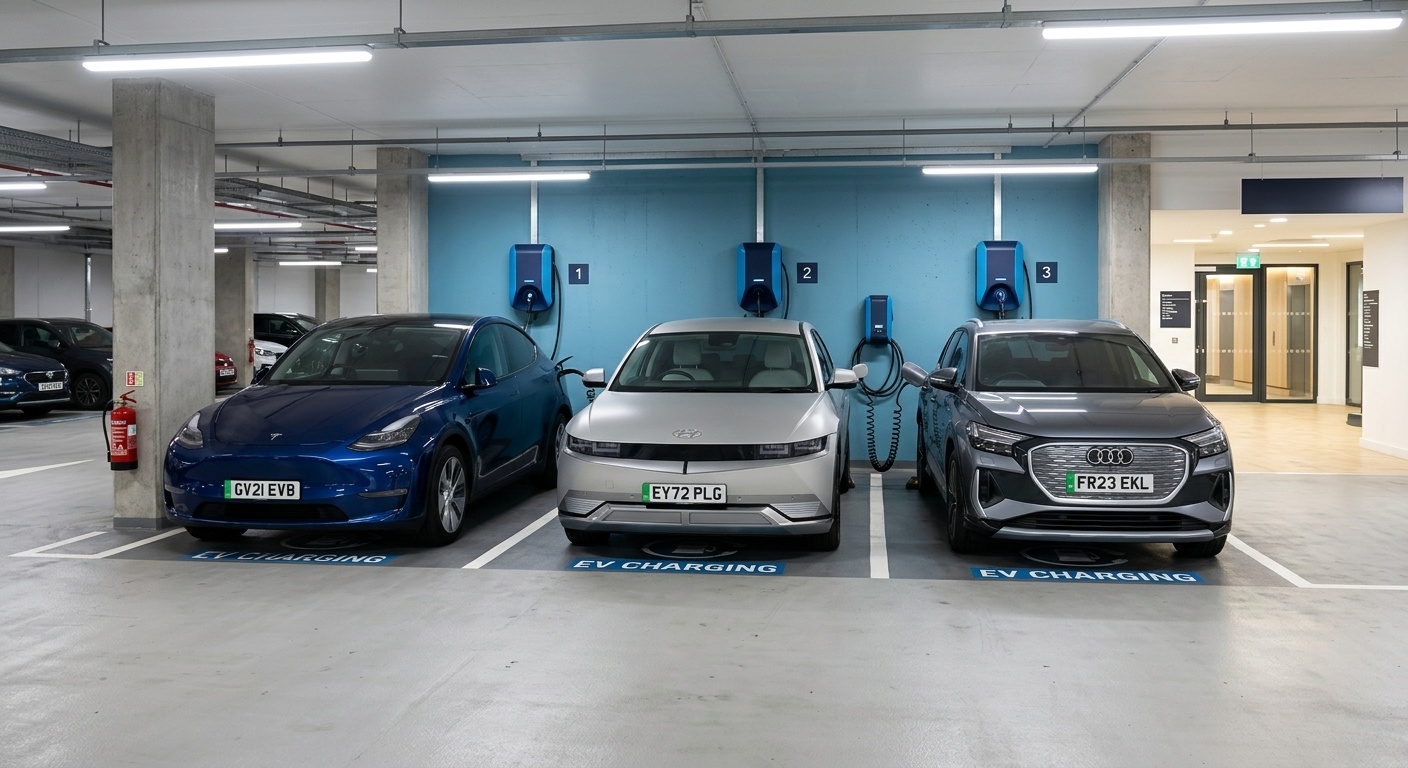
Workplace EV Charging Policy
&x1f4a1; Workplace EV Charging Policy: Key Highlights
- Eligibility first: decide whether all EV drivers, company-car drivers only, or specific roles get access before installing a single charger.
- Four pricing models dominate: free, flat monthly fee, per-kWh at cost, and tiered staff/visitor rates — most employers start free and shift to per-kWh as usage grows.
- UK tax: workplace charging of company cars is not a benefit in kind — HMRC confirms electricity is not classified as fuel (ITEPA 2003 s.239(4)). Employee-owned vehicles are treated differently.
- US tax: the IRS has not ruled explicitly; employers commonly treat it as a de minimis fringe benefit under IRC s.132(a)(4), but should verify with a tax adviser.
- Software enforces the policy: user groups, RFID/app authentication, tariff engines, idle fees, and per-employee utilisation reports turn rules into automated logic.
- Load management solves the 9 a.m. spike: dynamic power sharing lets more vehicles charge on the same electrical supply without costly infrastructure upgrades.
An increasing number of organisations now offer workplace EV charging, but far fewer have a written policy that answers the questions employees actually ask: who is eligible, what does it cost, and what happens when every bay is full at 9 a.m.? Without clear rules, charging perks generate more friction than goodwill — and the finance team is left guessing at tax treatment.
This guide walks through every decision a facilities or HR team needs to make when drafting a workplace EV charging policy: eligibility, pricing models, tax rules in the UK and US, fair-use etiquette, and how software turns policy into something enforceable without a parking warden. The post speaks primarily to corporate facilities managers, HR and sustainability leads, and to CPOs or charging-as-a-service providers selling managed workplace charger installations to those corporates.
Who Should Be Eligible for Workplace Charging?
Start with the simplest question: does every employee with an EV get access, or only specific groups? Most organisations land on one of three tiers.
All employees with a plug-in vehicle
This is the simplest to administer and avoids the perception of favouritism. If the site has enough chargers relative to its EV-driving population, it is the obvious default.
Company-car and car-allowance drivers first
Personal-EV drivers join on a space-available basis. This reflects the fact that the employer chose to put those drivers in EVs and has a financial interest in keeping charging costs low.
Role-based eligibility
Field sales staff whose vehicles are on-site only briefly during the day, or night-shift workers whose vehicles occupy bays during off-peak hours, may be prioritised to maximise charger utilisation.
Visitors and contractors are a separate question. Many sites offer visitor charging at a commercial per-kWh rate while keeping employee charging free or subsidised. If you operate multiple offices, the policy should state whether the benefit follows the employee to any company site or is limited to their primary workplace.
Four Pricing Models for Employee EV Charging
Deciding whether workplace charging should be free, subsidised or priced at a commercial rate is the highest-stakes line in the policy. Here are the four models most commonly adopted.
| Model | How It Works | Best For | Watch Out For |
|---|---|---|---|
| Free charging | Employer absorbs all electricity cost; zero admin for payroll | Early adoption; recruitment/retention signal | Rising electricity bill with no cost visibility; overuse |
| Flat monthly fee | Employee pays a fixed amount per month regardless of consumption | Simple payroll deduction; predictable cost | Does not reward efficient charging behaviour |
| Per-kWh at cost | Employee pays actual electricity cost with no margin | Fairest model for mixed use; heavy users pay more | Requires metered chargers and billing software |
| Tiered staff / visitor | Staff charge at subsidised rate; visitors or public pay commercial rate | Sites that also serve external drivers | More complex tariff configuration |
The right model depends on fleet size, electricity tariff structure, and whether the organisation is trying to accelerate EV adoption (free) or manage an already-large charging estate (cost recovery). Many employers start free and move to per-kWh at cost once utilisation exceeds the point where the electricity spend is noticeable on the facilities budget. YoCharge’s payment and billing engine supports all four models and lets operators switch between them without re-cabling.
Tax and Benefit Treatment: UK and US
Tax authorities in the UK and US treat workplace charging differently, and both positions carry conditions that a blanket “it’s tax-free” summary would miss.
United Kingdom
HMRC’s Employment Income Manual (EIM23900) states that electricity does not sit within the meaning of fuel, so the fuel benefit charge does not apply when an employer allows a company car to be charged from a workplace charging point. The exemption is grounded in section 239(4) of the Income Tax (Earnings and Pensions) Act 2003 (ITEPA 2003). However, for employee-owned vehicles, employer-provided workplace charging is treated as a taxable benefit in kind based on the employer’s cost.
United States
The IRS has not published specific guidance stating that free workplace EV charging is a tax-free fringe benefit. Many employers treat it as a de minimis fringe benefit under Internal Revenue Code section 132(a)(4), which excludes any property or service whose value is so small as to make accounting for it unreasonable or administratively impracticable. The IRS’s own de minimis fringe benefit examples page lists items such as occasional snacks and personal use of a company phone but does not mention EV charging. Because the IRS has not ruled explicitly, employers should consult a tax adviser to confirm how their particular programme should be treated — particularly as EV adoption grows and the per-employee charging value rises. Cash reimbursement for charging, regardless of amount, is taxable wages.
Fair Use and Etiquette Rules
A policy is only as good as the daily behaviours it shapes. Without fair-use rules, the same five early arrivals will occupy every bay all day while the rest of the team never gets a charge.
Session time limits
A four-hour maximum per session gives two rotation windows in a standard workday. Once a vehicle reaches a sufficient state of charge, the driver should move it.
Idle fees
A per-minute charge that begins after the session ends — or after a grace period — creates a financial nudge to vacate the bay. Many platforms apply idle fees only during peak hours, which avoids penalising overnight charging in a 24-hour workplace.
Reservations
Reservation systems let drivers book a slot in advance, which is especially useful in offices where only a fraction of parking spaces have chargers. YoCharge’s platform supports charger reservations, though the approach carries trade-offs worth understanding.
Rotation protocols
Some organisations use a simple messaging channel where the current user posts when their vehicle is charged and the next person in the queue plugs in. Others rely entirely on the app-based queue. The policy should state which method the site uses and what happens if a vehicle is not moved within the grace period.
How Software Enforces the Policy
A written policy becomes enforceable when the charging platform can translate its rules into automated logic. Here is what that looks like in practice.
User groups and zero-price groups
The platform creates distinct user groups — employees, visitors, contractors — and each group maps to a tariff. A zero-price group for employees who charge free means no transaction is generated, but utilisation is still tracked. Visitors or tenants can be assigned a commercial tariff under their own group.
Authentication ties a session to a person
RFID cards give each employee a physical token linked to their account, ensuring only authorised users can start a session. Mobile-app authentication does the same without the card. Both methods produce a per-user charging log that ties energy consumption to the individual.
Tariff configuration
The operator can set different rates per group, per time-of-day, or per charger. A workplace might charge employees nothing during off-peak hours but apply a small per-kWh fee during the demand peak between 9 a.m. and 11 a.m. to spread load. YoCharge’s payment and billing engine handles these tariff structures without manual invoicing.
Per-employee utilisation reporting
Facilities managers get visibility into who is charging, how much energy each user consumes, and when demand peaks. This data supports internal cost allocation — charging the department’s budget for its drivers’ consumption — and sustainability reporting. Charging data showing kWh delivered per employee can feed into Scope 3 commuting calculations as an input, though the platform does not calculate or certify emissions.
The 9 a.m. Problem: Load Management
Every workplace with more chargers than its electrical supply can serve simultaneously hits what facilities teams call the 9 a.m. problem: everyone arrives, plugs in, and the building’s demand spikes. Dynamic load management solves this by distributing available power across connected vehicles in real time, throttling charge rates so that total draw stays within the site’s electrical capacity.
Without it, adding chargers means upgrading the electrical supply — which is slow and expensive. With it, the same supply can serve significantly more vehicles by sharing power intelligently as vehicles connect and disconnect throughout the day.
The policy should reference load management so employees understand why their vehicle may charge more slowly during peak hours. Transparency prevents complaints: “Your vehicle will receive a full charge during the workday; charging speed may vary based on site demand” is a better message than silence followed by a support ticket.
Putting the Policy Together
The policy document itself does not need to be long. A single page covering eligibility, pricing model, fair-use rules, and the enforcement mechanism is enough. Circulate it as part of the employee handbook or facilities guide, and display a summary at the charging bays. Review the policy annually — or whenever the number of EVs on-site changes materially.
For CPOs and charging-as-a-service providers selling workplace solutions to corporates, offering a template policy alongside the hardware-and-software package is a differentiator. It moves the conversation from “we install chargers” to “we solve the workplace charging problem end to end” — with YoCharge’s charging management platform handling the software side.
Researched and drafted with AI assistance; facts checked against the sources linked above and reviewed by the YoCharge team.
Frequently Asked Questions
Common questions about workplace EV charging policies
Sources: HMRC Employment Income Manual EIM23900 | ITEPA 2003 s.239 | IRS De Minimis Fringe Benefits
Set Up Workplace EV Charging That Runs Itself
See how YoCharge handles user groups, tariffs, idle fees, and load management for workplace sites — in one platform.
What happens next?
Initial site and policy consultation
Customised user-group and tariff setup
Load management configuration and testing
Ongoing support and policy refinement