
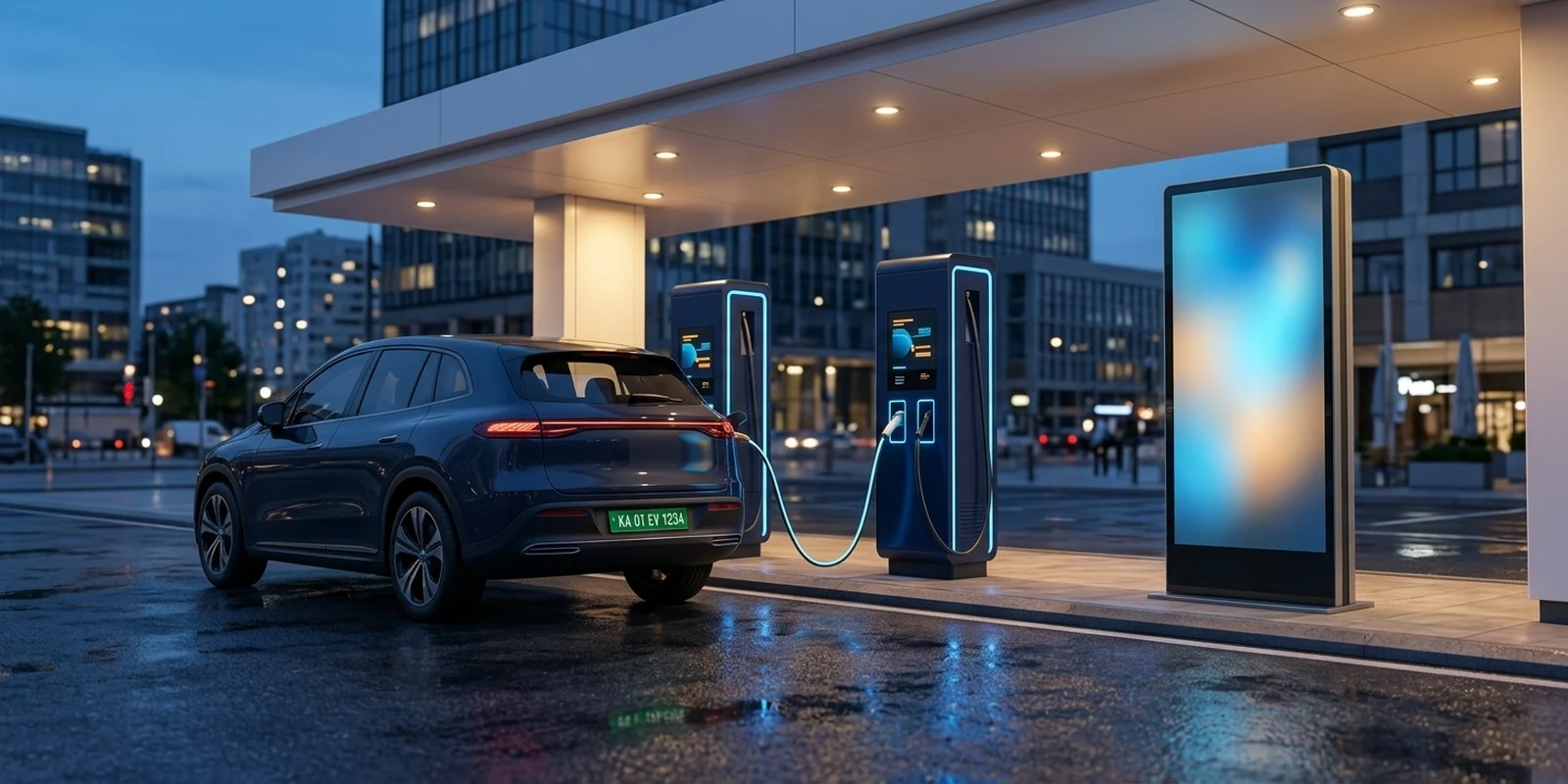
EV Charging Station Advertising: Selling The Screen
💡 EV Charging Station Advertising: Key Highlights
- Two different businesses share one phrase. This is about third-party advertising sold at your sites — not about promoting your own network to drivers.
- Dwell is the asset: 25 to 40 minutes at a DC charger against three to five at a fuel pump. But long dwell per person is not the same thing as a large audience.
- Your driver app is usually better inventory than your charger screen. Impressions there are decoupled from session count, and the targeting data is first-party.
- Volta — the purest ad-funded charging network ever built — took 85% of its revenue from media ($12.2M of $14.4M in Q3 2022) and still lost $42.5M in the same quarter.
- Session margin is capped; media revenue is not. India’s DC service charge is held at ₹11 per unit until 31 March 2028 — which is exactly why operators keep looking at the screen.
Two very different businesses hide behind the phrase EV charging station advertising. One is promoting your own network so that drivers find it, trust it and come back. The other — the subject of this article — is selling third-party advertising at your sites: taking the twenty-five to forty minutes a driver spends stationary at a DC charger and selling that attention to somebody else. If you came here for the first one, our guide to promoting and marketing EV charging stations covers it properly. This post is about the second: the media line on a charge point operator’s P&L.
It is also distinct from bundling services for the driver — parking, Wi-Fi, retail vouchers — where you are still selling to the same customer. Advertising inverts that: the driver becomes the product. For CPOs, fuel retailers and site owners weighing a screen, what follows is the inventory you own, how it is priced, what it costs to run, and a sizing exercise most media proposals leave out.
Why Charging Dwell Is Unusually Good DOOH Inventory
Out-of-home media is priced on attention, and attention is mostly a function of dwell. A driver at a fuel pump is stationary for three to five minutes, standing, watching the nozzle. A driver at a 60 kW DC charger is stationary for twenty-five to forty minutes, seated, actively looking for something to do. That is an order of magnitude more exposure per visit, from an audience pinned to a known location, identifiable by vehicle type, and skewed towards higher income and earlier adoption than the general driving population.
Three qualifications belong in the same breath. First, the audience is small: dwell per person is long, but the number of people is set by how many guns you have and how busy they are. Second, the competing screen is already in the driver’s hand — a 55-inch display has to earn attention against a phone. Third, AC charging inverts the maths: dwell runs into hours, but the driver has walked away, so the screen is talking to a parked car.
The demand side is real enough: India’s out-of-home segment grew 13% in 2025 and digital formats reached 18% of segment revenue, up from 7% in 2023, per the FICCI-EY report. Charging is a venue type that growth is hunting for — which is not the same as saying it has found it.
The Three Kinds Of Inventory A Charging Operator Owns
1. Charger-mounted screens
The display on or beside the charger. This is what most people mean by charging-station advertising, and commercially it is the weakest of the three: its audience is capped at your session count. It is also the most entangled, because the same glass often carries session status, tariff and payment instructions. Fitting a dedicated media display beside the charger, rather than sharing its UI, is almost always cleaner.
2. Forecourt and canopy displays
A freestanding totem or canopy-mounted display sees everyone who enters the site, not only the people charging. At a fuel forecourt or mall entrance that is a completely different number — hundreds or thousands of vehicles a day against your twenty sessions. It is why EV charging for fuel retailers has a genuine media story and a standalone highway charger usually does not.
3. In-app placements in your own driver app
The most valuable inventory a charge point operator owns is usually the one nobody counts. App impressions are decoupled from sessions: drivers open the app to find a charger, check a tariff, pay or review history, often several times per charge and sometimes without charging at all. You also hold first-party data no external seller has — vehicle type, charging frequency, home city, spend band. A sponsored placement in your own EV charging app sells on that targeting rather than raw reach, which is the better trade when reach is your weak number.
How EV Charging Station Advertising Is Actually Priced
Three commercial structures dominate EV charging station advertising, and which one is available to you is decided almost entirely by your screen count.
| Pricing model | How it is sold | Who it fits | The catch |
|---|---|---|---|
| CPM | A rate per thousand impressions, bought directly or programmatically against an audience measurement you publish. | Networks with 50+ screens and an impression methodology a buyer will accept. | Your impression count is your revenue — and charging-only audiences rarely clear a media buyer’s minimum spend. |
| Fixed slot per site per month | A flat monthly fee per screen for one slot in a repeating loop — say ten seconds in a sixty-second rotation. | Small networks selling to local advertisers: the nearby dealership, an insurer, a restaurant. | Predictable, but it caps your upside and you carry the fill risk yourself. |
| Revenue share with a DOOH partner | The partner brings demand, the playback stack and the measurement; often the screen itself. You take a cut of net. | Almost every network under roughly fifty screens. | Typically 30–50% to you, and you give up control over what appears on your forecourt. |
Screen count, not audience quality, usually decides which of the three is on the table.
CPM is the model buyers prefer, because it is what the rest of digital advertising uses. It also obliges you to prove impressions — vehicle counts, session counts, an occupancy assumption, ideally audited. Below roughly fifty screens most operators cannot produce that at a cost the revenue justifies, which is why they sell through an aggregator instead. Fixed-slot pricing is how small Indian networks actually transact, and it is a reasonable place to start.
One assumption to interrogate in every proposal: fill rate. A new venue class, in a market where buyers have no benchmark, does not sell out. Twenty-five to forty per cent in year one is a realistic planning number; a proposal modelled at full occupancy is a brochure, not a forecast.
The Operating Reality: A Second Uptime Commitment
An advertising contract is an availability contract. Sell a month of slots, have the screen dark for nine days, and you refund or make good — the mechanism you already run for charger downtime, now on a second asset with its own failure modes. Four costs rarely appear in the pitch:
- Power. An outdoor-rated, sunlight-readable display draws roughly 250–500 W at full brightness, before enclosure heating or cooling. At 350 W for sixteen hours a day that is about 170 kWh a month, at a commercial tariff, paid whether or not the slot sold.
- Connectivity. Media playback needs its own data path — sharing the charger’s SIM is tempting and wrong: a creative download should never compete with an OCPP heartbeat.
- Proof of play. Buyers pay against playback logs: you need timestamped, per-asset play records you can hand over, and a content system that schedules loops by daypart.
- Field service. A cracked or frozen screen is a site visit. These assets sit outdoors, at eye height, in public.
Settle one integration question before signing: who controls the display when the session needs it. That handover — charging UI takes priority, media resumes afterwards — is core-business logic. A charging management system like YoCharge’s is where that rule should live, not a media partner’s player.
Rules That Protect The Core Business
EV charging station advertising is a supplement; the moment it degrades a session it has cost more than it earned. Four terms worth writing into both the screen specification and the media contract:
- Session state always wins. Charging status, energy delivered, cost so far, fault messages and the payment flow are never occluded, never delayed by a creative, and never require the driver to dismiss an ad. If the media player is technically able to cover the payment screen, the design is wrong.
- Content standards are yours to set. You are an energy retailer in a public space. Categories you decline — competing fuel brands, rival charging networks, gambling, anything the site host’s brand team would refuse — belong in the contract as an exclusion list, not a phone call after the creative goes live.
- Screen ownership and revenue split are written terms. Who buys the display, who maintains it, who keeps the media revenue and what happens to the asset at exit are the same questions that decide site economics generally — covered in our post on who installs, who operates and who keeps the revenue.
- Cap the exclusivity. A partner asking for your whole network for five years is buying an option on your entire media upside at today’s prices. Three years with a volume-linked break is a more honest shape.
Sizing It Honestly: What A Ten-Site Network Can Expect
Here is the arithmetic most proposals skip. Take ten DC sites, each running twenty sessions a day at twenty units per session, at a realised service charge of ₹9 per unit — inside the ₹11 solar-hours ceiling set by the Ministry of Power’s 2024 charging infrastructure guidelines. That is about ₹10.8 lakh a month in service charge. Now price the screens two ways.
| Monthly, across ten screens | Charging audience only | Sites with real footfall |
|---|---|---|
| Audience | 7,800 impressions (20 sessions × 1.3 occupants × 30 days) | 240,000 impressions (800 vehicles entering the site per day) |
| Assumed CPM | ₹2,500 — premium EV audience | ₹800 — mass forecourt audience |
| Gross media revenue | ₹19,500 | ₹1.92 lakh |
| Net after a 40% partner share | ₹11,700 | ₹1.15 lakh |
| Screen running cost (power + data) | ₹17,400 | ₹17,400 |
| Net contribution | −₹5,700 | ≈ ₹98,000 |
| Against ₹10.8 lakh of session revenue | Loss-making | ≈ 9% |
Illustrative, at full sell-out. The only variable that moved between the columns is who walks past the screen.
Two conclusions follow, neither of them in the brochure. The charger-only column does not merely earn little — it earns less than the electricity and connectivity the screen consumes. And the tenfold gap between the columns is driven by footfall, not charging volume: the audience that pays is largely the audience that is not charging. That is why ad-funded charging networks get built at grocery stores, malls and forecourts, not on highways.
Then apply the fill rate. At 30% occupancy in year one the right-hand column falls to about ₹17,000 a month net of running cost — roughly 1.6% of session revenue, and that is the board-pack number. Advertising is a margin supplement with a double threshold: enough utilisation for the site to be worth visiting, and enough non-charging footfall for the screen to have an audience. Below either, it is an expense with a story attached.
The cautionary case is instructive. Volta built the purest advertising-funded charging network anyone has attempted — free Level 2 charging at retail sites, paid for by large media displays. Its Q3 2022 filing shows $12.2 million of media revenue against $38,000 from charging, and a $42.5 million loss for the quarter; Shell bought it for $169 million in 2023 and divested most of the media-enabled network at the start of 2026. Media can be the majority of a charging business’s revenue and still not be a business case. Treat it as one line in a broader EV charging revenue model, alongside subscriptions, fleet contracts and driver loyalty programmes.
Frequently Asked Questions
Sources: Ministry of Power — Guidelines and Standards for EV Charging Infrastructure, 17 September 2024 | Volta Inc. Form 10-Q, quarter ended 30 September 2022 (SEC EDGAR) | FICCI-EY Media & Entertainment Report 2026 | Shell USA — completion of the Volta Inc. acquisition
Model The Media Line Before You Buy The Screen
Tell us your sites, session volumes and the footfall each location actually sees, and we will size the media opportunity against your session revenue — and show you how session priority, screen control and in-app placements sit inside one platform.
What happens next ?
Impression model built from your real session and footfall data
Media revenue compared honestly against your session margin
Session-priority and screen-control rules specified before procurement