
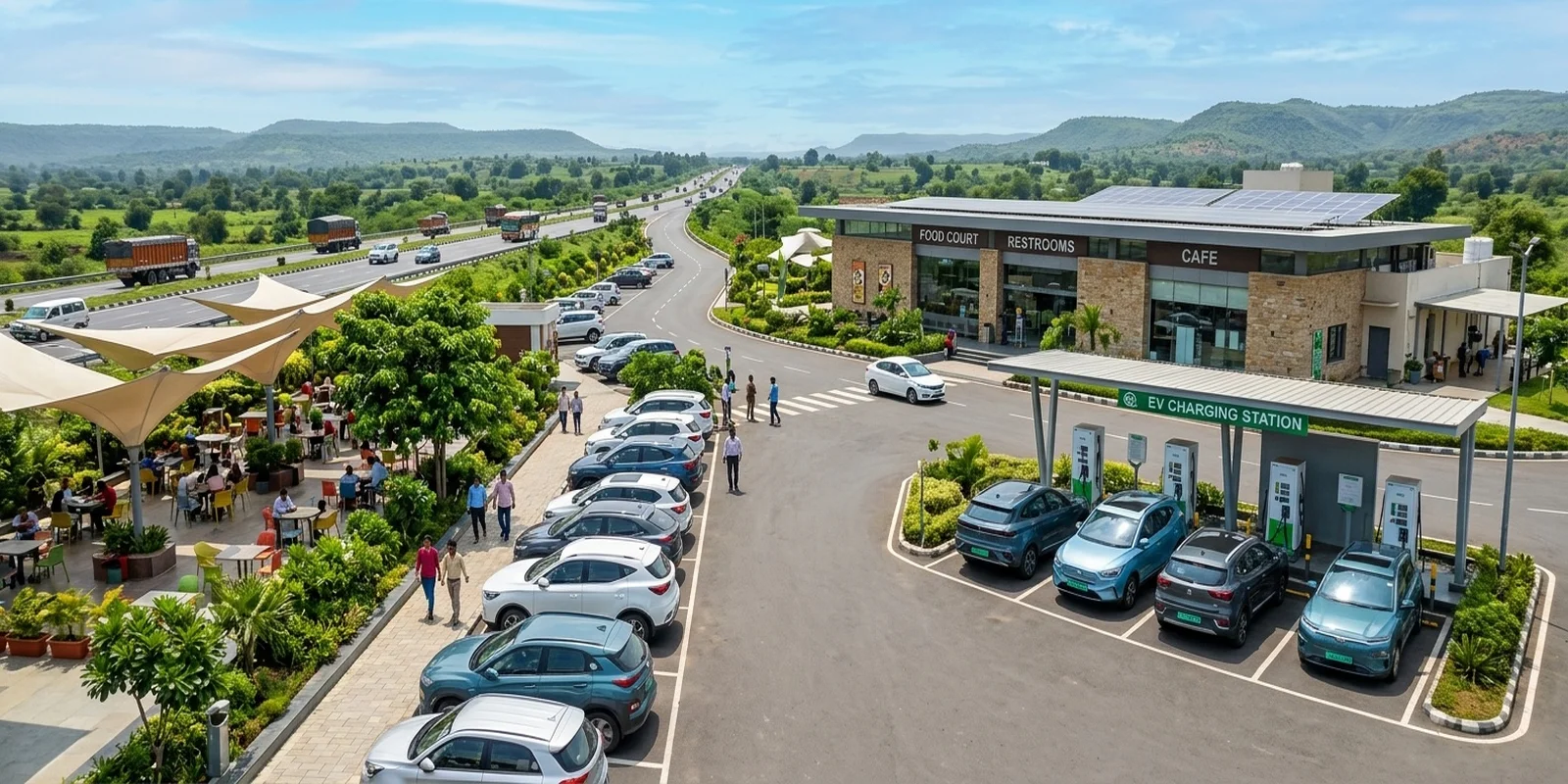
Wayside Amenities And Highway EV Charging
- Highway EV chargers earn disproportionately on weekends, long weekends and festival days — the best ~50 days can deliver 35–40% of annual revenue while making up only 14% of the calendar.
- NHAI’s wayside amenity programme offers CPOs land on lease for up to 30 years, with EV charging a mandatory facility at every WSA site since February 2021.
- Distance to the nearest HT feeder — not the land itself — usually determines what a highway site costs to energise, with 33 kV overhead line extensions running Rs 5–7 lakh per km.
- The food court, shade and restroom beside the charger are what make drivers stop. The charger alone is not a destination on a highway.
- Network-wide public charger utilisation in India remains at 1–5%. Highway sites with the right anchor and peak-day capacity can outperform that floor significantly.
If you run EV charging at a fuel forecourt, a state highway rest stop, or a CPO network planning its next intercity corridor, the highway site is a fundamentally different business from an urban one. This post is not about where to place chargers across a city — that belongs to our site-selection guide — or about the public-sector procurement route for government buildings, which we cover separately. It is about wayside amenities on national highways: the plot, the power, the anchor amenity, and the revenue shape that makes or breaks the investment.
YoCharge’s highway and toll-plaza charging solutions already serve CPOs who operate at these sites. What follows is the business-case logic underneath — built for fuel retailers, highway amenity developers, and CPOs planning intercity corridors.
Why Highway Charger Revenue Is Peak-Day Revenue
India’s public EV charging network has crossed 67,000 chargers, yet network-wide utilisation sits between 1% and 5% according to estimates by SBI Research and S&P Global. At highway wayside amenities, the picture is not just low — it is deeply uneven. Weekday throughput trickles. Weekend and festival throughput surges. That asymmetry is the single most important fact in highway charging economics, and most business plans get it wrong by modelling on a daily average.
The Weekday Trickle
A midweek Tuesday on a well-positioned national highway corridor sees modest intercity EV traffic. Most four-wheeler EVs on the road are urban commuters who charge at home or at work. Highway sessions come from a narrow band: salespeople between cities, the occasional road-tripper, and logistics fleets still in early electrification. On such a day, a four-bay DC fast-charging site might log 4–6 sessions per charger — 16 to 24 sessions total.
The picture inverts on weekends and, more sharply, on festival travel windows. A Diwali Saturday, a Holi long weekend, a Christmas-to-New-Year stretch, or the opening week of summer holidays puts a fundamentally different load on the same chargers. Sessions per bay can climb to 15–20 on those days — 60 to 80 total at a four-bay site — and queues form at every connector.
A Worked Peak Day
Take a four-bay highway site, each bay a 60 kW DC fast charger. Each session averages 25 minutes of charging plus five minutes of connector handover — a 30-minute slot. In a 16-hour operating window, each bay can theoretically serve 32 sessions. On a Tuesday, it serves five. On a peak Saturday, it serves 18.
At a gross tariff of Rs 18 per kWh and an average energy dispensed of 20 kWh per session, each session generates about Rs 360 in gross revenue:
That single peak day outearns 3.5 ordinary weekdays. Across a year, the roughly 50 strongest days — peak weekends, long weekends and festival travel spikes — can account for 35–40% of total annual revenue, despite occupying only 14% of the calendar. Model on a daily average, and you undersize the site for the days that actually pay for it.
More Connectors At Moderate Power
This revenue shape argues for a specific hardware strategy: more charging bays at moderate power (60 kW) rather than fewer bays at maximum power (120–180 kW). On a peak Saturday, the bottleneck is queue depth, not charge speed. A driver who finds all four bays occupied drives on; an eight-bay site captures that overflow. The incremental revenue from bays five through eight — heavily used on only 50 days a year — still sets the payback arithmetic for the entire site.
The Wayside Amenity Route — What An NHAI Plot Offers
Wayside amenities are the formal route to a highway charging site on government land. MoRTH’s February 2021 policy guidelines require wayside amenities to be spaced every 40–60 km along national highways and expressways. Since that same 2021 circular, EV charging has been a mandatory facility at every wayside amenity site. MoRTH’s stated target is roughly 5,000 wayside amenities across the highway network, with about 900 under development on government land as of mid-2025.
How The Allotment Works
NHAI offers land to private developers on competitive lease for up to 30 years (15 years where NHAI has already built the amenity structure). The bid parameter is typically the highest annual revenue share, with a minimum threshold of 5% of land and construction cost. For the EV charging component specifically, the Ministry of Power’s 2024 guidelines prescribe a land-use charge of Rs 1 per kWh of energy dispensed, payable to the land-owning agency, initially for a 10-year term.
A separate MoRTH draft policy (July 2025) extends the wayside amenity model to private landowners on a franchise basis through NHLML, with a nominal franchise fee of Rs 100 per month for the first three years and Rs 25,000 per month from year four onward, indexed annually. If finalised, it would sharply expand the available land pool beyond government-owned parcels.
What The Site Owes
The developer pays the lease or franchise fee, builds access and deceleration lanes at its own cost, maintains the facility 24×7, and meets periodic inspection standards. For the charging bays, the Rs 1/kWh land-use charge is computed on CMS-recorded energy — the charging management system’s metered data is the primary reconciliation basis — so a platform like YoCharge’s charging management platform is directly in the revenue loop even before a single session is billed to a driver.
Power At A Highway Site — The Feeder, Not The Land
Land at a wayside amenity comes from the allotment. Power does not. The binding constraint at most highway sites is the distance between the plot and the nearest 11 kV or 33 kV DISCOM feeder. A fast-charging site drawing 240–480 kW (four to eight 60 kW bays) needs a high-tension connection, and if the nearest HT feeder is 3–5 km away, the line extension becomes the largest single capital cost on the project.
Line Cost And Staged Build-Out
State DISCOM schedules vary, but illustrative rates from published utility tariff orders put a 33 kV overhead line extension at Rs 5–7 lakh per km and an 11 kV line at Rs 3.5–5 lakh per km. Underground cable multiplies the cost roughly five-fold. A 4 km, 33 kV overhead extension to a highway site can cost Rs 20–28 lakh before the transformer and metering — often exceeding the cost of the chargers themselves.
The honest design response is a staged build-out. Start with fewer bays at a power level the existing feeder distance supports. Add bays and power capacity as utilisation data justifies the next capital step. A site that spends Rs 50 lakh upfront on eight bays and a long line extension, then runs at 3% utilisation for two years, has a worse payback than one that starts with four bays, proves the traffic, and extends later. For the DISCOM application process itself — tariff categories, contract demand and the supply agreement — we cover the full sequence in our EV charging station licence guide.
The Anchor — Food, Shade And Toilets Win The Stop
A 25-to-40-minute fast-charging session is tolerable if the driver has somewhere to eat, use a restroom, and sit in shade. It is not tolerable if the driver is standing beside a charger in 42-degree midday heat on a highway shoulder. The anchor — the food court, the restrooms, the seating area — is what converts a charger location into a stop people choose.
At wayside amenities, this is built into the design. The WSA layout requires food, water, restrooms, parking and first aid as mandatory facilities. The charging operator typically shares the site with a food-court concessionaire or runs the food service as part of the same amenity lease. In most NHAI allotments, the developer operates both under a single lease, making the revenue-share arrangement between charging and food an internal allocation rather than a separate negotiation.
For fuel retailers adding EV charging at existing highway forecourts — dhabas, toll-restaurant complexes, petrol stations with convenience stores — the anchor already exists. This is where EV charging for fuel retailers intersects with the wayside amenity model: the forecourt’s existing food and rest infrastructure is the anchor, and the chargers extend its relevance to a new vehicle category. The right question is not “will drivers come to charge?” but “will drivers who already stop here also charge?”
Interoperability For Out-Of-Network Drivers
A highway site, by definition, serves travellers who may not be on your network. If a driver from Mumbai cannot start a session at your Pune–Bengaluru corridor site because your app is not on their phone and your chargers do not accept ad-hoc payment, the session — and the revenue — goes to the next stop. OCPI-based roaming lets drivers from other networks start a session without downloading a new app. We cover the full roaming architecture in our EV charging roaming and interoperability guide. For highway wayside amenities, the operational minimum is that every charger accepts at least one roaming protocol and one ad-hoc payment method — UPI QR, card, or both.
Frequently Asked Questions
The 2021 MoRTH policy covers government-owned land along national highways and expressways. A July 2025 draft policy extends the wayside amenity model to private landowners through NHLML on a franchise basis. If finalised, private land parcels abutting national highways would also qualify, subject to suitability norms — minimum 100 m frontage, at least 5 km from town limits, and vacant encumbrance-free land.
The Ministry of Power’s guidelines prescribe Rs 1 per kWh of energy dispensed as a land-use charge to the land-owning agency, computed from the site’s charging management system records. This is separate from the broader lease or franchise fee the wayside amenity developer pays to NHAI or NHLML for the overall site, which is set by competitive bidding.
MoRTH has reported over 5,200 EV charging stations along highways, and roughly 91% of national highways now have a charger within 50 km. India’s total public charging network crossed 67,000 chargers by August 2026, though network-wide utilisation remains between 1% and 5% according to SBI Research and S&P Global estimates.
In NHAI’s current allotment model, the developer bids for and operates the entire wayside amenity — food, restrooms, parking and charging together. A CPO that wants only the charging bays would typically sub-contract under the site developer’s lease or enter a revenue-share arrangement with the master concessionaire, rather than bidding independently for the full WSA.
A four-to-eight-bay DC fast-charging site at 60 kW per bay draws 240–480 kW and needs a high-tension connection at 11 kV or 33 kV. The cost depends primarily on the distance to the nearest DISCOM feeder — line extensions at highway sites can run Rs 5–7 lakh per km for a 33 kV overhead line, often exceeding the charger hardware cost itself.
Sources: MoRTH Policy Guidelines for Wayside Amenities (February 2021) | NITI Aayog — Electric Vehicles in India: Unlocking a $200 Billion Opportunity (2025) | IEA Global EV Outlook 2026
Planning A Highway Charging Network?
YoCharge gives CPOs and fuel retailers one platform for session management, billing, land-use-charge reconciliation and multi-site monitoring across highway corridors.
Get a Demo