
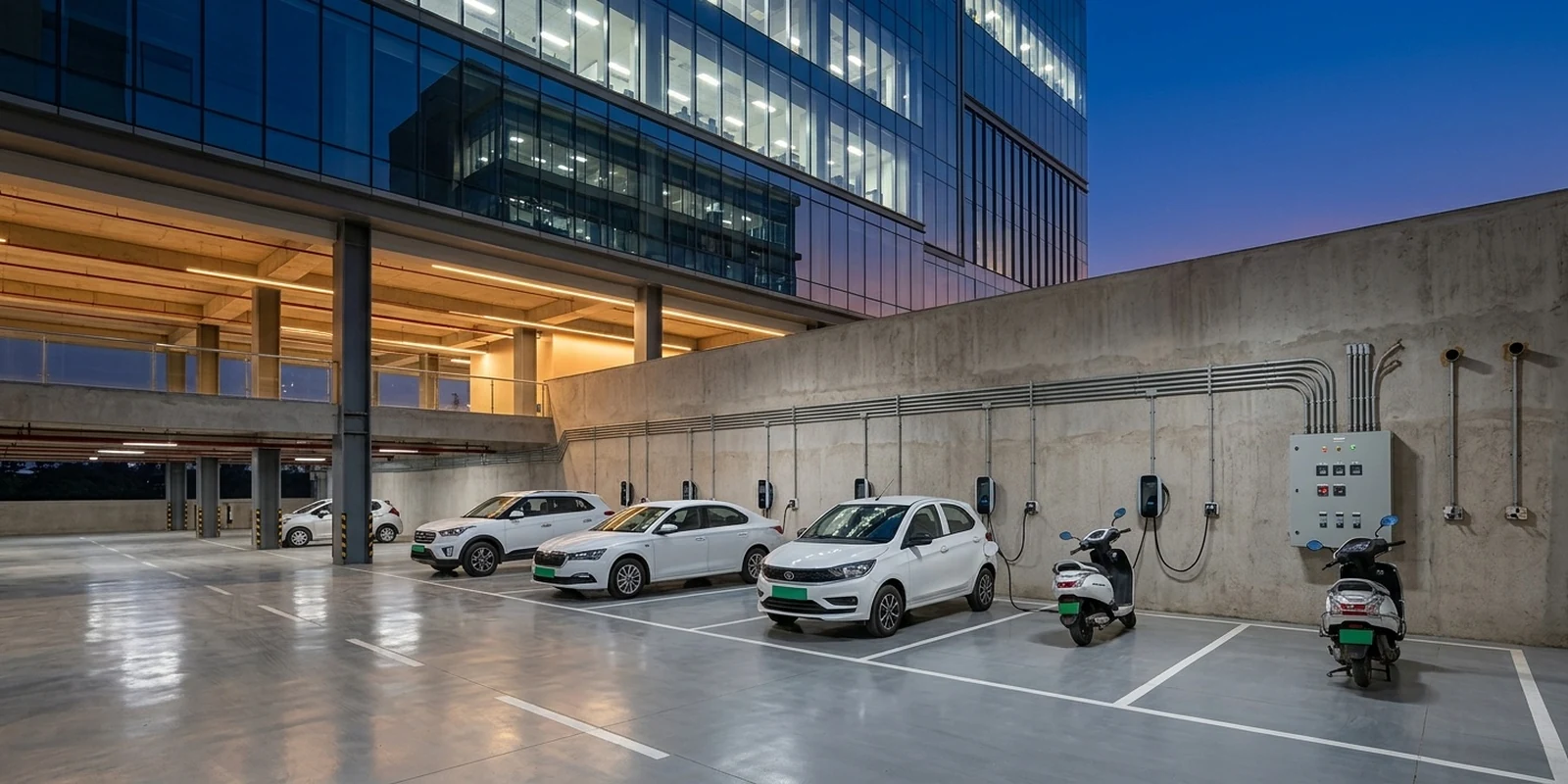
EV Charging And Green Building Certification
💡 Green Building Certification And EV Charging: Key Highlights
- ECSBC 2024 sets the hard floor in India: 20% of parking capacity with EV charging facility — rising to 25% for ECSBC Plus and 35% for Super ECSBC, and the percentage must be met independently for two-wheelers, four-wheelers and visitor parking.
- The Model Building Bye-Laws amendment of February 2019 put the same 20% into clause 10.4, plus an additional sanctioned load covering every charging point running at once with a 1.25 safety factor.
- IGBC Green New Buildings v4.0 awards 2 points at 10% of two- and four-wheeler bays (visitor parking excluded); LEED v5 awards up to 2 points; GRIHA Version 6 awards 1 point at 5% of four-wheeler bays — and EV is only one of three competing strategies there.
- Provisioning conduit and panel capacity during construction runs about four times cheaper than retrofitting a finished basement — roughly $1,500–$3,000 per bay against an extra ~$5,000 to dig one out later.
- 20% of bays does not mean 20× the connection. Load sharing across a shared circuit cuts the per-bay cost of EV-ready parking by roughly 75%.
- Every one of these instruments stops at the day of commissioning. None of them asks who authorises a session, who bills it, or who keeps it online.
If you are a real estate developer, a commercial landlord, an architect or a facility and ESG manager, green building certification has quietly become the place where your EV charging decisions get made — usually before anyone on your team has thought about charging at all. The parking percentage is fixed at design stage, the conduit is either in the slab or it is not, and by the time a leasing head asks for chargers on level B2, the cheap window has closed.
This post is written for the site-host side of the market, not the charge point operator side. Two of our existing articles already own the neighbouring questions, and this one deliberately does not repeat them: EV charging for commercial real estate covers who installs, who operates and who keeps the revenue, and EV charging stations in apartment buildings covers the residential case. What follows is the regulatory and ratings floor underneath both of them — what you must provide, what earns points, and what “EV-ready” legally means.
Every figure below was read from the issuing body’s own current document — BEE, MoHUA, IGBC, the GRIHA Council and USGBC. Three have changed version within the last year, which is why a consultant’s summary from 2022 is no longer a safe basis for a design brief.
Codes Oblige, Green Building Certification Rewards
These are two different kinds of instrument and they fail in different ways. A building code is law the moment a state or urban local body notifies it into its own bye-laws — miss the EV clause and you are arguing with a building official over an occupancy certificate. A rating system is voluntary: you buy into it, and it pays you back in points that convert into a certification level, a green-finance rate, or a line in a tenant’s ESG disclosure.
The practical consequence is a sequencing rule: the code sets your floor, the rating decides whether you go past it. Most projects discover this in the wrong order — the rating consultant arrives after the electrical single-line diagram is frozen, finds the scheme two percentage points short of a credit, and the only remaining fix is a change order.
One scope trap before you read the table: India’s energy code binds only at a defined size — 100 kW connected load or 120 kVA contract demand and above — so a small retail block can sit outside it while the locally adopted bye-law provision still applies to the same plot.
What Each Code And Rating System Actually Requires
Five instruments, one table, read from the documents current in September 2026.
| Instrument | Status | What it asks for | How it is measured | What it is worth |
|---|---|---|---|---|
| ECSBC 2024Bureau of Energy Efficiency, Ministry of Power | Mandatory | Parking places provided with EV charging infrastructure per CEA safety regulations, Ministry of Power guidelines and IS 17017 (clause 8.2.11(e)). | 20% of parking capacity with EV charging facility for base ECSBC, 25% for ECSBC Plus, 35% for Super ECSBC — and each threshold must be met independently for two-wheelers, four-wheelers and visitor parking. | Compliance condition, not a score. Applies to buildings at 100 kW connected load or 120 kVA contract demand and above, once the state notifies the code. |
| Model Building Bye-Laws 2016, EVCI amendmentMoHUA / Town and Country Planning Organisation, Feb 2019 | Mandatory where adopted | Charging infrastructure in building premises under new clause 10.4, plus additional sanctioned load. | 20% of total vehicle holding / parking capacity. Additional power load equal to every charging point operating simultaneously, with a 1.25 safety factor. Charger ratios given: one slow charger per 3 four-wheeler EVs and one fast charger per 10; one slow charger per 2 two- or three-wheelers. | A model document. It binds only after a state or urban local body writes it into its own bye-laws — which most large states now have. |
| IGBC Green New Buildings v4.0Indian Green Building Council / CII, Nov 2025 | Voluntary | SSP Credit 2, “Electric Vehicle Charging” — installed charging equipment and/or EV-ready provisioning. | Option 1: charging equipment for >10% of total two- and four-wheeler parking capacity, excluding visitor parking (1 point), plus a second point if EV-infra-ready is also provided for >10%. Option 2: EV-infra-ready alone at 10% (1 point). Charger provision norms mirror the bye-laws. | 2 points maximum. Exceeding 20% qualifies as exemplary performance under the innovation credit; powering 25% of EV charging load from on-site solar is a separate innovation credit. v4.0 becomes compulsory for new registrations from 1 May 2026. |
| GRIHA Version 6GRIHA Council | Voluntary | Criterion 1, Appraisal 1.1.6 — adopt any one strategy to promote sustainable transport on site. EV parking is Strategy 2, Part A. | E-vehicle parking for at least 5% of total four-wheeler parking spaces, with charging facility and adequate signage. Two-wheelers are not counted. | 1 point — and EV competes for it against designated bays for informal transport modes, or 5% of four-wheeler area given to bicycle parking. A project can score the point without a single charger. |
| LEED v5 BD+CU.S. Green Building Council, Nov 2025 edition | Voluntary | LTc5 “Electric Vehicles”, under Location and Transportation. Two options that may be combined. | Option 1, installed EVSE: commercial 5% or 2 bays for 1 point, 10% or 4 bays for 2; residential 10% or 5 bays for 1 point, 15% or 10 bays for 2. Level 2 or 3, 208–240 V or greater, ENERGY STAR connected functionality and able to respond to time-of-use price signals, with at least one accessible bay. Option 2, EV-ready: commercial 10% or 10 bays, residential 20% or 20 bays. | 1–2 points. A bay counted as installed EVSE under Option 1 cannot be counted again as EV-ready under Option 2. |
Sources: ECSBC 2024 clause 8.2.11(e); MBBL 2016 EVCI amendment clause 10.4; IGBC Green New Buildings v4.0 SSP Credit 2; GRIHA Version 6 Appraisal 1.1.6; LEED v5 BD+C LTc5. Read September 2026.
The wording that catches projects out
ECSBC’s EV clause is not a single blended percentage. The code says the requirement “shall comply independently for two wheelers, four wheelers and visitors parking” — so a scheme that puts all its chargers in the car park and none in the two-wheeler bay is non-compliant even if the total count clears 20%. In an Indian office or mall, where two-wheeler bays often outnumber car bays, that one word changes the charger count materially.
IGBC pulls in the opposite direction on the same question: its 10% is calculated on total two- and four-wheeler capacity excluding visitor parking. GRIHA counts four-wheeler bays only. Three instruments, three different denominators on the same car park — which is why the percentage you design to should be the strictest one that applies, calculated separately for each vehicle class, not an average.
EV-Ready Versus EV-Installed: Where The Money Goes
“EV-ready” is a defined technical state, not a marketing phrase, and the two rating systems define it almost identically. LEED v5 requires a full-circuit installation at 208–240 volts with 40-amp panel capacity and conduit carrying wiring that terminates in a junction box or charging outlet. IGBC v4.0 asks for the same, and adds that the service panel must have both spare capacity and physical space for the new circuit.
Read that carefully and you will see what it really tests: not the charger, but the three things a retrofit cannot easily buy back — a cable route, a spare way in the board, and headroom in the transformer. Those are slab-and-riser decisions, taken at structural design or paid for twice.
$1,500–$3,000
Labour and materials per EV-ready port in commercial new construction.
+ ~$5,000
Additional cost to retrofit a comparable legacy parking bay after the fact.
~4×
How much cheaper charger installation is when the bay was made EV-ready at construction.
~75%
Cost reduction per bay from power sharing versus summing every charger’s maximum load.
Those figures come from work published through the U.S. Department of Energy’s Alternative Fuels Data Center, and the currency is beside the point — the ratio is what travels. A conduit run pulled with the rest of the electrical package is a line item. The same conduit core-drilled through a finished basement, with the ramp closed for a week and a tenant’s cars displaced, is a project.
The commercial reading is simple: go EV-ready well beyond the mandated percentage, EV-installed only up to it. EV-ready bays are cheap while the slab is open, earn a LEED or IGBC point in their own right, and turn a future tenant request into a two-hour job rather than a capital proposal.
Meeting The Percentage Without Upsizing Your Connection
The objection every developer raises at this point is the electrical one, and it is the right objection: if 20% of my 200 bays need charging, am I adding 40 chargers’ worth of sanctioned demand? Read naively, yes. Forty 7.4 kW AC points is close to 300 kW of additional load — a transformer, a substation room, a demand charge and a DISCOM conversation nobody budgeted.
But the standards themselves never assumed one gun per car. Both the Model Building Bye-Laws and IGBC v4.0 specify provision norms of one slow or moderate charger per three four-wheeler EVs and one fast charger per ten, and one slow charger per two two-wheelers. The percentage is a coverage target for a parking population, not a per-bay dedication.
Energy delivered, not simultaneous peak
Work an office car park as an example. Forty EV bays, each car needing roughly 20 kWh across a nine-hour dwell, is 800 kWh to deliver in a window far longer than any single car needs. Sized to simultaneous peak that is about 300 kW; sized to energy delivered it is about 90 kW of average draw. The gap between those two numbers is the whole business case for managed charging — and the bye-laws’ 1.25 safety factor is a worst-case rule for an unmanaged installation.
That is what dynamic load management does in practice: it shares a circuit across several bays, holds total site draw under a contracted ceiling, and throttles rather than refuses when the building’s chillers come on. The published cost evidence is blunt — four-way sharing on a single 40-amp circuit cuts the per-bay cost of EV-ready parking by roughly 75% against the traditional design approach of summing every charger’s nameplate load.
There is an alignment hiding in ECSBC worth raising with your energy consultant. The same code that asks for 20% EV parking also asks, in the clause immediately before it, for a demonstrable peak demand reduction capability — 5% for ECSBC, 7.5% for ECSBC Plus, 10% for Super ECSBC. Controllable charging is one of the few genuinely flexible loads a commercial building has, so the chargers installed for one clause become evidence for the other.
What Green Building Certification Does Not Cover
Here is the limit of every instrument in the table, and it is the one a facility manager feels two years later. Points are awarded for equipment installed and documented, never for a network that works. IGBC’s certification submission asks for purchase invoices, parking layouts and geotagged, time-stamped photographs of the charging facilities. LEED asks for specification compliance. Both are satisfied by a photograph of a charger on the day of assessment.
Nothing in that process answers the questions that decide whether the asset gets used: who is authorised to start a session, how a tenant’s staff are told apart from a visitor, how electricity is recharged or billed, who is called when a gun faults at 8 p.m., and who owns the data. A certified building with forty dark chargers is a common enough outcome to deserve naming.
One clause in LEED v5 does cross into operations: to claim the installed-EVSE option, the equipment must meet ENERGY STAR connected functionality criteria and be capable of responding to time-of-use market signals. That is a software requirement sitting inside a hardware credit, and a useful signal of where ratings are heading. Pulling authorisation, tariffs, session records and fault alerts into one place is what a charging management platform like YoCharge is for — and for a landlord with several buildings it is the difference between a portfolio and forty separate problems.
Deciding who holds that platform — you, a charge point operator on a licence, or a revenue-share partner — is answered at length in our commercial real estate ownership models guide. For residential and mixed-use assets, see EV charging for apartments, housing societies and builders.
Outside India: LEED Sits On Top Of Local Codes
Outside India the structure holds even though the numbers do not. LEED v5’s thresholds are deliberately modest because in most of its core markets a local code has already moved first — California’s CALGreen and the EV appendices of the 2024 International Energy Conservation Code both set percentages of their own, and a project often clears the LEED credit simply by complying locally. The rule for a multi-market portfolio is the same one that applies here: find the strictest mandatory percentage binding the site, design to that, and treat the rating credit as the part you get free.
Frequently Asked Questions
Percentages, point values and definitions developers and facility teams ask about most.
Sources: Bureau of Energy Efficiency — ECSBC 2024 | MoHUA — Amendments in Model Building Bye-Laws for EV Charging Infrastructure | IGBC Green New Buildings Rating System v4.0 | GRIHA Council — GRIHA Version 6 manual | USGBC — LEED v5 credit LTc5, Electric Vehicles | US DOE Alternative Fuels Data Center — EV readiness cost analysis
Design The Charging In Before The Slab Closes
Certification gets you the bays. Talk to us about what runs on them — authorisation, tariffs, billing and uptime across one building or a whole portfolio.
What happens next ?
Parking and load review against the code tier that binds your site
EV-ready versus installed split priced before design freeze
Connection sizing with load sharing, not simultaneous peak
Authorisation, billing and uptime handled after handover