
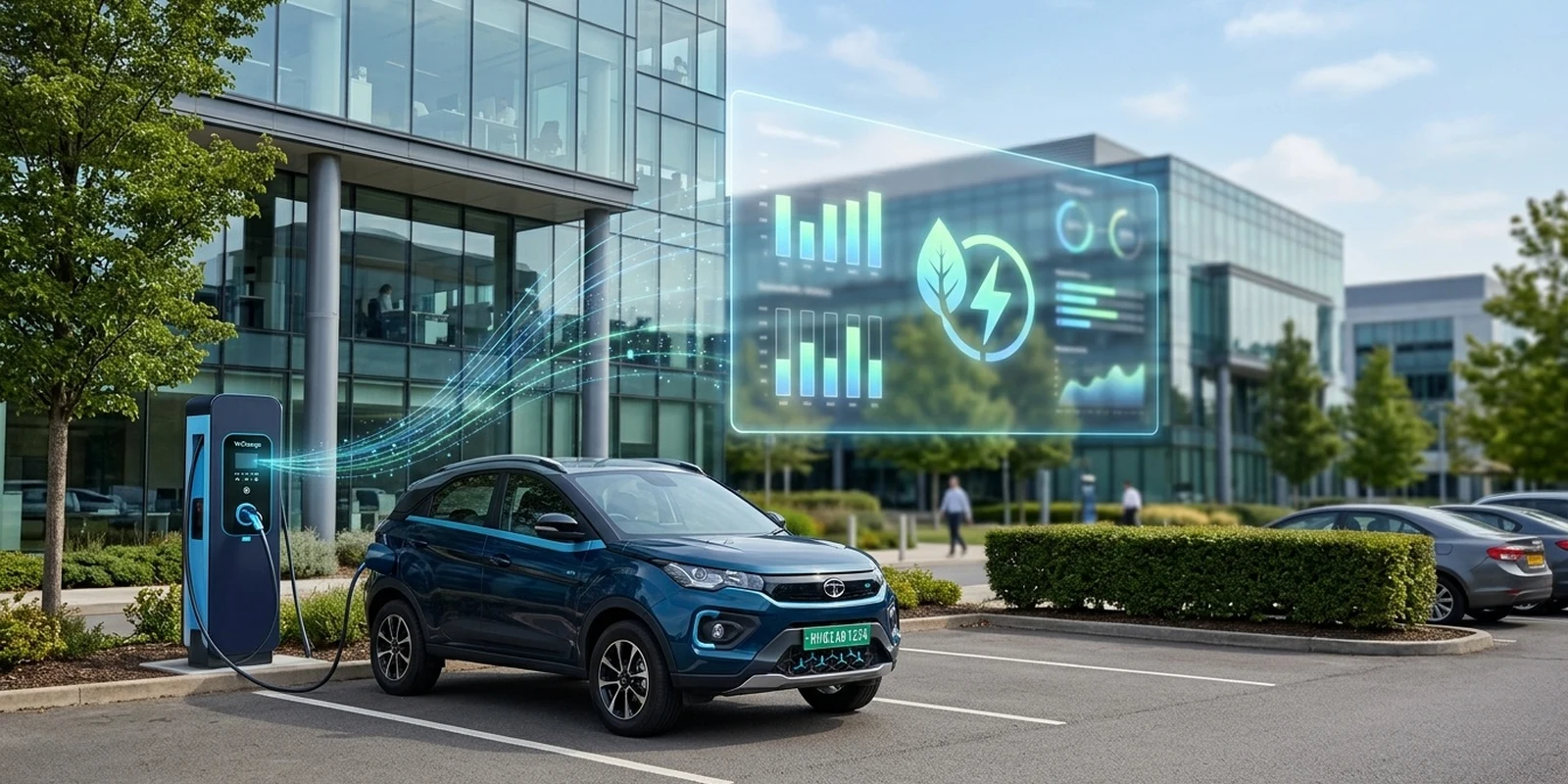
Turning Charging Data Into ESG-Ready Reporting
💡 EV Charging Sustainability Data Integration: Key Highlights
- India’s grid emission factor: 0.710 kgCO₂/kWh (FY2024-25, provisional CEA v21.0) — the number location-based Scope 2 reports must use, not zero.
- A 30 kWh session in India ≈ 21 kg CO₂e location-based — scale that across a fleet and it gets material fast.
- Charging data needs a GHG Protocol scope tag (1, 2, or 3) at capture, not reconstructed at audit time.
- BRSR Core and CSRD/ESRS E1 both expect session-level, auditable data — spreadsheet totals no longer pass muster.
- Written for enterprise fleet/real estate teams filing the numbers, and the CPOs/eMSPs generating them.
For enterprise fleet operators, corporate real estate teams, and the CPOs who run their charging infrastructure, EV charging sustainability data integration has gone from nice-to-have to compliance line item. As frameworks like India’s BRSR and the EU’s CSRD push more companies toward mandatory emissions disclosure, the real question isn’t whether charging data belongs in an ESG report — it’s how energy, emissions, and usage numbers move cleanly from a charger’s telemetry into a sustainability platform without a quarterly spreadsheet reconciliation.
This is written for two audiences reading the same problem from opposite sides of the table: enterprise fleet and real estate teams filing the numbers, and the CPOs and eMSPs whose platforms generate them. Both need the same three things — the right data, mapped to the right framework, moving through a pipe that doesn’t break every reporting cycle.
The Three Data Categories ESG Tools Actually Need
Most ESG platforms don’t care how many charging sessions happened last month — they care about three data categories, each in a specific shape.
Energy Consumed (kWh), Not Just Sessions Logged
The atomic unit is kWh delivered per session, with a timestamp, a site/charger ID, and increasingly a user or cost-centre tag. Without that, a reporting team can’t split charging between Scope 2 (a company-controlled site) and Scope 3 (home, customer site, roaming partner). “Total kWh for the quarter” isn’t reportable; session-level kWh with metadata is.
Emissions Avoided — Calculated, Never Assumed
Treating every charging kWh as “zero emissions” doesn’t survive an audit. Under the GHG Protocol’s Scope 2 guidance, electricity is reported location-based (actual grid intensity) and, where relevant, market-based (adjusted for RECs/PPAs). India’s CEA puts the FY2024-25 provisional grid factor at 0.710 kgCO₂/kWh — down from 0.727 — per its CO₂ Baseline Database, v21.0. A 30 kWh session is roughly 21 kg of CO₂e, location-based — defensible, not a rounding error to zero.
Usage Patterns — Peak/Off-Peak Mix
Grid intensity dips when solar peaks and rises during evening demand, so when a fleet charges affects the emissions number almost as much as how much it charges. ESG platforms increasingly want interval-level usage data, both for time-matched factors and for utilization/capacity-planning work.
Which Reporting Framework Is Actually Asking For This
Three overlapping frameworks drive most of the demand for clean charging data, depending on where the enterprise client is listed and how large it is.
India: SEBI’s BRSR and BRSR Core
BRSR is mandatory for India’s top 1,000 listed entities; BRSR Core adds intensity ratios plus value-chain reporting for suppliers/customers crossing 2% of purchases/sales individually, or 75% collectively. The top 250 entities began filing this from FY2024-25, though a March 2025 SEBI circular made it voluntary and deferred mandatory assurance, per CEEW’s analysis. A company’s own fleet still sits inside BRSR’s core scope regardless.
EU: CSRD and ESRS E1
CSRD applies to large companies (1,000+ employees, €450M+ turnover after the Dec-2025 Omnibus I amendment) from FY2025-26, requiring gross Scope 1, 2, and 3 emissions reported separately under ESRS E1, with no netting — a utility bill alone isn’t sufficient evidence.
Global: GHG Protocol and CDP
The GHG Protocol scope structure everything else builds on: owned combustion vehicles are Scope 1; electricity at a controlled charging site is Scope 2; charging away from company control — home, customer site, roaming partner — is Scope 3. CDP’s climate questionnaire uses this same structure, so the boundary decision pays off across every downstream disclosure.
How Charging Data Actually Reaches an ESG Platform
The pipe looks the same regardless of framework: charger telemetry lands in the CPO’s platform, gets normalised and exported (a scheduled feed or an API call), and is ingested by whichever carbon-accounting software the client runs — Persefoni, Workiva, IBM Envizi, SAP Sustainability Control Tower, Salesforce Net Zero Cloud. Emission factors apply at the ESG-platform layer; the resulting line items flow into whichever report is due.
What the CPO Side Needs to Expose
Session-level records — kWh, timestamp, site/charger ID, ideally a cost-centre tag — through an open API rather than a monthly invoice PDF. Stable identifiers matter: if a charger ID changes every hardware swap, the client’s emissions time series breaks.
What the Enterprise Side Needs to Normalize
Timezone alignment, a consistent map from charger/site IDs to the legal-entity structure used for CSRD/BRSR boundaries, and one documented location- vs. market-based choice applied consistently — switching methods mid-year for a better-looking number is what auditors flag first.
| Data point | Captured at | Feeds |
|---|---|---|
| kWh delivered per session | Charger/CMS telemetry | Scope 2/3 energy totals, BRSR & ESRS E1 energy metrics |
| Session timestamp (interval) | Charger/CMS telemetry | Location-based grid-intensity matching, peak/off-peak mix |
| Site/charger ID + ownership flag | CMS asset registry | Scope boundary assignment (1/2/3), CSRD entity consolidation |
| User/cost-centre tag | Fleet or access-control system | BRSR Core value-chain allocation, departmental emissions attribution |
| Grid emission factor applied | National grid database (e.g. CEA) | Location-based Scope 2 calculation |
| REC/PPA coverage | Energy procurement records | Market-based Scope 2 calculation |
What This Looks Like By Segment
Enterprise Fleet Operators
Charging data feeds fleet-electrification progress reporting and a Scope 1 vs. Scope 3 split depending on ownership and where the fleet charges. A 200-vehicle fleet averaging four 30 kWh sessions a week runs roughly 1.25 million kWh a year — about 886 tonnes of CO₂e location-based — and that figure has to reconcile against any diesel-baseline claim elsewhere in the same report. Structuring EV fleet charging management data correctly at the source is what makes that reconciliation possible.
CPOs and eMSPs Serving Enterprise Clients
Handing an enterprise client clean, framework-ready data is becoming a retention lever, not a back-office chore. EV charging management software that already captures session-level energy and site data has most of the raw material an ESG export needs — the gap is usually just exposing it through a documented feed instead of a monthly PDF.
Real Estate and Retail Site Hosts
Tenant or visitor charging typically lands in Scope 3 for the property owner, but green-lease clauses increasingly require hosts to supply that usage data for tenants’ own disclosures — a site that can’t produce it on request is a lease-negotiation liability.
Where These Numbers Usually Go Wrong
Three mistakes account for most of the audit queries an enterprise sustainability team gets on charging data:
| Mistake | Why it fails audit |
|---|---|
| Mixing location-based and market-based figures without labelling which is which | A site with a renewable PPA can post a near-zero market-based number and a very real location-based one at once — both are correct only if the report says which method produced which figure. |
| Treating every charging kWh as zero emissions | Charging is cleaner than the tailpipe alternative, but “cleaner” and “zero” aren’t the same claim. The defensible number is always grid emission factor × kWh, not an assumption. |
| Not assigning a scope at the point of capture | Deciding after the fact whether a session was Scope 2 or 3 means re-deriving ownership and location context for every historical record — expensive and exactly what a good data pipeline should eliminate. |
Building EV Charging Sustainability Data Integration Without Reinventing ESG Software
None of this requires a CPO or an enterprise fleet team to build their own carbon-accounting software — that space is already crowded with dedicated ESG platforms doing the framework-mapping and assurance-ready reporting. What it requires is a charging layer that captures the right data at the right granularity and gets out of the way through an open, documented API for pulling session-level charging records, instead of locking energy and usage data inside a dashboard that only exports monthly PDFs. A charging management system sits upstream of every one of these frameworks — it’s the system of record for the kWh, timestamp, and site metadata that a BRSR filing, a CSRD disclosure, or a CDP response ultimately traces back to. Getting that foundation right once is cheaper than a data-reconciliation project every filing season.
Frequently Asked Questions
Session-level kWh delivered, a timestamp, and a site/charger ID — ideally with a user or cost-centre tag. Monthly totals aren’t granular enough to map to a GHG Protocol scope.
No. Location-based Scope 2 carries the local grid’s intensity — 0.710 kgCO₂/kWh in India for FY2024-25. Only a market-based method backed by RECs or a PPA brings it near zero, reported separately.
Depends on who controls the site. Electricity at a company-controlled charger is Scope 2. Charging at an employee’s home, a customer site, or a roaming partner’s network is Scope 3.
Yes, for a company’s own fleet and sites — BRSR is mandatory for India’s top 1,000 listed entities. Value-chain (supplier/customer) reporting under BRSR Core is currently voluntary after SEBI’s March 2025 circular.
Companies in scope (1,000+ employees, €450M+ turnover from FY2025-26) must report gross Scope 1, 2, and 3 emissions under ESRS E1, no netting. EU fleet or site charging data needs to be granular and auditable enough to support that.
Sources: Central Electricity Authority — CO₂ Baseline Database v21.0 | GHG Protocol — Scope 2 Standard | CEEW — Value-Chain Emissions Reporting Analysis | SEBI — BRSR Circular
Give Enterprise Clients ESG-Ready Charging Data
YoCharge captures session-level energy, emissions, and usage data at the source, so your enterprise fleet and real estate clients can feed it straight into their sustainability reporting stack instead of chasing spreadsheets every quarter.