
On 28th June 2025, the Ministry of Power, Government of India announced the launch of a task force to conceive the India Energy Stack (IES) — a unified digital infrastructure designed to catalyze India’s transition to a sustainable, efficient, and intelligent energy ecosystem.
The India Energy Stack builds upon the Smart Grid Observatory (SGO), which was started in 2023 under the India–EU Clean Energy and Climate Partnership (EU-CECP) and is now being spearheaded by the Ministry of Power.
🔑 Key Highlights at a Glance
- Announced on 28th June 2025 by the Ministry of Power, Government of India
- Task force chaired by Dr. Ram Sewak Sharma with Nandan Nilekani as Chief Mentor
- Inspired by India’s DPI success — Aadhaar, UPI & DigiLocker
- 12-month Proof of Concept piloting with DISCOMs in Mumbai, Gujarat & Delhi
- Followed by a national rollout blueprint to scale across India
Background
India’s energy sector is undergoing rapid transformation to meet the demands of economic growth, rising renewable energy integration, and its Net Zero commitments by 2070. However, several deep-rooted structural challenges continue to hinder efficient grid management and innovation.
⚠️ The Core Challenges
- Fragmented digital systems with poor interoperability across DISCOMs
- No unique identifiers for assets, consumers, or energy transactions
- Limited scalability — existing tools like SCADA and Smart Meters weren’t designed with interoperability in mind
- No cross-regional communication between integrated systems
- Restricted Demand-Side Management despite availability of machine-readable data
Unlike financial infrastructure (e.g., NPCI’s UPI), the energy sector lacks standardised platforms for seamless integration and cross-DISCOM transactions. These challenges collectively point to a fundamental need for a unified digital architecture — one built on a Digital Public Infrastructure (DPI) approach that has already proven transformative in other sectors of India’s digital economy.
What is the India Energy Stack?
Inspired by the success of India’s Digital Public Infrastructure (DPI) like Aadhaar, UPI, and DigiLocker, the Energy Stack aims to create a modular, open, and interoperable digital framework that accelerates innovation and stakeholder collaboration across the energy sector.
The India Energy Stack Enables:
📊 Seamless Data Exchange
Between consumers, utilities, grid operators, EV players, and energy service providers.
🔋 Decentralized Energy Management
Including rooftop solar, EV charging, battery storage, and smart metering.
🏪 Market Access for All
Democratizing energy trading, retailing, and billing for every stakeholder.
💡 Innovation Enablement
Through open APIs and public data registries that startups and developers can leverage.
What IES Offers
The Ministry of Power is reimagining the digital backbone for India’s power sector through a Digital Public Infrastructure (DPI) approach. At its core, the India Energy Stack provides:
- 🪪 Unique IDs for consumers, assets, and transactions
- 🔌 Open APIs for seamless system integration
- ⚡ Real-time, consent-based data sharing
- 🛠️ Plug & Play Tools for consumer empowerment, market access, and innovation
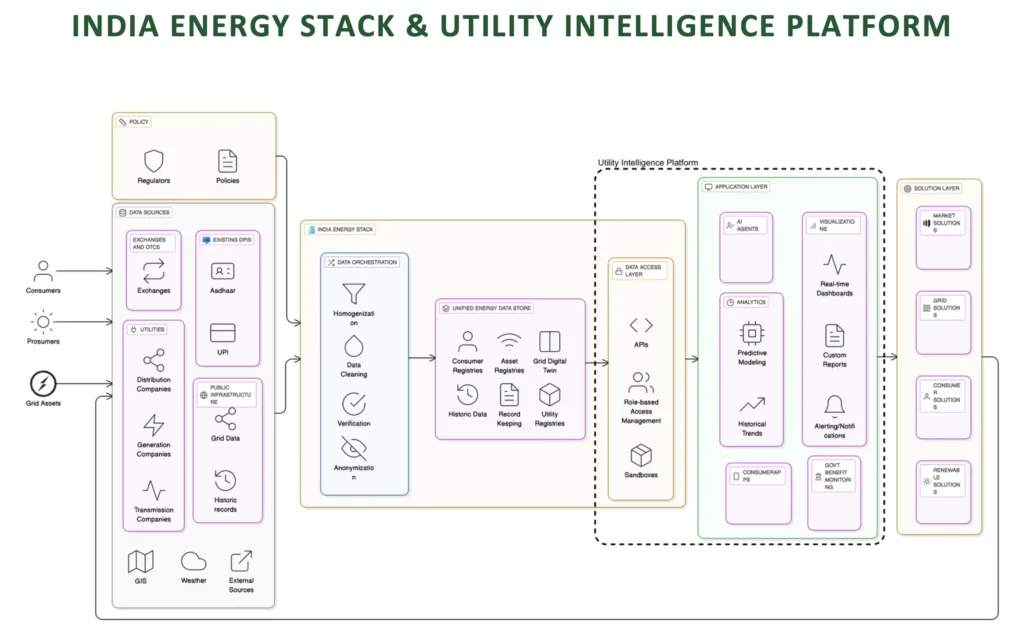
The 3 Core Layers of IES
The India Energy Stack operates through three interconnected layers, each building on the one below:
🟢 Layer 1 — Base Data Layer
Registries, unique identifiers, and secure data flows — the foundational infrastructure of the stack.
🔵 Layer 2 — Services Layer
Open APIs, consent architecture, and interoperability protocols that connect all participants.
🔴 Layer 3 — Applications Layer
Platforms like the Utility Intelligence Platform (UIP) for real-time analytics, simulations, and consumer-facing apps.
IES vs Aadhaar & UPI
The proposed India Energy Stack (IES) aims to do for the power sector what Aadhaar did for identity, and UPI for finance. Prior to Aadhaar, digital identities were fragmented — catering only to specific functions like driving or paying taxes. As a foundational identity system, Aadhaar established a standardised, verifiable, and interoperable identity infrastructure, paving the way for seamless verification of identity and address.
Aadhaar facilitated interoperability through its Proof of Identity (PoI) and Proof of Address (PoA) APIs, supporting scalable platforms like DigiLocker, FASTag, DigiYatra, and UPI through standardised digital infrastructure. Similarly, IES will enable standardised APIs for seamless integration, cross-state energy transactions, and innovation — unlocking possibilities like energy fintech, virtual power plants, and peer-to-peer trading.
How IES Mirrors UPI
| UPI Component | IES Equivalent | Role |
|---|---|---|
| UPI-ID | Virtual Energy Identification (VEI-ID) | Unique identifier for energy consumers & assets |
| Bank Account with Banks | Consumer A/c with DISCOMs | Primary account holder |
| Banks | DISCOMs | Core infrastructure providers |
| Participation Apps (PayTM, PhonePe) | YoCharge & other EV platforms | Consumer-facing apps & services |
| NPCI | Ministry of Power / IES Authority | Standards body & oversight |
What’s Next
🏛️ Step 1 — Task Force Constituted
The Ministry of Power has constituted a dedicated Task Force comprising experts to steer the development of the India Energy Stack. The task force is chaired by Dr. Ram Sewak Sharma, with Nandan Nilekani as Chief Mentor.
🧪 Step 2 — 12-Month Proof of Concept
The Ministry will undertake a 12-month Proof of Concept (PoC) to demonstrate IES through real-world use cases in partnership with selected utilities. This includes piloting the Utility Intelligence Platform (UIP) — a modular, analytics-driven application built on IES to support utilities, policymakers, and consumers with real-time insights and smarter energy management. Pilot testing will be carried out with DISCOMs in Mumbai, Gujarat, and Delhi.
🗺️ Step 3 — National Rollout Blueprint
Following the PoC, a national rollout blueprint and capacity-building program will be launched to scale the India Energy Stack across the entire country.
YoCharge × India Energy Stack
As the India Energy Stack takes shape, YoCharge is positioned as a foundational digital layer — empowering CPOs, enabling eMSPs, integrating with DISCOMs, and unlocking access to clean, affordable energy for millions of EV users across India.
With the Energy Stack, India is not just digitizing energy — it is reimagining its future. At YoCharge, we’re honored to contribute to this transformation as an active stakeholder in building this stack.
The Future of Energy Is
⚡
Electric
🔗
Connected
🧠
Intelligent
🌍
Open for All
The future of Energy is both Digital & Green.
Join us in building it.