
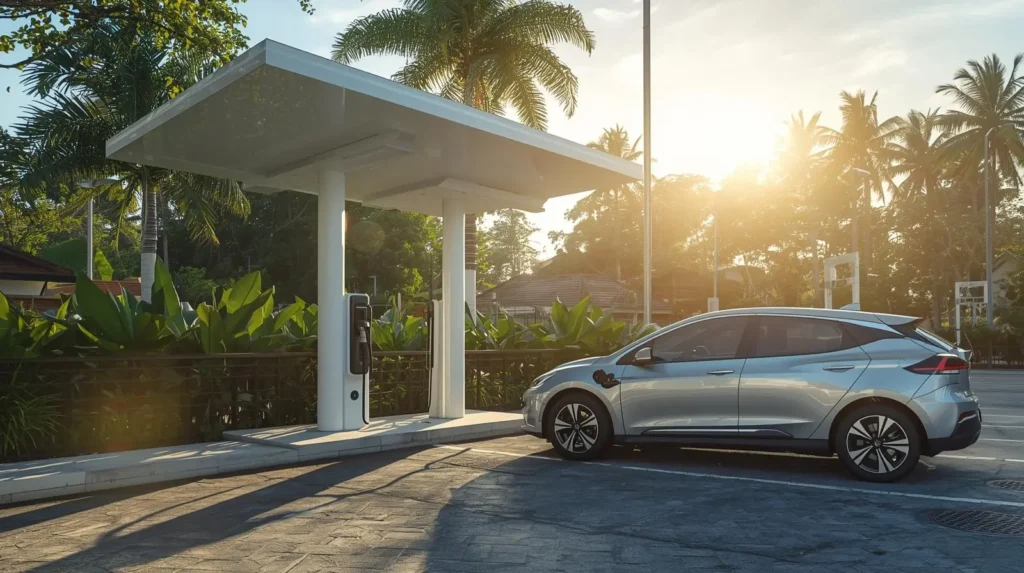
SPKLU tariff & Service fee are the most important determinants of success for your EV Charging Business in Indonesia. The Ministry of Energy & Mineral Resources (ESDM) is the nodal ministry for regulation of EV Charging Business in Indonesia, and has periodically introduced regulations to accelerate charging infrastructure and catalyse EV transition.
Since 2013, the Indonesian government has been introducing incentives to support xEVs (BEVs, PHEVs, and HEVs) through the Low Carbon Emission Vehicle (LCEV) program and Presidential Regulation No. 55/2019, which aims to develop an end-to-end EV supply chain. The Ministry of Industry Regulation No. 6/2022 sets a national target of 600K battery electric four-wheelers (e4Ws) and 2.45 million e2Ws by 2030.
According to ESDM data, approximately 11 million cars currently on Indonesian roads generate over 35 million tons of carbon emissions annually — accounting for 70–80% of urban emissions.
🔑 Key Highlights
- SPKLU tariff = Energy Charge (kWh) + Service Fee (per session)
- Max energy tariff: Rp 2,466.78/kWh (PLN L-tariff × factor 1.5)
- Max service fee: Rp 25,000/session (Fast) & Rp 57,000/session (Ultra-Fast)
- Governed by Permen ESDM No. 1/2023 & Kepmen ESDM No. 182.K/2023
- Slow & Medium chargers: no service fee allowed
- VAT (PPN) applies on top of stated maxima
EV Charging Infrastructure in Indonesia
EV Charging Infrastructure in Indonesia comes under two broad categories. Charging technology at SPKLU for four-wheeled vehicles includes:
- ⚡ Slow charging
- ⚡⚡ Medium charging
- ⚡⚡⚡ Fast charging
- ⚡⚡⚡⚡ Ultra-fast charging
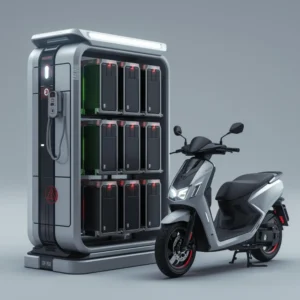
SPBKLU
Stasiun Penukaran Baterai Kendaraan Listrik Umum
Battery Swapping Station
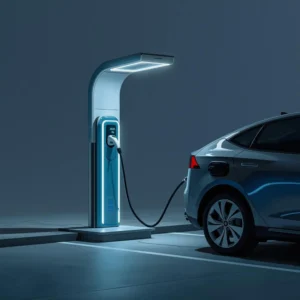
SPKLU
Stasiun Pengisian Kendaraan Listrik Umum
Electric Vehicle Charging Station
SPKLU Tariff Regulations
Two key regulations form the legal backbone of SPKLU pricing in Indonesia:
📋 Permen ESDM No. 1/2023
Amends Permen 13/2020. Frames the SPKLU business model, charging technologies, and tariff basis. This is the umbrella regulation for all SPKLU pricing. Notably, no service fee applies to Slow/Medium chargers or 2/3-wheel charging.
📋 Kepmen ESDM No. 182.K/TL.04/MEM.S/2023
Sets the maximum (ceiling) service fee per charging session for Fast & Ultra-fast SPKLU and defines key implementation rules for business entities.
SPKLU Tariff Structure in Indonesia
The SPKLU charging tariff in Indonesia is structured as a two-part formula:
Total Charge = Energy Fee (Rp/kWh) + Service Fee (per session) + VAT
A. Per kWh Energy Fee
The electricity tariff applied for charging at SPKLU is the special service purposes tariff (L) with a multiplier factor of N of up to 1.5, resulting in a maximum energy rate of Rp 2,466.78/kWh. This is the cost of purchasing electricity (energy charge) and applies uniformly across all SPKLU types.
B. Service Fee (Per Session)
The service fee is an incentive for SPKLU Business Entities to continue developing fast and ultra-fast charging stations. According to Kepmen ESDM No. 182.K/2023, the maximum allowable service fees are:
| Charger Type | Power Rating | Max Service Fee (per kWh) | Max Service Fee Per Session |
|---|---|---|---|
| Slow / Medium Charger | < 22 kW | — | No service fee |
| Fast Charger | 22–50 kW | Rp 933.22 | Rp 25,000 |
| Ultra-Fast Charger | > 50 kW | Rp 1,133.22 | Rp 57,000 |
Frequently Asked Questions
❓ What does this mean for my business?
Your applicable service fee depends on both your Station Power Rating (kW) and your business strategy. As per ESDM No. 1/2023, there are limits to both the maximum overall service fee per session and the maximum service fee per unit — you can set any rate within these bounds.
❓ Is the SPKLU tariff fixed in Indonesia?
No. While the regulatory ceilings are fixed, each business entity is free to set their own rate within the applicable range. Example: Two businesses both operating a 30 kW Fast Charger must stay within Rp 933.22/kWh and Rp 25,000/session. Business A charges Rp 500/kWh → can bill up to 50 units per session. Business B charges Rp 250/kWh → can bill up to 100 units per session.
❓ How should I decide my SPKLU service fee?
Look at the average kWh delivered per session on your charger and set your per-unit fee accordingly. Example: If your 30 kW charger delivers an average of 50 units per session, setting Rp 500/kWh as the service fee keeps you within the Rp 25,000/session ceiling while maximising revenue per session.
How to Set Up EV Charging Tariff in Your EV-CMS Platform
In the white-labelled EV-CMS platform by YoCharge, EV Charging Tariffs are managed through the Tariff Module. Follow these steps to configure an ESDM-compliant tariff:
✅ Step 1 — Go to Tariff Management

Navigate to the Tariff Management module under Charger Management in your EV-CMS dashboard.
✅ Step 2 — Add Base Tariff (Energy Charge)
As per Permen ESDM No. 1/2023, the PLN electricity tariff is Rp 2,466.78/kWh. Set the tariff name (e.g. “Electricity Tariff”), select type Energy from the dropdown, and enter 2466.78 as the rate. Your base electricity tariff is now set.
✅ Step 3 — Add Service Fee
In the additional tariff elements, select kWh element. Name it “Service Fee”, set the type to Energy, and enter your chosen per-unit rate. Set Min kWh = 0 and calculate Max kWh based on your rate and session ceiling.
Example: 30 kW Fast Charger, Service Fee = Rp 500/kWh → Max kWh = 25,000 ÷ 500 = 50 units.
How YoCharge Keeps Your Business Compliant
At YoCharge, we believe the future of transportation is electric. Our white-label EV-CMS platform helps Charging Business Entities in Indonesia build their brand while staying fully compliant with ESDM policies.
We don’t set your business model or SPKLU tariff — but we ensure your operations stay compliant and reliable for your EV users.
- ✅ Custom branded EV-CMS platform
- ✅ ESDM-compliant SPKLU tariff structure
- ✅ Deep integration with ESDM Gatrik portal — stations sync automatically, no duplicate entry needed
YoCharge is deeply integrated with the ESDM Gatrik portal, meaning your platform is Day 0 compliant — session data and station information auto-sync between your YoCharge EV-CMS and Gatrik.
Ready to Launch Your SPKLU Business in Indonesia?
Talk to our Indonesia EV Charging experts. Get a platform that is ESDM-compliant from Day 1.
The SPKLU tariff service fee regulations in Indonesia represent a comprehensive approach to developing sustainable EV charging infrastructure. Through carefully structured pricing mechanisms, business incentives, and technical standards, the government aims to achieve its target of 24,720 SPKLU units by 2030 while ensuring economic viability for operators and affordable access for consumers. The regulatory framework continues to evolve to address market needs and technological advances in Indonesia’s rapidly growing EV sector.
Sources
- Kepmen ESDM No. 182.K/TL.04/MEM.S/2023 — Official PDF: ceilings, VAT note, evaluation cycle, transparency & reporting.
- Permen ESDM No. 1/2023 — Official release: scope, technologies, no service fee for Slow/Medium & 2/3-wheel charging.
- MoEMR News Release (31 Jul 2023) — Source: plain-language explanation of energy-tariff basis (L × N) and service-fee ceilings.