
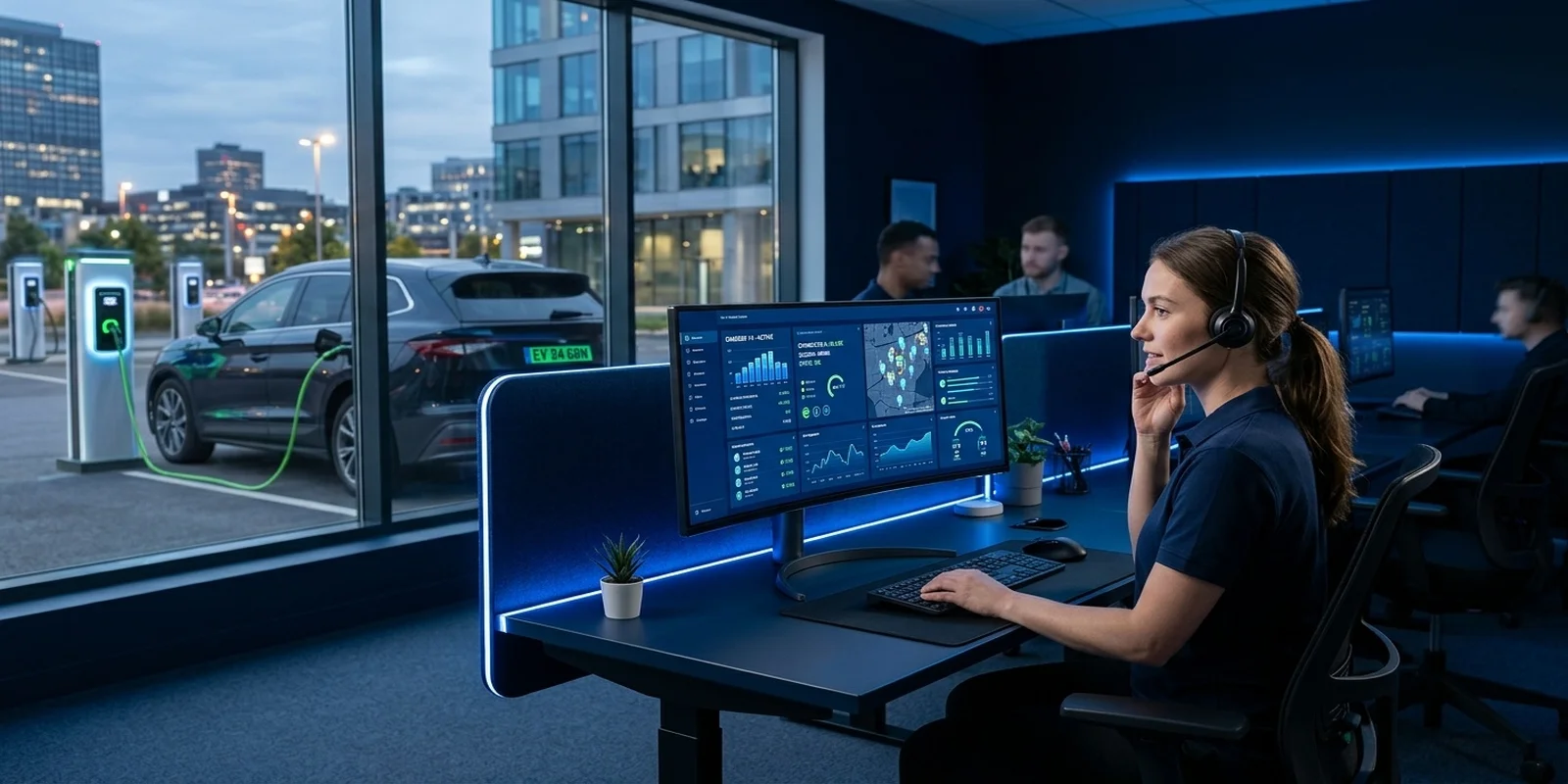
EV Charging Customer Support: Running A Driver Helpdesk That Scales
💡 EV Charging Customer Support: Key Highlights
- Over a third of driver helpline calls are about sessions that will not start, according to Fuuse data from 72,329 calls handled in one year.
- The AA reports 95% of EV charging issues can be resolved with a phone call, making remote resolution the single biggest cost lever for operators.
- The UK Public Charge Point Regulations 2023 require every public charge point operator to provide a free, staffed, 24/7 helpline via an 0800 number.
- US NEVI-funded stations must provide a mechanism for drivers to report outages and malfunctions, with multilingual and ADA-compliant access.
- Four helpdesk models exist — in-house, outsourced 24/7, eMSP-provided and hardware OEM — and who owns L1, L2 and L3 differs in each.
EV charging customer support is what happens after the charger is installed, the app is live and the first driver taps a connector that does not respond. For CPOs and eMSPs running networks of any size, the reactive helpdesk — the team that answers when something goes wrong mid-session — is simultaneously the most visible and most neglected function in the business. Proactive downtime communication and remote monitoring reduce the volume of calls that reach this desk, but they do not eliminate it. This post covers what remains: the driver is at the charger, something has gone wrong, and someone needs to fix it now.
What Drivers Contact Support About
Driver calls follow a narrow distribution. Fuuse analysed 72,329 helpline calls over its first year of operation and found that 36% were about a session that would not start, 14% about a session that would not end, 9% about pre-authorisation queries, and 7% about a physically stuck charging cable. Half of all contacts were therefore about starting or stopping a charge — the two most basic actions a charger performs.
The pattern is consistent with The AA’s EV Recharge Report (January 2025), which found that one in six calls (17%) were about digital queries — app login, account setup, pre-authorisation confusion — rather than infrastructure faults. A further 7% were pricing queries. These contact reasons cluster into six categories that any helpdesk must be built to handle:
| Category | Typical Driver Query |
|---|---|
| Session will not start | Tapped my card/app but charger shows no response, authorisation timeout, QR code not scanning |
| Payment or refund | Charged twice, pre-auth hold not released, invoice missing, refund not received |
| RFID or app login | RFID card not recognised, cannot log in, app crashes on session start |
| Connector stuck or locked | Cable locked after session ended, connector latch jammed, emergency release needed |
| Overstay or idle-fee dispute | Billed for overstay while still charging, idle fee applied before grace period ended |
| Roaming session not recognised | Started session via a different network’s app, session does not appear in CPO’s system |
Four EV Charging Customer Support Models
How a CPO or eMSP staffs its helpdesk depends on network size, geography and whether the operator is the brand the driver sees. The four models below are not mutually exclusive — most operators combine two or three of them, splitting ownership by issue tier.
| Model | L1 (First Contact) | L2 (Back-Office / Remote Fix) | L3 (Field / Hardware) |
|---|---|---|---|
| In-house desk | Own agents | Own agents with OCPP access | Own field team or contracted installer |
| Outsourced 24/7 contact centre | BPO partner | CPO’s platform team (escalation) | Contracted installer or OEM |
| eMSP-provided support | eMSP’s desk (branded) | Platform provider’s team (via API) | CPO or OEM |
| Hardware OEM | Not applicable (escalation only) | Not applicable | OEM warranty / field service |
In-House Desk
Works when the CPO is large enough to justify dedicated headcount. The advantage is direct access to the charging management platform — agents can look up connector status, restart sessions and issue refunds without an escalation handoff. The disadvantage is covering 24/7 in markets where regulations require it.
Outsourced 24/7 Contact Centre
A BPO partner handles L1 triage around the clock. The BPO’s agents work from scripts and from a view of the CPO’s platform. Anything they cannot resolve — a stuck connector that needs a remote OCPP reset, a refund above a threshold — escalates to the CPO’s own L2 team. This is the dominant model for mid-size operators who need round-the-clock coverage without the fixed cost of an in-house night shift.
eMSP-Provided Support
In a white-label arrangement, the eMSP — or the platform provider behind it — takes the driver-facing call. The contract between the eMSP and the CPO defines who owns L1 and who owns L2. The driver never sees the CPO’s brand; the eMSP’s desk is the brand. This model works well for site hosts (workplaces, fuel retailers, retail venues) who want charging without operating a helpdesk themselves.
Hardware OEM
The charger manufacturer’s field-service team is not a helpdesk model in its own right — drivers do not call the OEM. But the OEM owns L3 for hardware faults under warranty: a failed power module, a broken actuator on a CCS connector latch, a mainboard replacement. The CPO’s or eMSP’s desk triages the call, determines the fault is hardware, and raises a field ticket to the OEM or its contracted installer.
What The Agent Must Do From The Back Office
The helpdesk agent’s value is not empathy on the phone — it is what they can actually do from a screen. An agent with remote charging management access can resolve the majority of driver issues without dispatching a technician. The AA’s data bears this out: 95% of EV charging issues can be resolved with a phone call, according to their January 2025 EV Recharge Report.
That resolution rate depends on the agent having the right tools. The minimum capability set is:
- Live connector status — see whether a connector is available, occupied, faulted or offline, in real time, without waiting for the driver to describe what the screen shows.
- Remote start and stop — trigger a charging session on behalf of a driver whose app or RFID failed to authorise. This alone resolves the single largest call category (session will not start).
- Unlock connector and reset over OCPP — send an UnlockConnector or Reset command to release a stuck cable or clear a software fault without a site visit.
- Session and payment lookup — find the driver’s transaction by time, connector or account, check the energy delivered and the amount billed, and identify mismatches.
- Issue a refund or credit — process a refund directly from the payment and billing software, within policy limits, on the same call.
- Raise a field ticket — when the fault is hardware (a blown fuse, a damaged connector, a communication board failure), create a maintenance ticket routed to the OEM or installer with the charger’s location, fault code and OCPP diagnostics attached.
Remote resolution is the main cost lever in EV charging customer support. Fuuse reported a 98% resolution rate within 2.5 minutes and an average answer time of 24 seconds across its 72,329-call data set. Each call resolved remotely is a field visit avoided — and a field visit to a public charging site typically costs multiples of what the helpdesk call costs, before accounting for the downtime revenue lost while the charger sits offline waiting for a technician.
Helpdesk Integration: Tickets, Faults And Driver Contacts In One Queue
The worst version of EV charging customer support is a helpdesk that runs on a separate system from the charger platform — the agent takes a call, then switches to a different screen to look up the charger, then switches back to log the ticket. The fix is integration: faults raised by the charger itself (via OCPP StatusNotification) and contacts initiated by the driver land in the same ticketing queue, with the charger’s identity, status and recent session history already attached.
The standard helpdesk platforms — Freshdesk, Zoho Desk, Salesforce Service Cloud and Jira Service Management — all support this through API-based ticket creation. A charging platform with an open API pushes charger faults and driver-reported issues into the helpdesk as structured tickets, so the agent sees everything in one place. Voltana, YoCharge’s AI assistant, supports integrations with Freshdesk, Zoho, Salesforce and Jira, routing tickets from charger events and driver contacts into whichever system the operator already uses.
The integration also works in reverse: when an agent resolves a ticket by sending a remote OCPP command, the resolution is logged against the ticket automatically, closing the loop without manual status updates.
AI And Self-Service Deflection
A meaningful share of helpline volume is not about a broken charger — it is about a confused driver. The AA’s data shows 17% of calls are digital queries (app login, account setup) and 7% are pricing queries. These are deflectable: the driver does not need a human agent, they need an answer.
Chat, WhatsApp and voice assistants handle the repeat questions — “how do I start a session”, “why was I charged twice”, “where is my nearest available charger” — and free the human desk for the calls that require platform access. AI integrations in EV charging software now extend beyond chat deflection into automated fault triage: the system reads the OCPP fault code, matches it against known resolution patterns, and either resolves it autonomously (a soft reset) or routes it to the right human queue (L2 for software, L3 for hardware) with the diagnosis already attached.
Self-service also means the app itself. A well-built driver app shows real-time connector status, provides a “report a problem” flow that creates a structured ticket (rather than a free-text email), and lets the driver request a remote start without calling anyone. Every interaction the app absorbs is a call the helpdesk does not take.
SLAs And KPIs That Matter
Running EV charging customer support without measuring it is running it blind. The metrics that matter for a charging helpdesk are operational, not satisfaction-survey scores:
| Metric | What It Measures | Why It Matters |
|---|---|---|
| Time to answer | Seconds from call connect to agent pickup | Drivers are standing at a charger, often in poor weather. 24 seconds is the benchmark Fuuse achieved. |
| Time to restore | Minutes from first contact to charger back in service | Directly determines lost-revenue duration per incident. |
| First-contact resolution (FCR) | % of issues resolved on the first call without escalation | High FCR means the agent has the right platform access and authority. |
| Remote-resolution rate | % of issues resolved without dispatching a field technician | The main cost lever. 95% remote resolution (The AA) means only 1 in 20 calls generates a site visit. |
| Refund cycle time | Hours from driver request to refund processed | Slow refunds generate repeat calls, social media complaints and regulatory attention. |
The Regulatory Floor: Where Customer Support Is Mandatory
In some markets, EV charging customer support is not a business decision — it is a legal obligation. Two regulations set the clearest floor:
UK: Public Charge Point Regulations 2023
The UK Public Charge Point Regulations 2023 (SI 2023/1168, in force 24 November 2023) require every public charge point operator to provide a staffed telephone helpline that is free to call, available 24 hours a day, every day of the year. “Free to call” means an 0800 number — 0300 numbers or local-rate numbers do not comply. A voicemail facility does not fulfil the requirement; the helpline must offer real-time assistance. The operator must display the helpline number prominently on or near every public charge point it operates.
US: NEVI Minimum Standards (23 CFR Part 680)
The NEVI minimum standards (23 CFR Part 680, final rule 28 February 2023) require that EV charging customers have a mechanism to report outages, malfunctions and other issues with charging infrastructure. FHWA does not prescribe the specific method — it could be a hotline, an in-app form or an on-site kiosk — but the reporting mechanism must be multilingual and compliant with the Americans with Disabilities Act. NEVI-funded stations must also provide an automated toll-free phone number or SMS for payment, and must meet a 97% uptime standard, which indirectly drives the need for responsive support to restore faulted chargers quickly.
Operators running networks across multiple jurisdictions need a helpdesk architecture that can meet the strictest applicable regulation. In practice, that means 24/7 staffed coverage with a free-to-call number, multilingual capability, and documented response times — which is also what a well-run helpdesk looks like regardless of regulation.
A charging management platform like YoCharge gives the helpdesk the operational layer it needs: live connector status, remote OCPP commands, session and payment data, and API-based ticket routing into the operator’s existing helpdesk system — so the support function scales with the network rather than scaling headcount linearly with charger count.
Frequently Asked Questions
Sessions that will not start. Fuuse data from 72,329 calls shows 36% of all helpline contacts are about a charging session that failed to initiate, often due to authorisation timeouts, app errors or RFID failures.
Yes. The AA’s January 2025 EV Recharge Report found that 95% of EV charging issues can be resolved with a phone call, using remote OCPP commands such as RemoteStartTransaction, UnlockConnector and Reset.
Yes. The UK Public Charge Point Regulations 2023 (SI 2023/1168) require every public charge point operator to provide a free, staffed helpline available 24 hours a day, 365 days a year, via an 0800 number. The number must be displayed on or near the charge point.
At minimum: live connector status, remote start/stop, connector unlock and charger reset over OCPP, session and payment lookup, the ability to issue refunds, and a field-ticket system for hardware faults that require a technician.
AI-powered chat, WhatsApp and voice assistants handle repeat questions about app login, pricing and session status — queries that account for roughly a quarter of helpline volume. AI can also automate fault triage, reading OCPP fault codes and either resolving known faults (soft resets) or routing the ticket to the correct human queue with the diagnosis attached.
Sources: Fuuse — EV Driver Support: Reasons for Calls (2026) | The AA — EV Recharge Report (January 2025) | UK Public Charge Point Regulations 2023 (SI 2023/1168) | US NEVI Final Rule — 23 CFR Part 680 (February 2023)
Researched and drafted with AI assistance; facts checked against the sources linked above and reviewed by the YoCharge team.
Build A Support Function That Scales With Your Network
See how YoCharge gives your helpdesk live connector status, remote OCPP commands and API-based ticket routing — without adding headcount.
What happens next ?
Support audit & gap analysis
Custom helpdesk integration plan
Remote-resolution cost analysis
Ongoing platform support & scaling