
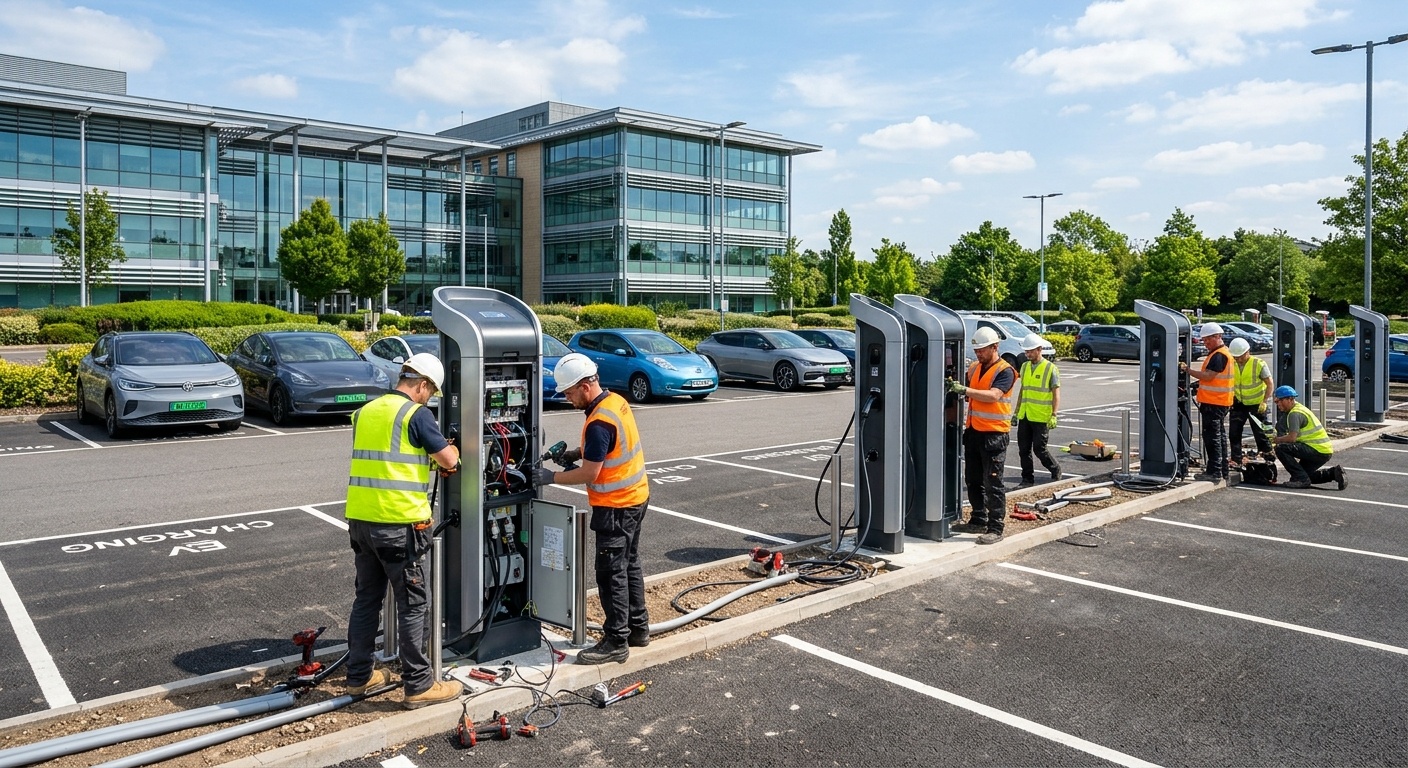
Choosing An EV Charging Installation Company
💡 EV Charging Installation Companies: Key Highlights
- Three delivery models exist: electrician-only, installer plus separate software, or full-service provider covering hardware, installation, software and maintenance under one contract.
- Credentials vary by region: UK requires OZEV-authorised installers and BS 7671 compliance; the US requires state-licensed electricians, NEC Article 625 compliance and EVITP certification; India requires a licensed electrical contractor and CEA safety regulation compliance.
- Twelve questions every commercial buyer should ask before signing, covering site surveys, OCPP compliance, backend credentials, maintenance scope and exit terms.
- Red flags to watch: chargers locked to closed proprietary software, no OCPP support, no handover of backend admin credentials, and site surveys quoted after the price is fixed.
- Installation is not the finish line: ongoing operation and maintenance must be contractually defined before go-live, not negotiated afterwards.
Choosing the right EV charging installation company determines whether a commercial site ends up with chargers that work, earn revenue and scale — or hardware that underperforms from day one. The difference lies in the delivery model, the credentials behind the installation, and the contract terms that govern what happens after the chargers go live.
This guide walks property owners, facility managers and fleet site operators through the three delivery models available in the market, the professional credentials to verify by region, a structured set of questions to put to any installer before signing, and the contract red flags that signal problems ahead.
Three Delivery Models For Commercial EV Charging Installation
Not every EV charging installation company offers the same scope. The market has settled into three distinct delivery models, each with different risk profiles for the site owner.
Electrician Or EPC Contractor Only
The site owner procures chargers independently, selects a separate software platform, and hires a licensed electrician or electrical EPC contractor to handle the physical installation: cabling, distribution boards, mounting, earthing and testing. The owner retains full control over hardware choice, software selection and ongoing operations, but also carries the full coordination burden. This model works when the owner already has the technical knowledge to specify equipment and manage multiple vendors.
Installer Plus Separate Charging Software
A specialist EV charging installer supplies and installs the hardware, but the site owner chooses and contracts a separate charging management platform for session control, payments, monitoring and reporting. The installer handles everything physical — from the site survey to commissioning — while the software vendor handles everything digital. The two contracts are independent, which means the owner can switch either party without being locked in, provided the chargers use an open protocol like OCPP.
Full-Service Provider: Hardware, Installation, Software And Maintenance Under One Contract
A single provider delivers the complete package: hardware supply, installation, charging management software and ongoing maintenance, often on a long-term build, operate and maintain contract. YoCharge, for example, enables this through partner CPOs who deliver hardware, installation and maintenance on build, operate and maintain contracts of up to seven years. Site owners who already have chargers can also bring their own OCPP-compliant hardware and run it on YoCharge’s charging management platform.
This model removes the coordination risk entirely. The provider is accountable for the whole system working, and the site owner deals with one contract, one support channel and one SLA.
Professional Credentials To Verify Before Hiring
Electrical work on commercial sites is regulated. The specific credentials vary by region, but the principle is universal: anyone installing EV charging equipment at a commercial property must hold the registrations and certifications that apply in that jurisdiction. Asking for proof is standard practice, not an insult.
United Kingdom
Installers working on OZEV grant-funded projects must be OZEV-authorised, which requires membership of a Competent Person Scheme such as NAPIT, NICEIC or ECA. All EV charging installations must comply with BS 7671 (the IET Wiring Regulations), and the installer must issue a BS 7671 Electrical Installation Certificate on completion. The installer must also notify the Distribution Network Operator in writing.
United States
Electricians must hold a valid state licence. The National Electrical Code (NFPA 70) Article 625 governs EV charging equipment installation, covering branch circuit sizing, overcurrent protection, ground-fault circuit-interrupter protection and equipment mounting heights. The Electric Vehicle Infrastructure Training Program (EVITP) offers a 20-hour, brand-neutral certification programme specifically for EVSE installation. EVITP certification was required for electricians working on federally funded NEVI programme charging stations.
European Union
Requirements vary by member state, but all require a nationally registered electrical contractor or equivalent. Installations must comply with the relevant national implementation of IEC 60364 (the basis for most European wiring regulations). Many member states require specific RCD protection and load notification to the distribution system operator.
India
A licensed electrical contractor is required. The Central Electricity Authority’s Measures Relating to Safety and Electric Supply Regulations, 2023, include Chapter XI on additional safety requirements for EV charging stations, covering overload protection, socket-outlet mounting heights, lightning protection and fire-retardant enclosure materials. EV charging equipment must be tested by a lab accredited by the National Accreditation Board for Testing and Calibration Laboratories (NABL).
Australia, GCC And Other Markets
The same principle applies: verify the installer holds the jurisdiction’s electrical licence and any EV-specific certification where one exists. In Australia, that means a licensed electrician registered with the relevant state authority. In the GCC, verify the installer’s trade licence and any authority-specific approvals for the emirate or municipality.
Twelve Questions To Ask Any EV Charging Installation Company
Before signing with any installer or full-service provider, work through these questions. They are not theoretical — each one addresses a specific failure mode that has caused problems on real commercial sites.
| Question | What It Reveals |
|---|---|
| Is a detailed site survey included before the price is fixed? | Confirms the quote is based on actual site conditions, not assumptions. |
| Who performs the electrical load calculation and applies to the utility, DNO or DISCOM? | Clarifies whether the installer handles the grid connection or leaves it to the owner. |
| Which charger brands and models will be installed? | Establishes hardware quality, warranty terms and local service availability. |
| Are the chargers OCPP-compliant, and which OCPP versions are supported? | OCPP compliance means the chargers can connect to any OCPP-compliant backend, not just the installer’s own software. |
| Who commissions the chargers onto the charging management backend? | Determines whether go-live is included in the scope or treated as a separate cost. |
| Who holds the backend admin credentials and the charging data after handover? | The site owner should always retain full administrative access and data ownership. |
| What is the warranty period, and what is the guaranteed response time for faults? | Separates installers who stand behind their work from those who disappear after commissioning. |
| What does the maintenance scope include, and what is excluded? | Prevents disputes over whether a failed connector or a firmware update is covered. |
| Which permits and approvals does the installer obtain, and which are the owner’s responsibility? | Avoids project delays from unclear permit ownership. |
| What is the realistic timeline from signed contract to chargers going live? | A credible installer will give a phased timeline, not a single optimistic date. |
| Does the installer carry professional indemnity and public liability insurance? | Protects the site owner if something goes wrong during or after installation. |
| What are the handover documents, and what are the exit or termination terms? | Ensures the owner receives as-built drawings, test certificates and a clear path to change provider if needed. |
For residential buildings looking to add EV charging, the considerations differ. See the guide to installing EV charging stations in apartment buildings.
If you are an installer looking for a software platform for the sites you build, see YoCharge’s installer solutions.
Red Flags In An EV Charging Installation Contract
Four warning signs that should stop a commercial buyer from signing:
Chargers locked to closed, proprietary software. If the chargers will only work with the installer’s own platform and cannot connect to any other OCPP-compliant backend, the site owner has no exit. Always confirm the chargers support OCPP, ideally version 2.0.1 for future-proofing. YoCharge’s OCPP-compliant charging software supports chargers from any manufacturer that implements OCPP 1.6J or 2.0.1.
No OCPP support at all. Some installers supply hardware that uses proprietary communication protocols with no OCPP capability. This eliminates every option for independent software, roaming and third-party integrations.
No handover of backend credentials. If the installer retains sole access to the charging management dashboard and the site owner cannot log in as an administrator, the owner does not control their own infrastructure. Insist on full admin access from day one.
Site survey quoted after the price. A price quoted without a physical site survey is a guess. The survey should come first; the fixed price comes after. A reversed sequence almost always leads to scope changes and cost increases once the installer sees the actual site.
What Happens After Installation: Operation And Maintenance
Installation is not the finish line. A commercial charging site needs ongoing monitoring, firmware management, fault response and periodic hardware servicing to maintain uptime and revenue. For a detailed breakdown of what a sound operation and maintenance programme looks like, see the guide to EV charging station operation and maintenance.
Site owners evaluating a full-service provider should confirm that the O&M scope, response-time SLA and performance guarantees are written into the same contract as the installation, not left as a separate negotiation after go-live. Those who prefer to manage operations independently can host chargers with a partner who handles the hardware lifecycle while the owner runs the software side.
Choosing an installation partner is a commercial decision with long-term consequences for uptime, revenue and flexibility. The steps to install EV charging at a commercial property start with the right questions — asking them early, verifying credentials, and reading the contract carefully will separate the providers who deliver from those who merely promise.
Frequently Asked Questions
Sources: OZEV Authorised Installer Requirements — GOV.UK | NEC (NFPA 70) Article 625 — NFPA | EVITP Certification Programme — evitp.org | BS 7671 EV Charging FAQs — IET | CEA Safety Regulations 2023 — Gazette of India | NEVI Standards — Federal Register
Researched and drafted with AI assistance; facts checked against the sources linked above and reviewed by the YoCharge team.
Get Your Commercial EV Charging Project Started
Tell us about your site and we will walk you through the right delivery model, hardware options and software setup.
What happens next?
Site assessment & delivery model recommendation
Hardware and software options matched to your site
Installation cost estimate and timeline
Ongoing maintenance and operations support