
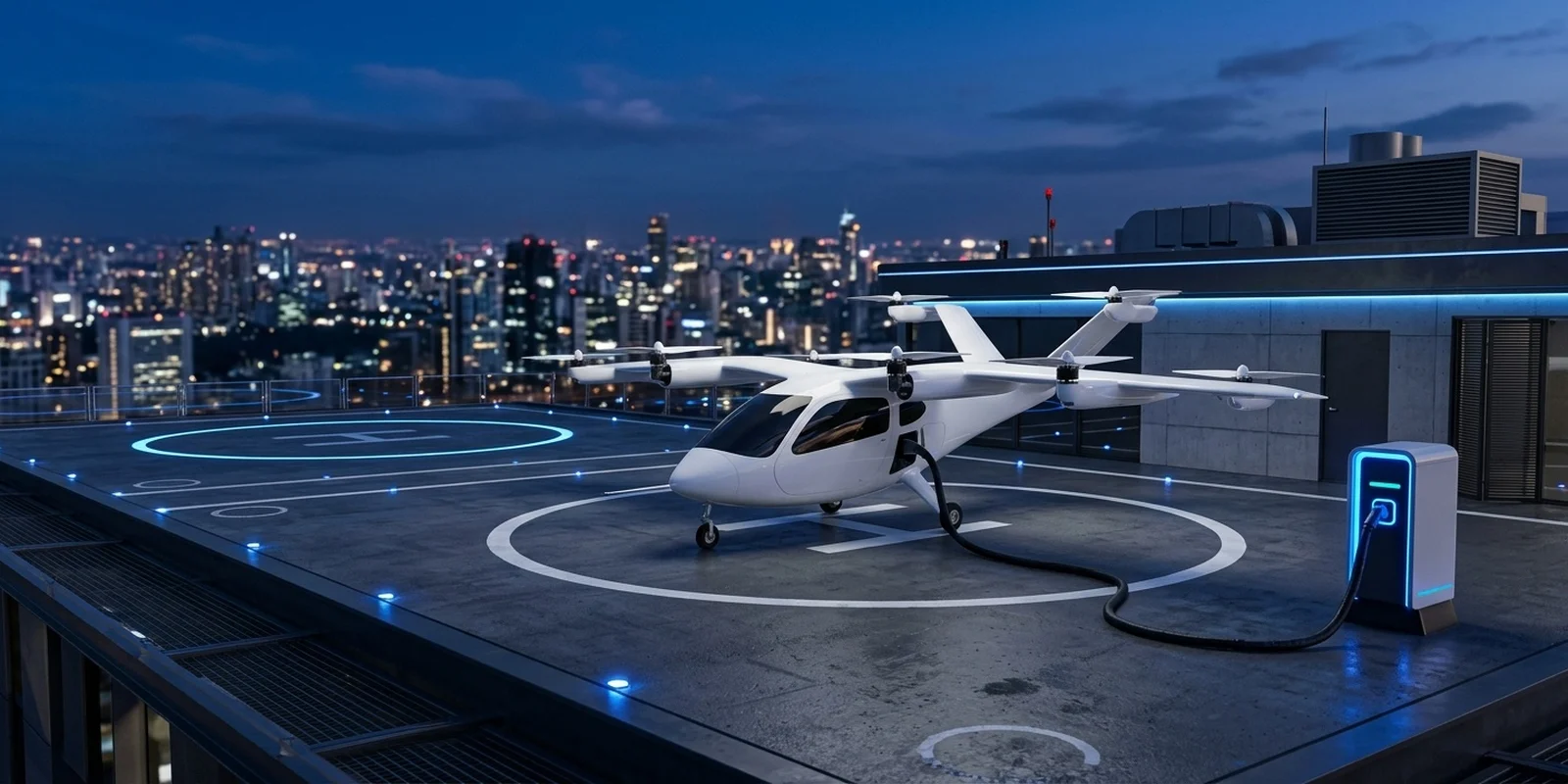
Vertiport Charging: The Energy Side Of eVTOL Turnarounds
💡 Vertiport Charging: Key Highlights
- 300 kW to 1 MW per aircraft: the peak DC charging range eVTOL manufacturers reported to the FAA-sponsored vertiport electrical study, which advises planning for 1 MW or more per site.
- Minutes, not half-hours: launch aircraft target a recharge of about 10 minutes between short hops, against the 25–40 minutes a car spends on a DC fast charger.
- 6–7x site demand: adding a vertiport multiplied the electrical demand of most candidate sites studied, and every site needed local grid upgrades.
- Standards are still moving: most of the industry backs CCS, SAE published the megawatt charging report J3271 in March 2025, and the FAA says there is no consensus yet on charging classes or connectors.
- The software decides the bill: charging sequenced against the flight schedule can roughly halve contracted demand compared with letting every pad draw at once.
A vertiport is, from the energy side, the most demanding charging site most engineers will ever be asked to size. Each electric vertical take-off and landing (eVTOL) aircraft wants somewhere between 300 kW and 1 MW, it wants it for minutes rather than half an hour, and the next departure is already on the schedule. This piece is written for airport and vertiport developers, aviation operators planning ground infrastructure, and the energy partners they will lean on. It is also for charge point operators (CPOs) wondering whether what they know about DC fast-charging hubs carries over.
Short answer: much of it does, but the margins for error shrink. A car that waits five extra minutes costs a driver some patience. An aircraft that misses its slot costs a flight, and the grid connection is sized for a peak that may last only ten minutes an hour. What follows is what the energy side will demand, benchmarked against a hub you already know, and an honest account of what is still unsettled in late 2026.
The Vertiport Energy Profile Next To A DC Fast-Charging Hub
The best public baseline is the FAA Vertiport Electrical Infrastructure Study, prepared by the National Renewable Energy Laboratory (NREL) and revised in December 2023. The manufacturers it surveyed reported peak DC charging of 300 kW to 1 MW per aircraft. They also said they plan to cool batteries from the ground during charging, and none planned battery swapping. On that basis the report suggests vertiports plan for at least 1 MW. Across its candidate sites, which included large heliports, a general aviation base, a commercial airport and a hotel-casino complex, adding a vertiport raised site demand six to seven times, and every site needed local electrical upgrades.
The spread between its two modelling cases is the real lesson. A constrained case of three chargers per site capped charging at 900 kW. An unconstrained case reached 13.3 MW per site. Same aircraft, same flights: the gap between those numbers is decided by how charging is managed.
| Parameter | DC fast-charging hub (cars) | Vertiport (eVTOL) |
|---|---|---|
| Power per connector | 60–350 kW (CCS hardware today tops out around 350 kW) | 300 kW–1 MW peak per aircraft (Stated, FAA/NREL OEM survey) |
| Time on the charger | 25–40 minutes for a typical fast-charge session | About 10 minutes between short hops (Stated, launch-operator design target, not yet shown in service) |
| Arrival pattern | Random; driven by traffic and driver choice | Scheduled; set by the flight timetable |
| Coincident draw | Bays rarely all peak together, since cars arrive at different states of charge | Peak departures bunch together, so several pads can draw at once |
| Cost of a late charge | A driver waits a few minutes | A missed departure slot and a knock-on delay |
| Site demand impact | Moderate on a retail or forecourt site | Six to seven times existing site demand (Stated, FAA/NREL) |
Hub figures are typical market ranges. Vertiport figures are labelled with their source. Neither column describes any specific site.
A worked example: four pads, one peak hour
Take a four-pad vertiport serving 12 departures in its busiest hour. Assume each turnaround puts back 125 kWh in a 10-minute charge, which works out to an average of 750 kW per aircraft, inside the surveyed range. That is 1.5 MWh in the hour, or an average draw of 1.5 MW. If all four aircraft are allowed to pull 1 MW at once, the site still needs a 4 MW connection to cover a peak that lasts only minutes. (Derived: YoCharge illustration using the assumptions stated here.)
This is where demand charges bite. On a tariff that bills peak kW monthly, take an illustrative US-style rate of $15 per kW-month. A 4 MW billed peak costs $60,000 a month. A site held to 2 MW by sequencing costs $30,000 a month, a difference of $360,000 a year before a single kWh is counted. (Derived: the rate is an assumption for illustration. Your utility’s or DISCOM’s tariff will differ.) Our guide to managing EV demand charges walks through the same arithmetic for road-vehicle sites. For aircraft, the ratio of peak to average is simply steeper.
A car hub has a natural cushion: arrivals are random, so the bays rarely all peak together. A flight timetable removes that cushion. Unless software puts it back, the connection, the transformer and the monthly bill all get sized to the worst ten minutes of the day.
Standards And Interfaces For Vertiport Charging: Where They Stand
This is the fastest-moving part of the picture, so treat everything below as the position in November 2026, and check it again before you write a specification.
Connectors: CCS has the majority, but not everyone
The General Aviation Manufacturers Association has backed the Combined Charging System (CCS) for aircraft since 2021, and launch aircraft from Archer, BETA Technologies and Vertical Aerospace have adopted it. Joby went its own way with the Global Electric Aviation Charging System, a design that builds in ground-side battery cooling and that Joby has offered as an openly published interface specification. Above CCS power levels, SAE issued J3271, the Megawatt Charging System report in March 2025. It covers equipment up to 1,500 V and 3,000 A, or 4.5 MW, and its committee scopes it for vehicles that “roll, fly or float”. CharIN said in November 2025 that it is developing guidelines to adapt CCS and MCS to aviation, from eVTOLs to future regional aircraft. Separately, SAE’s AE-7D committee has been drafting AS6968, a conductive charging standard for light electric aircraft.
Regulators: design guidance first, charging detail later
The FAA’s Engineering Brief 105A on vertiport design (December 2024) covers electrical infrastructure and battery safety. It also says plainly that consensus on charging classes and connection standards has not been reached, and that more guidance on charging design is still being developed. EASA’s prototype technical specifications for vertiport design (March 2022) are non-regulatory and deal mainly with physical layout, obstacles, visual aids and firefighting rather than power.
The real constraint is the battery, not the plug
Whatever connector wins, the turnaround is set by how much current the aircraft battery can take without overheating. That is why ground-side liquid cooling features in both the manufacturer survey and Joby’s design. For the energy side, this matters because charging power follows the battery’s acceptance curve, starting high and tapering. A 1 MW nameplate is a ceiling, not a flat draw, and good scheduling uses the taper to start the next aircraft while the last one is ramping down. One more point a CPO will recognise: under CCS the aircraft-to-charger conversation runs over ISO 15118 or DIN 70121. The charger-to-backend link, where scheduling and billing actually happen, is typically OCPP, whatever plug is on the cable.
What Ground-Side Software Must Do At A Vertiport
Most of this is road-vehicle charging management, retuned around a timetable. Four jobs matter.
Schedule against flights, not arrivals
At a hub, the platform reacts to whoever plugs in. Here, the next departure, its route energy and the state of charge it needs are known in advance. So the charging order can be planned before the aircraft lands, and re-planned when a flight slips.
Dispatch power by state of charge and departure time
With a site cap below the sum of the chargers, something has to decide who gets power first. Dynamic load management keeps total draw inside the site limit, and priority tiers put the next departure at the front of the queue. Done well, that is how the worked example above runs on 2 MW instead of 4 MW.
Balance pads and ground equipment on one connection
Aircraft are not the only load. Tugs, baggage carts, terminal HVAC and lighting share the same meter, and some of them can wait. Treating them as flexible load in the same scheduler is cheaper than building a connection for everything at once.
Account for energy per operator
A shared site serving more than one aircraft operator has to bill each one for its own energy, with session-level records of kWh, duration and status that will stand up to audit. This is standard practice in multi-tenant charging. YoCharge’s charging management platform already does it for networks in 25+ countries, works with any OCPP charger, AC or DC, and connects to operations systems through its charging API. For aviation, the offer is set out in our eVTOL charging for vertiports programme: a charging partner that understands fast turnarounds and builds the aviation-specific pieces with the operator.
Who Builds And Operates A Vertiport, And On What Model
Candidly, almost nothing runs at commercial scale yet. As of November 2026 we have found no report of scheduled paying-passenger eVTOL service anywhere. The early projects do show three operating models taking shape.
- Infrastructure specialist under a city concession. In Dubai, Skyports designs, builds, owns and operates the vertiports for the Roads and Transport Authority, while Joby holds six years of exclusive air-taxi operating rights. The first of four planned sites, at Dubai International Airport, was reported complete in April 2026, and passenger service awaits Joby’s operator certificate.
- Airport operator as network lead. Abu Dhabi Airports is rolling out up to 14 public vertiports and in November 2025 selected BETA Technologies’ 320 kW Charge Cube chargers, with work starting at Zayed International and Al Bateen Executive.
- Aircraft maker as charging provider. BETA reported more than 50 charging sites across the US and Canada by November 2025, on its own CCS chargers, which also serve electric ground equipment.
The model that wins will decide who carries the grid connection and who carries the demand charge. Whoever signs the utility agreement, the operator who controls charging scheduling controls the largest variable cost on the site.
India Context: DGCA Vertiport Guidance
India’s Directorate General of Civil Aviation issued guidance on the design, operation and authorisation of vertiports (Advisory Circular ADAC 01 of 2024, dated 5 September 2024), along with type-certification guidance for VTOL-capable aircraft a week later. Press coverage noted that the vertiport guidance addresses battery charging requirements. The Ministry of Civil Aviation confirmed both documents in a February 2025 Rajya Sabha reply. For an Indian site, a megawatt-class site means a high-tension DISCOM connection and a contract-demand decision taken years before the first flight, which is exactly where the sequencing arithmetic above earns its keep.
Frequently Asked Questions
Sources: FAA Vertiport Electrical Infrastructure Study (NREL/TP-5R00-86245, Dec 2023) | FAA Engineering Brief 105A, Vertiport Design | EASA Prototype Technical Specifications for VFR Vertiports | SAE J3271_202503 Megawatt Charging System | CharIN, MCS for mining, marine and aviation (Nov 2025) | Rajya Sabha reply on DGCA vertiport guidance (Feb 2025)
Tell us about your aircraft, pads and turnaround targets. We will show you what the YoCharge platform does today for scheduling, load limits and per-operator billing, and what we would build with you.
Talk to Sales