
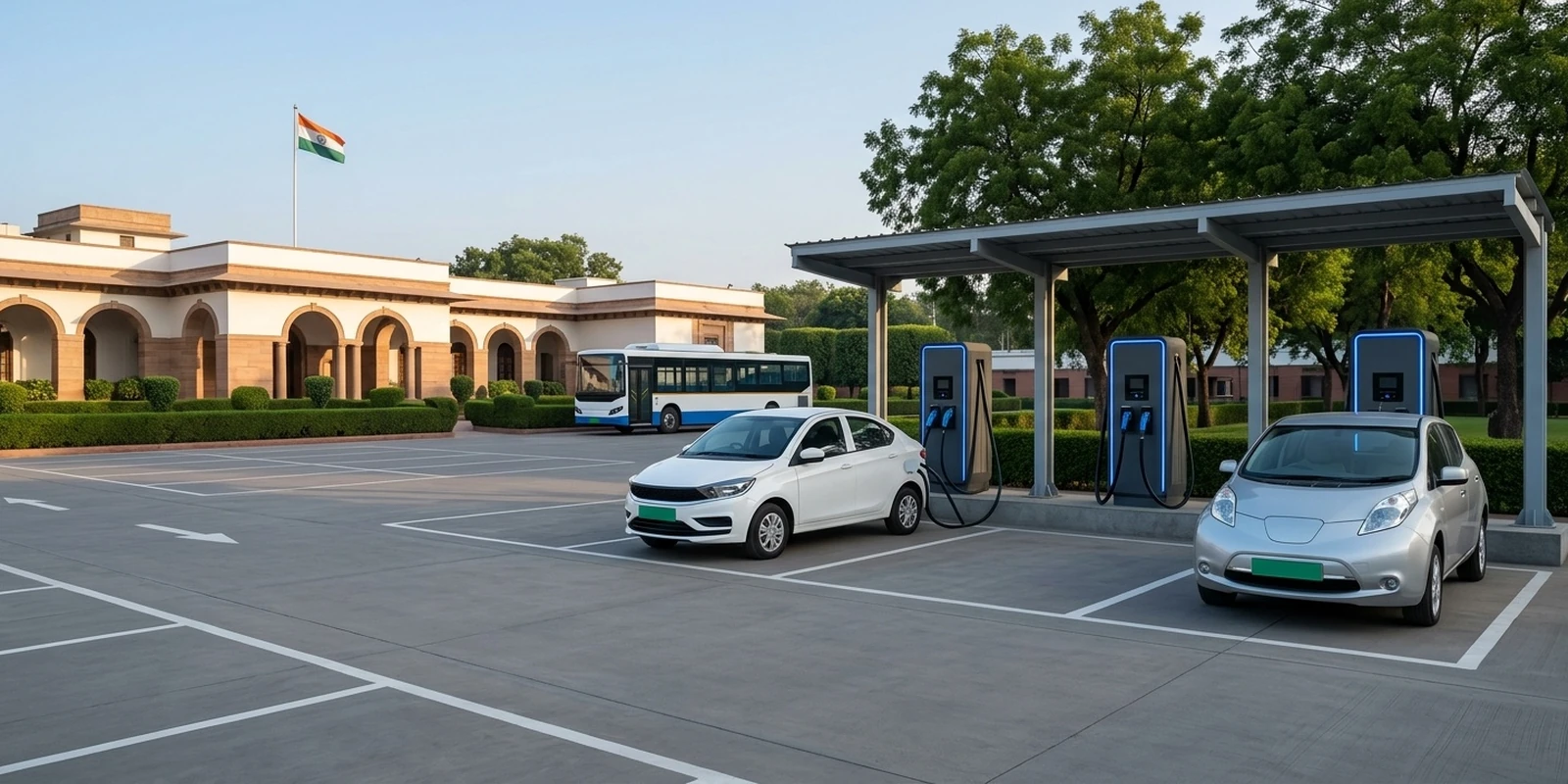
EV Charging For Government Buildings
💡 EV Charging For Government Buildings: Summary
- Government premises are the only 100%-funded location category under PM E-DRIVE — 100% on upstream infrastructure and 100% on the charger. Every other category tops out at 80% / 70%.
- A private CPO cannot apply. Only ministries, CPSEs, states/UTs and their PSUs submit proposals; the CPO is appointed afterwards through a transparent bidding mechanism.
- Public land costs ₹1 per kWh delivered, paid quarterly to the land-owning agency on an initially 10-year agreement — a floor price, bid upward, when the CPO is private.
- Service charges are capped at ₹3–4/unit (AC) and ₹11–13/unit (DC) until 31 March 2028, so utilisation — not price — is the only margin lever.
- The queue is still short: 4,874 chargers worth ₹503.86 crore approved as of 12 May 2026 against a ₹2,000 crore, ~72,000-charger target, in a fund-limited scheme that closes on 31 March 2028 or when the money runs out.
EV charging for government buildings looks like the easiest segment in Indian charging: captive parking, a landlord with a policy mandate, no rent negotiation. It is in fact where most CPO bids die, because winning a government office or municipal site is not a sales decision — it is a procurement decision, taken inside a budget cycle you were never part of. This post is for CPOs and eMSPs selling into the public sector, and secondarily for the government or PSU estate manager working out how to host chargers without absorbing the operating risk. What follows is the commercial mechanics — the part missing from most sector-by-sector charging strategies, which skip government premises entirely. The rules are India’s; the shape generalises to any public estate.
Why EV Charging For Government Buildings Became A Real Segment
Two policy instruments created this segment, and neither is a mandate to install chargers — the opportunity is commercial, and has to be underwritten like any other site. The first is land. The Ministry of Power’s Guidelines for Installation and Operation of Electric Vehicle Charging Infrastructure-2024 put public land on a revenue share rather than a rent: under Clause 7 the land-owning agency receives a fixed ₹1 per kWh used for charging, paid quarterly, on an agreement initially entered for 10 years — a floor price bid upward where the CPO is private. Site cost therefore scales with energy delivered, not with the calendar: an under-utilised government forecourt does not bleed fixed rent the way a mall bay does.
The second instrument is capital. PM E-DRIVE’s operational guidelines for EV public charging stations sort locations into four categories. Category A — government premises: offices, residential complexes, hospitals, educational institutes and CPSE establishments — is the only one funded at 100% on upstream infrastructure and 100% on the charger. Category B — government-controlled sites that are not offices: railway stations, AAI airports, PSU retail outlets, metro stations, municipal parking, NHAI toll plazas — gets 80% and 70%. Category C, everything else, gets 80% on upstream and nothing on the charger. Subsidy is computed on BEE benchmarks or actuals, whichever is lower.
The window is dated and finite. MHI extended PM E-DRIVE to 31 March 2028 within the same ₹10,900 crore outlay, and says plainly that it is fund-limited: if the money runs out first, the sub-component closes. Against the ₹2,000 crore charging allocation and a target of roughly 72,000 chargers, MHI had approved 4,874 chargers worth ₹503.86 crore as of 12 May 2026 — across CPSEs including HPCL, IOCL and BPCL and eight states. A quarter of the money against under 7% of the charger target: the queue is short.
The Procurement Route Is The Whole Game
You do not apply — you get appointed
Nothing about the procurement of EV charging for government buildings resembles a private site sale. PM E-DRIVE’s eligible entities are GoI ministries, CPSEs, states and UTs, and PSUs under them; a private CPO is not on that list and cannot file a proposal. The ministry or state appoints a nodal agency, which aggregates demand and files the proposal on the PM E-DRIVE portal, declaring as a line item whether it will operate the stations itself or appoint a CPO. BHEL evaluates proposals and recommends them to MHI. Only after approval does procurement begin, and the guidelines are unambiguous: “CPO selection shall be done through a transparent bidding mechanism as decided by respective State, GoI ministries & CPSEs.” Your go-to-market is therefore a pre-tender motion: shape the specification while the nodal agency is still drafting, because afterwards you are one bidder among many.
GeM, and why there is no quiet catalogue pilot
For a department buying outside PM E-DRIVE, the Government e-Marketplace is the default and, for anything listed on it, mandatory; both AC and DC charging stations are GeM categories. Deal shape follows the value ladder in General Financial Rules 2017, Rule 149: direct purchase up to ₹25,000; lowest of three manufacturers up to ₹5,00,000; above that, bids through GeM’s bidding or reverse-auction tool are mandatory. Set BEE’s benchmarks against that ladder — ₹6.04 lakh of upstream infrastructure for a site up to 50 kW plus ₹7.25 lakh for a 50 kW CCS-II charger — and one fast-charging bay is already 2.7× the bidding threshold. GFR separately forbids splitting a demand to avoid bidding. There is no catalogue-sized pilot; the first transaction is a competitive bid.
What eligibility requires — and why the clock runs in quarters
That turns the paperwork into a qualification gate. Before a connection is released, the MoP guidelines expect the CPO to produce:
- A registered land deed between the land-owning agency and the CPO — or between lessee and CPO on sub-leased property
- Power of attorney for the signatory, certified company registration certificate, PAN and GST registration, and government ID proof of the authorised representative
- A charger type-test certificate from an NABL-accredited lab
- Fire-department NOC for basement installations; PESO approval where the site is a fuel station
- An undertaking on stamp paper that the supply is used only for public EV charging
- Plus the usual tender instruments: earnest money with the bid, a performance bank guarantee for the term, and prior-experience clauses stated in kW commissioned
The licences and approvals a public charging station needs are no different here — they simply stop being post-award admin and become bid-qualification documents.
The timeline gap is structural, not inertia. GFR requires departments to decide procurement on an OPEX or CAPEX model when Budget Estimates are prepared, and to project the annual procurement plan on GeM within 30 days of budget approval — so the operating model you can offer is fixed months before a CPO is in the room. Add MHI approval and a tender cycle and you are measuring in quarters. Electricity is the fast part: under the Electricity (Rights of Consumers) Rules, 2020 the DISCOM must release a connection in 3 days in a metropolitan area and 7 in other municipal areas, stretching to 90 only where mains must be extended or a substation commissioned.
Three Operating Models — And Who Keeps The Revenue
The deal then reduces to one question: who spends the capital, and who books the session revenue.
| Model | Who funds what | Who keeps session revenue | Risk the CPO carries |
|---|---|---|---|
| Department-owned CAPEX, CPO on a fixed O&M fee | Department takes the Category A subsidy and owns the hardware; CPO brings software, operations and support | The department — CPO is paid a fixed fee per charger or per site | Almost no utilisation risk; thin fixed margin, full renewal risk at contract end |
| CPO-owned CAPEX on a revenue-share or licence-fee agreement | CPO funds the connection, transformer, meter, chargers and all O&M; the agency contributes only land | The CPO — paying ₹1/kWh, or the bid-discovered rate, to the land-owning agency | All of it: utilisation, energy cost, obsolescence, ceiling compression |
| Hybrid — department funds hardware, CPO funds the platform | Subsidy pays upstream and EVSE; CPO funds the network layer, payments and field support | Shared, on an agreed split of billed units | Operating cost and uptime exposure without the asset upside |
Most Category A sites land in the hybrid row: a department cannot reasonably decline 100% capital funding, and has no appetite to run a 24×7 charging network with it.
The MoP model revenue-sharing agreement (Annexure IV) makes the second row concrete. In your favour: the installed system remains the CPO’s property, never becomes a fixture of the premises, no lien may attach to it, and the agency keeps paying property tax. Against: the CPO bears the separate connection, transformer and meter, all electricity charges, all O&M, every statutory approval, third-party and fire-and-riot insurance, and any increase in local levies on the bay. The location count is explicitly non-binding — never underwrite a bid on the station count printed in the RFP.
The clause that decides the model: tariff-setting authority
What makes the choice arithmetic rather than negotiation is that a CPO on Indian public land does not set its own price. Clause 8 fixes the fee’s composition: supply tariff as a pass-through, a service charge per Clause 10, land cost as a pass-through per the registered land deed, plus GST. Clause 10 caps that service charge until 31 March 2028: ₹3.00 per unit for AC and ₹11.00 for DC in solar hours (09:00–16:00), rising to ₹4.00 and ₹13.00 outside them, with a Central Electricity Authority committee reviewing the ceilings. The supply tariff is single-part, capped at the average cost of supply, and billed at 0.7× ACoS in solar hours and 1.3× outside.
Ceiling fixed, land a pass-through, energy a pass-through with a solar-hour discount — the only variables a CPO controls are utilisation and cost to serve. Which is why a fixed O&M fee is worth more than it looks on an office campus with forty staff cars, and a revenue share is only defensible where the premises has real public through-traffic: a collectorate on a main road, a government hospital, a municipal parking lot. It is the calculation that decides who installs and who operates chargers in commercial real estate, with the ceiling statutory rather than negotiated. Check what has already been claimed on the site, too: the subsidies a CPO can actually claim route to the government entity, never to you.
The Operational Constraints A Private Site Does Not Have
A government building is not a hard site because of its electricals, but because four constraints that barely exist on a private forecourt land on the same bays.
Category A pays 100% on both upstream infrastructure and the charger on one written condition: the chargers must be “available to any private individual for charging their EVs without any restrictions, i.e. free public access”. Meanwhile the premises has a boom barrier, a visitor register and a security protocol built on the assumption that nobody drives in without a reason. Settle this at site-design stage — perimeter bays with their own entry, or a separately fenced compound — or you will be operating a fully public-funded asset behind a gate that keeps the public out, with the funding condition unmet.
Two user populations, one set of bays
Departmental EVs and pool cars charge on the same hardware as walk-up public users, and they are not the same customer. The fleet needs authorised identification, priority windows and a scheduled overnight top-up; the public user needs an open session and an instant receipt. That means two rate plans, an access list that survives staff turnover, and session reporting split by population — the same requirement as any EV fleet charging management deployment, except that here the fleet shares its chargers with strangers by contract.
Billing against a cost centre, not a card
Departmental consumption cannot be settled on a personal card and reimbursed. It needs GST-compliant invoices raised to the department, a monthly statement per cost centre, and departmental accounts a finance officer can reconcile against a sanctioned head. The model agreement adds a second flow: until a separate meter is issued in the CPO’s name, the CPO buys power from the agency at the rate the agency itself pays the DISCOM and reimburses on actuals within 10 days of demand. With the quarterly revenue share, that is three streams from one session ledger — which is the real job of payment and billing software here.
The audit trail is a payment condition
On a private site, reporting is a courtesy; under PM E-DRIVE it gates money. The first tranche of 70% is released against undertakings on DISCOM demand notes and PMP-compliant chargers; the second and final tranche only after the installed chargers are onboarded onto MHI’s National Unified Hub, with utilisation certificates. The nodal agency must keep sharing operational data — location, slot availability, pricing, payment options — and ensure continued uptime. All of it flows down into the CPO’s contract, which is why the reporting surface of a charging management platform like YoCharge matters more here than its feature list: the data the department owes the Centre is data only your software can produce.
A Qualification Checklist Before You Bid
Run this before committing bid costs. Any two failing at once is usually reason to pass and spend the same effort installing EV charging stations on a private site with a shorter cycle.
If the nodal agency has not filed and cleared a PM E-DRIVE proposal for this location, you are not bidding yet — you are lobbying. Ask for the approval reference and the location’s category.
Walk the gate. If unrestricted access needs a security waiver nobody will sign, a Category A site cannot meet its own funding condition.
The Budget Estimate decision already fixed which operating model is procurable. Pitching a revenue share into a CAPEX line wastes a cycle.
Confirm whether a separate LT connection up to 150 kW suffices, or whether mains extension or a new substation is needed — that one answer moves energisation by a quarter.
National Unified Hub onboarding, live slot availability, pricing, digital payment options, uptime evidence and billed-unit accounting for the quarterly revenue share — all from one ledger.
Model at the service-charge ceiling, not an aspirational price, and treat the station count as non-binding. If it only works at 1.5× the ceiling, it does not work.
EV charging for government buildings is the one segment where capital can be fully funded, land is priced per unit delivered, and the landlord has a statutory reason to want the asset used. The entry cost is patience with a procurement calendar, and software that can prove every session.
Frequently Asked Questions
Sources: Ministry of Power — Guidelines for Installation and Operation of EV Charging Infrastructure-2024 | Ministry of Heavy Industries — PM E-DRIVE Operational Guidelines for EV Public Charging Stations | PIB — National Conference on Nationwide EV Charging Infrastructure under PM E-DRIVE (12 May 2026) | PIB — PM E-DRIVE tenure extended to 31 March 2028 | Government e-Marketplace — DC EV Charging Station category
Bidding For A Government Charging Site?
Tell us the site category and the operating model on the table, and we will show you the platform side of the bid — tariff arithmetic, departmental billing, and the reporting a public body will audit.
What happens next ?
Public-sector readiness review of your platform and documents
Bid-support pack: site category, operating model, tariff arithmetic
Revenue-share and O&M-fee models run at capped service charges
Reporting, National Unified Hub and audit-trail configuration