
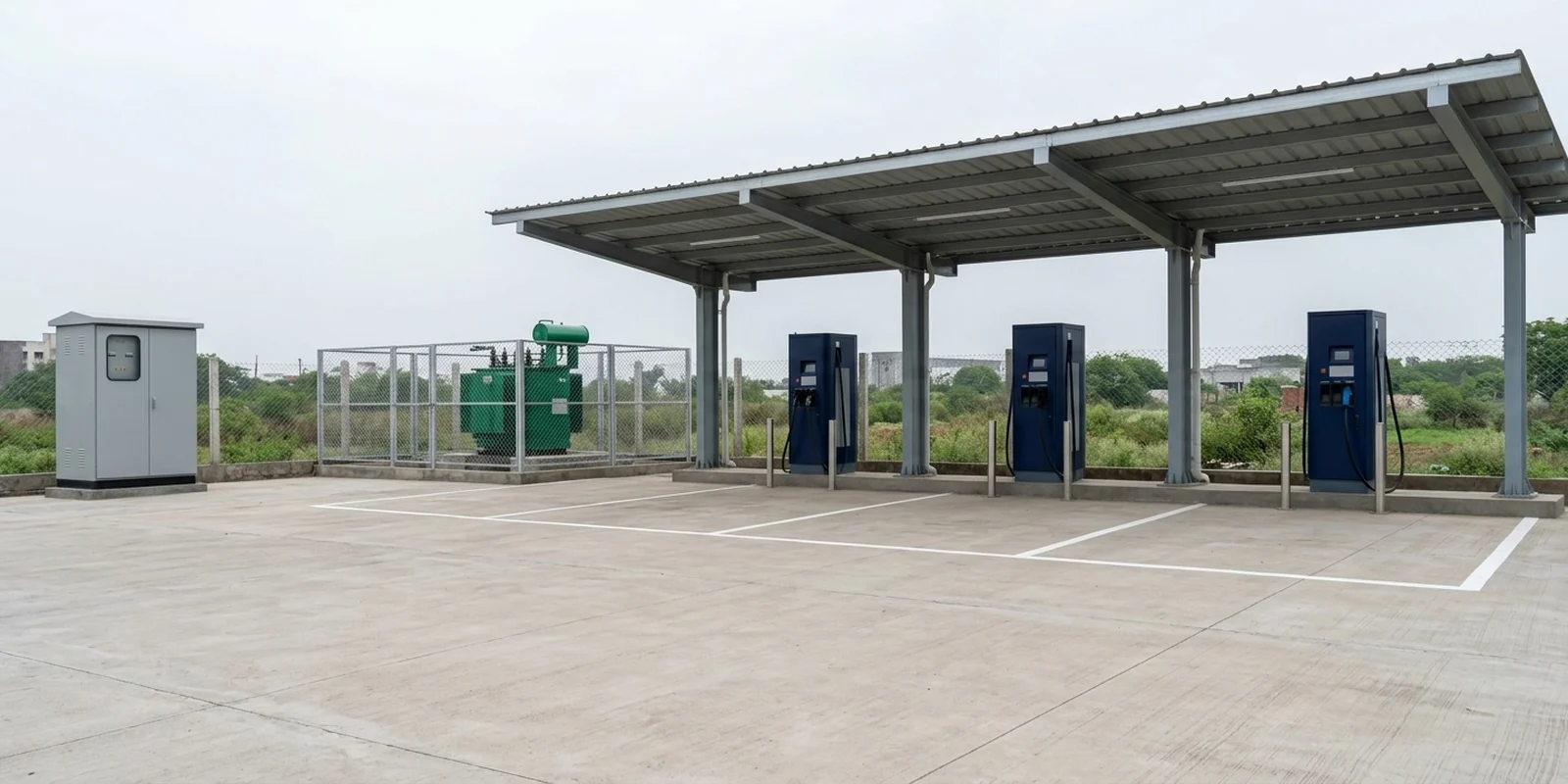
EV Charging Station License In India
💡 EV Charging Station License In India: Summary
- There is no EV charging station license in India. Clause 5(1) of the Ministry of Power’s 2024 guidelines makes setting up and operating charging stations a de-licensed activity — no permit to sell charging, no queue to join.
- The DISCOM connection is the critical path. Statutory timelines run 3 days (metro) to 15 days (rural) — but stretch to 90 days if the site needs a mains extension or a new substation.
- Ten documents gate the application, starting with a registered land deed. The clock only starts when the file is complete in all respects.
- Electrical Inspectorate clearance comes before energisation — and whether you queue for an inspector or self-certify depends on a voltage threshold each state notifies separately.
- A NABL type-test certificate is a connection document, not a procurement nicety. Chargers without one stall the file, not just the warranty.
Ask a first-time operator what stands between a signed lease and a live site and the answer usually comes back as a question: do I need an EV charging station license in India? The short answer is no — and that one fact reframes the entire project. Public charging is a de-licensed activity: there is no charging licence to apply for and no regulator deciding whether you may trade. What exists instead is a sequence of connection, safety and standards clearances, each owned by a different authority and on its own clock — one of which can quietly add six months.
This guide is for CPOs, fuel retailers and real estate or retail site owners who already have a site and a budget and now need it legally energised. It covers the approvals pathway and nothing else. The commercial case — utilisation, the financial model, the questions lenders ask — sits in our EV charging station business plan guide; capital numbers in EV charging station setup costs; what the government pays for in the EV charging station subsidy guide; and the build-or-not decision in how to start an EV charging station business in India.
Do You Need An EV Charging Station License In India?
No. The Ministry of Power’s Guidelines for Installation and Operation of Electric Vehicle Charging Infrastructure – 2024, issued on 17 September 2024, state it in one line at clause 5(1): “Setting up and operation of EV Charging Stations is a de-licensed activity and any entity is free to establish EV Charging Infrastructure by adhering to these guidelines.” You do not become a distribution licensee by selling charging: you buy electricity as a consumer and sell a charging service, which is why no licence under the Electricity Act is triggered and why a company, an LLP, a society or an individual can all operate a public station.
What de-licensed does not mean is unregulated. You remain an electricity consumer with a sanctioned load, bound by national safety regulations, selling at a price with a statutory ceiling, and obliged to list the site publicly: clause 13 requires public CPOs to register each station on the Bureau of Energy Efficiency’s national database and share annual energy-sold data per charger. That listing — not a licence — is the closest thing to an EV charging station registration requirement in India, and it follows commissioning rather than preceding it.
So the real question is which approvals apply and in what order. Three do: the electricity connection, the safety clearance and the equipment standards. For the site-readiness side of the same decision, see our install a charging station page.
The DISCOM Connection Is The Real Critical Path
Everything else can run in parallel. The distribution licensee cannot. Clause 5(2) binds DISCOMs to the connection timelines in the Electricity (Rights of Consumers) Rules, 2020, and makes the licensee liable for a penalty if it misses them.
| Where the site sits | Maximum time to release the connection |
|---|---|
| Metropolitan area | 3 days |
| Other municipal area | 7 days |
| Rural area | 15 days |
| Rural area, hilly terrain | 30 days |
| Any site needing a mains extension or a new substation | 90 days |
Connection timelines applied to EV charging stations by clause 5(2), MoP Guidelines 2024, from the Electricity (Rights of Consumers) Rules, 2020.
The last row decides your project calendar. Whether you sit in the 3-day bucket or the 90-day one is a function of the DISCOM’s feasibility assessment of your plot, not of your city — a 250 kW site on a feeder with no headroom is a 90-day site in the middle of a metro. Ask the local sub-division for an informal load view before signing the lease.
The clock only starts on a complete application
Annexure III of the guidelines sets the single-window standard operating procedure: the CPO files online, the DISCOM has three days to scrutinise and flag discrepancies, the CPO has three days to resubmit, and only then does the feasibility assessment and demand note follow. That loop repeats on every incomplete filing, which is how a “7-day” connection becomes a five-week connection. Annexure III(B) lists the ten documents that make a file complete — a registered land deed first among them, plus PESO approval where chargers go in at a petrol pump or gas station, a fire-department NOC for basement installations, a NABL-accredited type-test certificate for the charger model, and an undertaking on stamp paper that the supply will be used only for public EV charging.
150 kW is a commercial boundary, not just an electrical one
Clause 5(3) makes the state commission pre-specify connection charges up to 150 kW, and obliges the DISCOM to release a Low Tension connection up to that ceiling where a separate LT application is made. Below the line your connection cost is a published number you can model; above it you are into HT territory, a substation and site-specific costs. On tariff, clause 9 caps supply at the Average Cost of Supply until 31 March 2028 and prices it at 0.7× ACoS during solar hours (9:00 AM–4:00 PM) and 1.3× ACoS outside them — an 86% swing in your input cost across a single day, against service-charge ceilings of ₹3/₹4 per unit for AC and ₹11/₹13 for DC. Clause 12(5) also allows open access within 15 days of a complete application, at a surcharge capped at 20% of the applicable tariff.
Site, Safety And Electrical Clearances Before Energisation
Step 6 of the Annexure III procedure is blunt about ownership: “Electrical Inspectorate Safety clearance and other compliances to be shared by applicant before energization.” The DISCOM issues the demand note; you produce the clearance. Miss it and the meter stays dark however fast the connection was sanctioned.
The substance of that clearance is the Central Electricity Authority’s (Measures relating to Safety and Electric Supply) Regulations, 2023. Chapter XI, regulations 123–128, applies to charging stations in addition to the general chapters, and it is specific: socket-outlets at least 800 mm above finished ground level, no more than five metres between the charging point and the vehicle connection, no portable socket-outlets or cord extension sets, protection against uncontrolled reverse power flow from the vehicle, earth-continuity monitoring that cuts supply if the vehicle earth fails, fire-retardant halogen-free enclosures, underground cables at least one metre deep and never crossing an oil tank or pipeline, and a safety clearance between an oil or gas dispenser and a charge point as ordered by the Authority — the clause that governs forecourt retrofits. Regulation 128 then requires design, construction, testing and periodic-assessment records to be retained for seven years.
Inspector or self-certification — a voltage threshold decides
This is the part most approval checklists miss. Under regulation 32, installations above the notified voltage are inspected and tested by the Electrical Inspector; installations at or below it are self-certified by the owner in the prescribed Form, deemed received if the Inspector’s office does not acknowledge within three working days. “Notified voltage” is set by each state government, so an HT site and an LT site in the same city sit on materially different approval calendars — one queues for an inspection date, the other files a form. Regulation 31 adds the hard stop: work must be carried out by a State-licensed electrical contractor under a person holding a certificate of competency, and work done in contravention “shall not be energised or connected to the works of any supplier.”
Then the state adds its own layer
The national framework says what is required; the state decides where you file it and what you pay per unit. Maharashtra’s EV Policy 2025 (Government Resolution dated 23 May 2025) commits to a one-window online portal for charging-infrastructure permissions that integrates approvals from local bodies and other government agencies, directs Special Planning Authorities including MIDC to align their approval processes, and fixes the concessional EV tariff by reference to MERC Order No. 217 of 2024 dated 28 March 2025. Land-use and parking rules come from a third direction again: the MoHUA Model Building Bye-Laws 2016 and URDPFI amendments that clause 5(5) asks local development authorities to adopt — adoption varies by authority. Before budgeting a timeline, confirm locally whether the single-window portal is live, what the state commission’s current EV tariff order says, and whether your authority has adopted those bye-laws.
Standards Compliance Is An Approval Gate, Not A Procurement Preference
Clause 6(1) requires all EVSE to comply with the BIS standards listed in Annexure I, which maps four power levels to the IS 17017 family — from light EV AC and DC charge points at 7 kW and 12 kW up to DC high power of 250–500 kW for e-buses and trucks. Annexure II goes further: every EVSE model, at each power rating and communication protocol, must be type-tested by the manufacturer at a NABL-accredited laboratory with a valid type-test certificate.
Treat that certificate as a regulatory document, because the DISCOM does — it is item 9 on the Annexure III(B) list. A charger bought on price and lead time, without a current certificate matching the power level you applied for, holds up the connection file and any subsidy claim built on it. Order hardware against the certificate, not the datasheet. The standards themselves are covered in our explainer on BIS standards for EV chargers — IS 17017 and IS 15118.
The Approval Sequence: What To Run In Parallel
Approvals for a public charging station are not a queue; they are a dependency graph with one long pole. Sequenced properly, a straightforward urban LT site is a weeks-long exercise — sequenced badly, the same site takes two quarters.
| Step | Who owns it | What it blocks |
|---|---|---|
| Registered land deed or lease | CPO | Document 1 of the DISCOM file — nothing starts without it |
| Entity papers: registration, PAN, GST, power of attorney | CPO | The same file; run in parallel with land |
| Load sizing and the LT-vs-HT decision | CPO with an electrical consultant | Connection charges, tariff category and the inspection route |
| DISCOM application, Annexure III(A) and III(B) | CPO | Starts the statutory clock — only when complete |
| Charger order against a valid NABL type-test certificate | CPO | The document set, and later the subsidy claim |
| Site-specific NOCs: PESO at fuel sites, fire NOC for basements | CPO | Completeness of the application |
| Installation by a State-licensed electrical contractor | CPO | Energisation — non-compliant work cannot be connected |
| Electrical Inspectorate clearance or self-certification | CPO | Energisation |
| Demand note payment and energisation | DISCOM | Commissioning |
| BEE national-database registration and annual data sharing | CPO | Ongoing compliance, post-commissioning |
The approvals pathway for a public charging station, ordered by dependency rather than by authority.
The two mistakes that add months
Filing before the land deed is registered. Teams apply early to “get in the queue,” but the timelines run only from a complete file, and the discrepancy-and-resubmission loop repeats without counting against the DISCOM. Buying chargers before checking the certificate. The approvals file needs a valid type-test certificate for that exact model and rating; finding the gap after the hardware lands means re-ordering with the connection already sanctioned.
Clearing the approvals is the start, not the finish. From energisation onward the obligations are continuous: display rates transparently, meter every session against a tariff that changes at 9 AM and 4 PM, keep seven years of records, and report annual energy sold per charger. Those are duties a spreadsheet will not survive — which is why most operators put a charging management system like YoCharge in place before the first session, not after the first audit.
Frequently Asked Questions
Sources: Ministry of Power — Guidelines for Installation and Operation of EV Charging Infrastructure, 2024 | CEA (Measures relating to Safety and Electric Supply) Regulations, 2023 | Central Electricity Authority — Regulations | Maharashtra Electric Vehicle Policy 2025 | Bureau of Indian Standards — Transport Engineering Department
Transparent pricing, solar-hour tariff switching, seven-year records and annual energy reporting to the national database are continuous duties. YoCharge runs them from one platform.
- Session-level metering against solar and non-solar tariffs
- Uptime, transaction and assessment records you can export
- Multi-site rollout on one white-label stack
Walk one of your sites through with us — load, tariff and the software layer that follows energisation.
Get a DemoNo obligation. A 30-minute working session.