
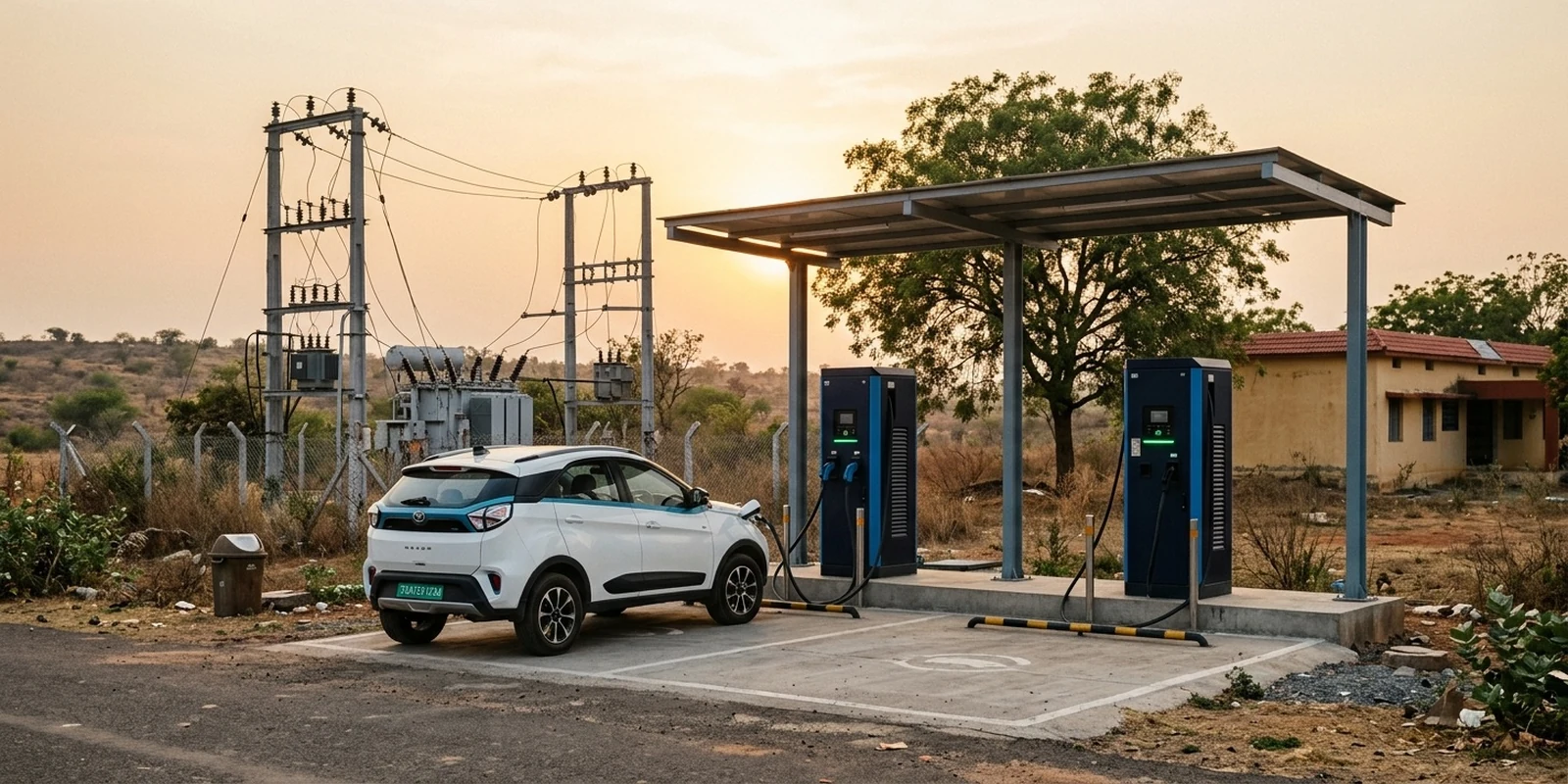
Telangana Opens 169 Public EV Charging Stations Under PM E-DRIVE
💡 Telangana EV Charging Tender: Key Highlights
- 169 public charging stations at 116 locations, split into five independently biddable clusters, on a 10-year operate-and-maintain contract.
- The model is inverted: the highest bidder (H1) wins, quoting Monthly Charges it pays TGREDCO — floors of ₹4L / ₹4L / ₹2.5L / ₹3L / ₹2.5L per cluster per month, escalating 5% cumulatively from year two.
- Plus ₹1/kWh revenue share on Category A and B energy dispensed, on top of the Monthly Charges. Driver-facing service charges are capped at ₹13/kWh.
- Eligibility is either/or: a BIS-certified charger maker (60 kW+ DC at 10+ Indian locations in FY 2025-26) or a CPO that ran 45+ locations in FY 2025-26. Turnover ≥ ₹5 crore. Consortiums are not eligible.
- Bids close 22 September 2026 at 15:00. The pre-bid meeting on 7 September has already passed; EMD is ₹10 lakh per cluster and the bid document costs ₹1,18,000.
The Telangana EV charging tender that opened this month is the most structurally unusual package to reach the market under PM E-DRIVE. On 2 September 2026 the Telangana Renewable Energy Development Corporation (TGREDCO), the state nodal agency for EV charging infrastructure, issued notice TGREDCO/EVI/PM E Drive/2026-27, inviting Charge Point Operators to build, commission and operate 169 public charging stations across 116 locations for ten years. If you are a CPO, a BIS-certified charger manufacturer or a fuel retailer weighing a bid, two facts come before all others: the window shuts on 22 September 2026 at 15:00, and the winner does not collect a viability payment from the state. It pays one.
What the Telangana EV Charging Tender Actually Covers
This is a Request for Selection under the MHI Operational Guidelines of 26 September 2025, handing the winner the whole lifecycle at its own cost and risk: survey, design, supply, civil works, installation, commissioning and ten years of O&M. The five clusters are awarded separately, so a bidder can take one or several.
| Cluster | Locations | Charging stations | Reserve floor (₹/month) | Floor per charger/month |
|---|---|---|---|---|
| Cluster 1 | 26 | 42 | 4,00,000 | ₹9,524 |
| Cluster 2 | 26 | 42 | 4,00,000 | ₹9,524 |
| Cluster 3 | 18 | 27 | 2,50,000 | ₹9,259 |
| Cluster 4 | 22 | 31 | 3,00,000 | ₹9,677 |
| Cluster 5 | 24 | 27 | 2,50,000 | ₹9,259 |
| Total | 116 | 169 | 16,00,000 | ≈₹9,467 |
This is not a Hyderabad tender
The location annexure matters more than the headline count. Every site sits in the TGNPDCL distribution area — northern Telangana, not the Hyderabad metro: Warangal and Hanumakonda, Karimnagar, Jagtial, Peddapalli, Khammam, Bhadradri Kothagudem, Mulugu. The great majority of the sites are TGNPDCL 33/11 kV substations, with collectorates and integrated district office complexes, primary agricultural cooperative society offices, government hospitals and colleges, municipal parks and Haritha tourism hotels making up most of the rest: 109 of the 116 locations are government-owned or government-controlled, and just seven are private. That mix is excellent for grid-connection cost and captive government demand, and thin on the passing retail traffic that normally underwrites utilisation.
The hardware split follows the same logic: of the 169 chargers, 52 are 12 kW light-EV units for e-2W and e-3W and 117 are CCS-II DC — 97 at 60 kW, 20 at 120 kW. This is a district-town network around substations and government premises, not a highway-corridor play, and a bid model built on metro assumptions will misprice it.
The Commercial Model Is Inverted — The CPO Pays TGREDCO
In the Rajasthan and Kerala packages, bidders competed to deliver charging capacity for the state. In the Telangana EV charging tender, the state is monetising an asset base instead. Financial bids open only for technically qualified bidders, who quote Monthly Charges in ₹ per cluster per month payable to TGREDCO; the highest quote (H1) wins the cluster, provided it clears the reserve price. Those charges escalate 5% cumulatively from year two, are invoiced by the 5th of each month and paid by the 10th. Miss three consecutive months and it is a material breach, with forfeiture of the performance security.
Total Monthly Charges payable to TGREDCO across all five clusters over the 10-year term — at the reserve floor, before anyone bids a rupee above it.
What a Cluster 1 floor bid of ₹4 lakh/month becomes in year ten, after nine years of 5% cumulative escalation.
Energy each charger must dispense every day just to cover the floor — roughly one car charge, or nine e-2W sessions, per charger per day.
Those figures are ours, derived from the tender’s own numbers, and they define the bid. Work the third one backwards: driver-facing service charges are capped at ₹13/kWh exclusive of taxes, and a separate ₹1/kWh revenue share on Category A and B energy goes to TGREDCO for the land-owning agencies — leaving at most ₹12/kWh of gross contribution. Covering Cluster 1’s ₹4,00,000 floor therefore takes about 33,300 kWh a month across 42 chargers, roughly 26 kWh per charger per day, before electricity, O&M, insurance, CCTV, helpdesk or any return on capital. Breaching the cap carries a penalty of twice the tariff charged.
That is the whole analytical case. In Rajasthan the winning bid was a revenue share per kWh — a variable cost that shrinks when demand disappoints. Here it is fixed rent that does not care whether a single vehicle plugs in, so utilisation risk sits entirely with the CPO, in district towns where utilisation is precisely the unknown. Two clauses soften it: Monthly Charges run only from each location’s Commercial Operation Date, not from signing, and adjust proportionately if TGREDCO adds or removes stations. Nothing else does. So model each cluster on its own site list, not a blended average — the margin differences between site types decide which clusters are worth winning, and the exclusivity clause below rules out the ancillary revenue that normally rescues a thin site.
Who Can Bid, and the Clause That Excludes Most of the Market
Technical eligibility runs on an either/or test that opens the Telangana EV charging tender to two kinds of company. Route one is for manufacturers: a maker of EV chargers with valid BIS certification under IS 17017, having supplied 60 kW-or-higher DC fast chargers to at least ten Indian locations in FY 2025-26. Route two is for operators: a charge point operator that managed at least 45 charging locations, AC or DC, in FY 2025-26. Financially, turnover of ₹5 crore or more in any one of FY 2022-23 to FY 2025-26, CA-certified with a UDIN.
The clause that will actually thin the field is easier to miss: consortium entities are not eligible. The bidder must be a single company, LLP, partnership firm or proprietorship. A manufacturer cannot borrow a CPO’s operating record, and a mid-size CPO short of 45 locations cannot pair up with one that clears it. Whoever bids carries the balance sheet and the track record alone — an argument for a hardware-agnostic software layer rather than a partner you are not allowed to bid with.
Dates and Money: What It Costs To Be in the Room
⏰ Time-critical — the window is already half gone
- 02 Sep 2026, 22:00: bid documents available for download.
- 07 Sep 2026, 11:30: pre-bid meeting at TGREDCO head office — this date has passed. Any clarification you needed from it now has to come from the corrigenda posted on the portals.
- 22 Sep 2026, 14:30: document downloading closes.
- 22 Sep 2026, 15:00: last date and time for uploading bids.
- 22 Sep 2026, 15:30: pre-qualification and technical bid opening.
- 24 Sep 2026, 11:30: price bid opening. Bids stay valid 120 days from opening.
| Item | Amount | Notes |
|---|---|---|
| Bid document charge | ₹1,18,000 incl. GST | Non-refundable, paid online to TGREDCO |
| EMD / bid security | ₹10,00,000 per cluster | Refundable; bidding all five clusters ties up ₹50 lakh |
| Performance security (PSD/PBG) | 10% of annualised Monthly Charges | PBG valid 15 months initially, renewed annually with the escalation topped up |
| Delay damages | ₹1,000 per location per day | COD due within 150 days of the Appointed Date; capped at 10% of annualised Monthly Charges |
The Telangana EV charging tender is entirely e-tendered on the Telangana e-procurement portal, mirrored on the TGREDCO website. Corrigenda appear nowhere else — no print notice, no individual intimation — so a bidder who stops refreshing those two pages is bidding on stale terms.
What PM E-DRIVE Actually Pays For
The counterweight to the Monthly Charges is the capital subsidy. PM E-DRIVE carries a ₹10,900 crore outlay, of which MHI earmarked ₹2,000 crore for public charging. Subsidy is paid on the lower of MHI benchmark cost or actual cost, excluding GST and refundable deposits — buying above benchmark is entirely on the CPO. Benchmarks here run ₹1.6 lakh for a 12 kW light-EV or AC/DC combo unit, ₹3.4 lakh for 60 kW CCS-II, ₹5.0 lakh for 120 kW, ₹8.0 lakh for 240 kW and ₹12.5 lakh for 360 kW — roughly ₹5.1 crore of eligible EVSE value across all 169 chargers, before upstream infrastructure, which is reimbursed against the DISCOM demand note.
| Category | Subsidy | Locations in this tender |
|---|---|---|
| A — Government offices and establishments with free public access | 100% upstream + 100% EVSE | 24 |
| B — Government/PSU-controlled sites: substations, railway and bus stations, municipal parking, toll plazas, wayside amenities | 80% upstream + 70% EVSE | 85 |
| C — All other sites: streets, malls, market complexes, private land | 80% upstream only | 7 |
| D — Battery swapping / battery charging stations | 80% upstream only | — |
Two release conditions shape working capital more than the headline percentages do. The subsidy arrives in tranches — 70% on an undertaking that DISCOM demand notes are paid and the chargers meet Phased Manufacturing Programme and Ministry of Power standards, then 30% on commissioning, energisation and National Unified Hub onboarding. And acceptance is cluster-wise: nothing is released until every charger in that cluster, across all categories, is commissioned, so one stalled site holds the whole claim. TGREDCO facilitates but takes no liability for MHI delay or rejection — that risk is the bidder’s.
The Ten-Year Obligations Behind the Bid
Winning is the cheap part. The service levels attached to these 169 chargers run for a decade, metered and penalised in detail.
- 95% minimum monthly uptime per station, computed location-wise, penalised at ₹500 per charger per day of excess downtime. Three consecutive months of failure, or five instances in a contract year, can mean forfeiture of the performance security, termination and blacklisting. DISCOM outages are excluded only if evidence is filed within seven days.
- Your own CMS, with web and mobile apps, giving TGREDCO secure monitoring access and exposing real-time availability, tariffs, digital payments including UPI, and advance slot booking.
- Two mandatory integrations: every station onboarded to MHI’s National Unified Hub on commissioning — validated on the MHI dashboard as a precondition of COD — and listed permanently on TGREDCO’s consumer-facing TGEV app, which the operator may never delist, hide or suspend.
- Reporting cadence: monthly operational reports on energy dispensed, utilisation, uptime and complaints; location-wise energy statements backing the ₹1/kWh revenue share; fortnightly grievance reports — all auditable at any time.
- Site obligations: 24×7 support, CCTV with three months of retained footage, full insurance, all statutory approvals, and electricity bills paid to TGNPDCL on time — non-payment is itself a material breach. Open Access procurement is permitted as an alternative.
- No ancillary revenue. The premises may be used only for EV charging — no retail, food and beverage, warehousing, third-party business or advertising; only charging-station branding is permitted. Carbon credits do remain the operator’s to own and trade, but at expiry Category A and B assets vest in TGREDCO free of cost.
Read that list next to the bid sheet and the decision takes shape. A fixed monthly payment, a capped tariff, a 95% uptime floor enforced per location, two external platform integrations and an audit trail that reconciles to the session — across 116 dispersed sites — is an operations problem long before it is a hardware one. Every rupee of the escalating Monthly Charges is earned back through utilisation and availability, which is why bidders who make this arithmetic work tend to run a charging management platform like YoCharge under their own brand, with remote diagnostics, per-location uptime reporting and settlement that ties every kilowatt-hour to what is owed. That is what separates a ten-year annuity from a ten-year liability.
Previously in this series: Rajasthan’s 236-station RRECL tender and KSEB Kerala’s 209-station package, both under PM E-DRIVE.
Frequently Asked Questions
What CPOs, charger manufacturers and site partners ask most about the TGREDCO package.
Source: TGREDCO Request for Selection of Charge Point Operators — Telangana Renewable Energy Development Corporation Ltd, Tender Notice TGREDCO/EVI/PM E Drive/2026-27 dated 2 September 2026, published on the BHEL EVC portal as proposal PMEDRIVE/TGREDCO/P0284.
Bidding Before 22 September? Get Your CMS Answer First
TGREDCO’s technical bid asks what platform will run 95% uptime, National Unified Hub onboarding and TGEV listing across your clusters. We can answer that in one call.
What happens next ?
Walkthrough of the tender’s CMS, Hub and TGEV requirements
A white-label platform mapped to your cluster mix
Utilisation and uptime modelling against the Monthly Charges
Rollout and O&M support across all 116 locations