
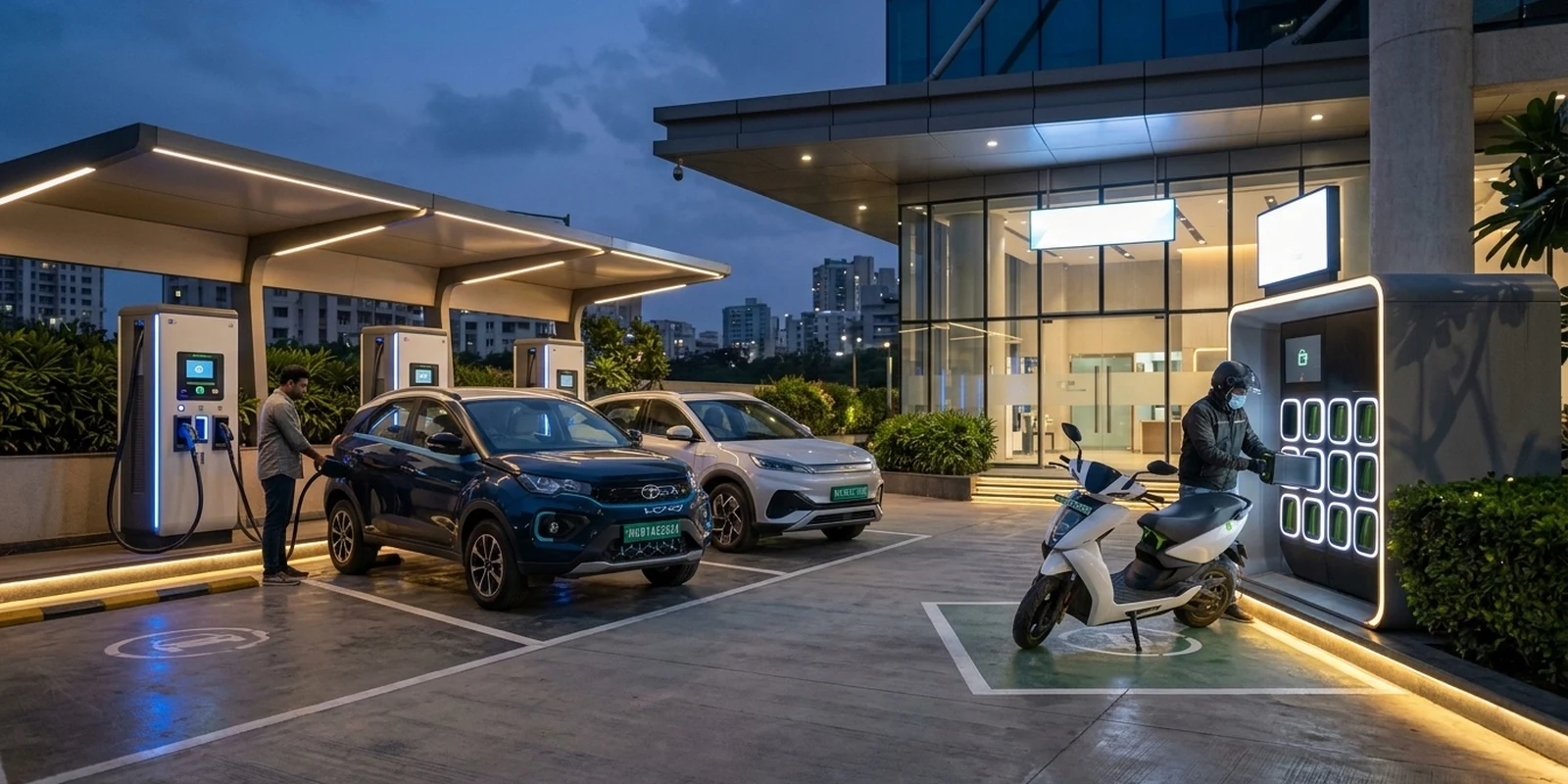
India’s EV Charger Count Hits 67,657 In 2026
💡 India EV Chargers 67,657 (2026): Key Highlights
- 67,657 EV chargers installed across India as of 07.08.2026, per Ministry of Heavy Industries (MHI) data tabled in Parliament — 1,139 are battery-swapping station chargers, broken out separately for the first time.
- FAME-II e-bus deployment: 5,299 e-buses as of 31.07.2026 (up from 5,197 a month earlier); 9,583 EV public charging stations installed specifically under FAME-II’s ₹912.50 Cr allocation.
- PM E-DRIVE has now backed 26.59 lakh EVs sold, with ₹2,000 Cr still earmarked for pan-India EVPCS deployment and ₹4,391 Cr for 14,028 e-buses.
- Across FAME-I, FAME-II, PM E-DRIVE and PLI-Auto combined, cumulative EV sales the government now counts add up to roughly 67.4 lakh vehicles.
- The PLI-ACC battery scheme has allotted 40 of its 50 GWh domestic cell-manufacturing target to four beneficiary firms — capacity that’s agnostic to whether the cells land in an EV or a swappable pack.
India now has 67,657 EV chargers installed across states and union territories as of 07 August 2026, according to fresh Ministry of Heavy Industries (MHI) data tabled in a written Lok Sabha reply on 12 August 2026. The number itself is notable, but the detail underneath it is more useful to anyone actually running charging infrastructure: for the first time, the government’s own reply separates out 1,139 battery-swapping station chargers from the plug-in count — a formal acknowledgment that swapping is now its own category of public charging infrastructure, not a footnote inside it. This is written for CPOs and eMSPs deciding what that split means for site-format planning, not for drivers picking where to plug in.
India’s EV Chargers Hit 67,657 In 2026: The New MHI Number
The 67,657 figure comes from the Ministry of Heavy Industries (MHI), given in response to a Parliament question on 12 August 2026, with the underlying data current as of 07.08.2026. It’s a different, and higher, number than the 52,718 public charging stations we reported on in July — and that’s expected, not a contradiction. The July figure came from a BHEL-portal count of public charging stations; this one is an MHI charger-level tally with a later cut-off and a broader scope that, for the first time, explicitly folds in swapping infrastructure. Both are real, official numbers — they’re just measuring slightly different things, at different points on a curve that’s moving fast either way.
For a CPO or eMSP tracking the market, the takeaway isn’t which number is “correct” — it’s that the government is now maintaining multiple, increasingly granular counts of charging infrastructure, and swapping has graduated into one of them.
Battery Swapping Gets Its Own Line Item — 1,139 Chargers, Counted For The First Time
Of the 67,657 total, 1,139 are battery-swapping station chargers — a category MHI has never broken out separately in a Parliament reply before. Earlier answers on charging infrastructure folded swapping in with plug-in chargers, or left it out of the headline number entirely. This time it gets its own line.
Why the breakout matters more than the number itself
1,139 is a small slice of 67,657 — roughly 1.7%. That’s not the story. The story is that a battery-swapping charger is now a countable unit in the same official ledger as a DC fast charger, which is usually what happens right before a category becomes financeable at scale. India’s swap-network operators (2W/3W-focused, running subscription and per-swap models) have built out swap infrastructure independent of this count for a couple of years already — industry trackers put the largest single network past 1,500 active stations. What changes now is that CPOs, lenders and policymakers have a shared, official baseline to plan against, instead of relying only on operator-reported numbers.
What Swapping-vs-Charging Coexistence Means For CPO Business Models
This section speaks to CPOs and eMSPs weighing site-format decisions; fuel retailers and real estate owners evaluating hosting will find the economics useful too. Battery swapping and plug-in charging aren’t fighting for the same vehicle. Swap networks are almost entirely a 2-wheeler and 3-wheeler play — delivery riders, e-rickshaws, last-mile fleets — where a 3–5 minute swap keeps a vehicle earning instead of idling at a plug for 45 minutes to an hour. Plug-in charging still owns cars, buses and commercial trucks, where downtime is scheduled around a shift or route rather than optimized to the minute.
That non-overlap is exactly why swapping reads as an adjacent revenue line, not a competing one, for a CPO that already operates plug-in sites. A high-footfall forecourt, a fleet hub, or a mixed-use retail site can carry a swap cabinet alongside AC/DC chargers and monetize both a Battery-as-a-Service (BaaS) subscription or per-swap fee stream and a conventional per-kWh/session stream, without one cannibalizing the other’s utilization numbers. Operators exploring what it takes to host a mixed-format charging site are increasingly weighing swap infrastructure as one more format to slot into an existing footprint, not a separate business to stand up from scratch.
The operational catch is that swap cabinets and OCPP-based chargers don’t speak the same protocol stack, and running both formats on separate, disconnected back-ends defeats the purpose of consolidating a site’s revenue and uptime reporting. A charging management system like YoCharge that can sit across OCPP-compliant fast chargers and swap-cabinet integrations on one ops dashboard is what actually makes a two-format site operable — one uptime view, one revenue reconciliation, one driver-facing app — rather than two half-managed businesses sharing a parking lot.
Scheme Execution In Numbers: FAME-II, PM E-DRIVE And PLI-Auto
The same MHI reply updates the running scoreboard on India’s demand-incentive schemes. None of these numbers are dramatic jumps — that’s the point. They read as steady, incremental execution rather than a scheme finding its footing:
| Scheme | Metric | Latest figure |
|---|---|---|
| FAME-II (2019–2024, ₹11,500 Cr) | EVs sold (e-2W/3W/4W) | ~16.72 lakh |
| FAME-II | E-buses deployed (as of 31.07.2026) | 5,299 (up from 5,197 as of 30.06.2026) |
| FAME-II | EVPCS installed (₹912.50 Cr allocated) | 9,583 |
| PM E-DRIVE (₹10,900 Cr, notified 29.09.2024) | EVs sold, cumulative to 30.06.2026 | 26.59 lakh |
| PM E-DRIVE | E-bus allocation | ₹4,391 Cr for 14,028 e-buses |
| PM E-DRIVE | EVPCS allocation | ₹2,000 Cr, pan-India rollout |
| PLI-Auto & Auto Components | EVs sold (to 31.03.2026) | ~21.30 lakh |
| PLI-ACC (₹18,100 Cr) | Cell capacity awarded | 40 of 50 GWh target, 4 firms |
| FAME-I | EVs sold | 2.80 lakh |
The reply also reiterates the policy tailwinds behind these numbers: GST on EVs and EV chargers cut to 5%, green licence plates with permit-fee exemption, and a standing MoRTH advisory urging states to waive road tax on EVs. None of this is new — the government is leaning on the same three levers rather than adding fresh ones, worth knowing if you’re modelling how much fiscal support headroom remains.
What It Means: The Market Is Diversifying In Format, Not Just Growing In Count
Read the two charger counts side by side — 52,718 in July’s BHEL-portal tally, 67,657 in this MHI reply, with 1,139 now formally tagged as swapping — and the useful signal isn’t “the market grew.” It’s that the market is diversifying in format. Fixed charging and battery swapping are both scaling, on different vehicle segments, under separate government counts. For a CPO building a multi-year site pipeline, that has a direct consequence: hardware-mix decisions can’t default to “more DC fast chargers everywhere.” The right mix depends on whether a site’s dominant traffic is 4-wheeler/commercial (favoring plug-in) or high-turnover 2W/3W (where a swap bay may earn better per square foot of forecourt).
The scheme-execution numbers point the same way: FAME-II and PM E-DRIVE aren’t producing headline jumps month to month, they’re producing steady, auditable increments — 5,197 to 5,299 e-buses, 9,583 EVPCS under one scheme alone. In a market moving like that, operational discipline — uptime, revenue-share reconciliation across formats, one pane of glass over whichever mix of chargers and swap infrastructure a site runs — is what separates operators who compound their footprint from operators who just built one.
Frequently Asked Questions
67,657 EV chargers were installed across India as of 07.08.2026, per Ministry of Heavy Industries data tabled in Parliament on 12 August 2026. This includes 1,139 battery-swapping station chargers.
They’re two separate official counts. The 52,718 figure was a BHEL-portal tally of public charging stations as of July 2026. The 67,657 figure is a newer Ministry of Heavy Industries charger-level tally (07.08.2026 cut-off) that also explicitly includes battery-swapping chargers for the first time. Both are accurate; they measure slightly different scopes at different points in time.
1,139 of the 67,657 total are battery-swapping station chargers — about 1.7% of the count, and the first time MHI has broken this category out separately in a Parliament reply.
5,299 e-buses had been deployed as of 31.07.2026, up from 5,197 as of 30.06.2026 — a steady, incremental increase rather than a sudden jump.
Rarely in practice. Swapping is concentrated in 2-wheelers and 3-wheelers, where fast turnover matters most (delivery, e-rickshaws, last-mile fleets). Plug-in charging continues to serve cars, buses and commercial fleets. For CPOs, the two formats tend to sit alongside each other on the same site as complementary revenue lines rather than cannibalizing one another.
Turn A Growing, Diversifying Charger Count Into Uptime You Can Sell
As India’s charging footprint scales past 67,000 points across fixed and swap formats, the operators who win are the ones running it on one platform — remote monitoring, dynamic pricing and OCPP/OCPI interoperability built in from day one.
Talk to SalesSource: Ministry of Heavy Industries, Lok Sabha written reply — Press Information Bureau, Government of India, 12 August 2026 (PRID 2298052).