
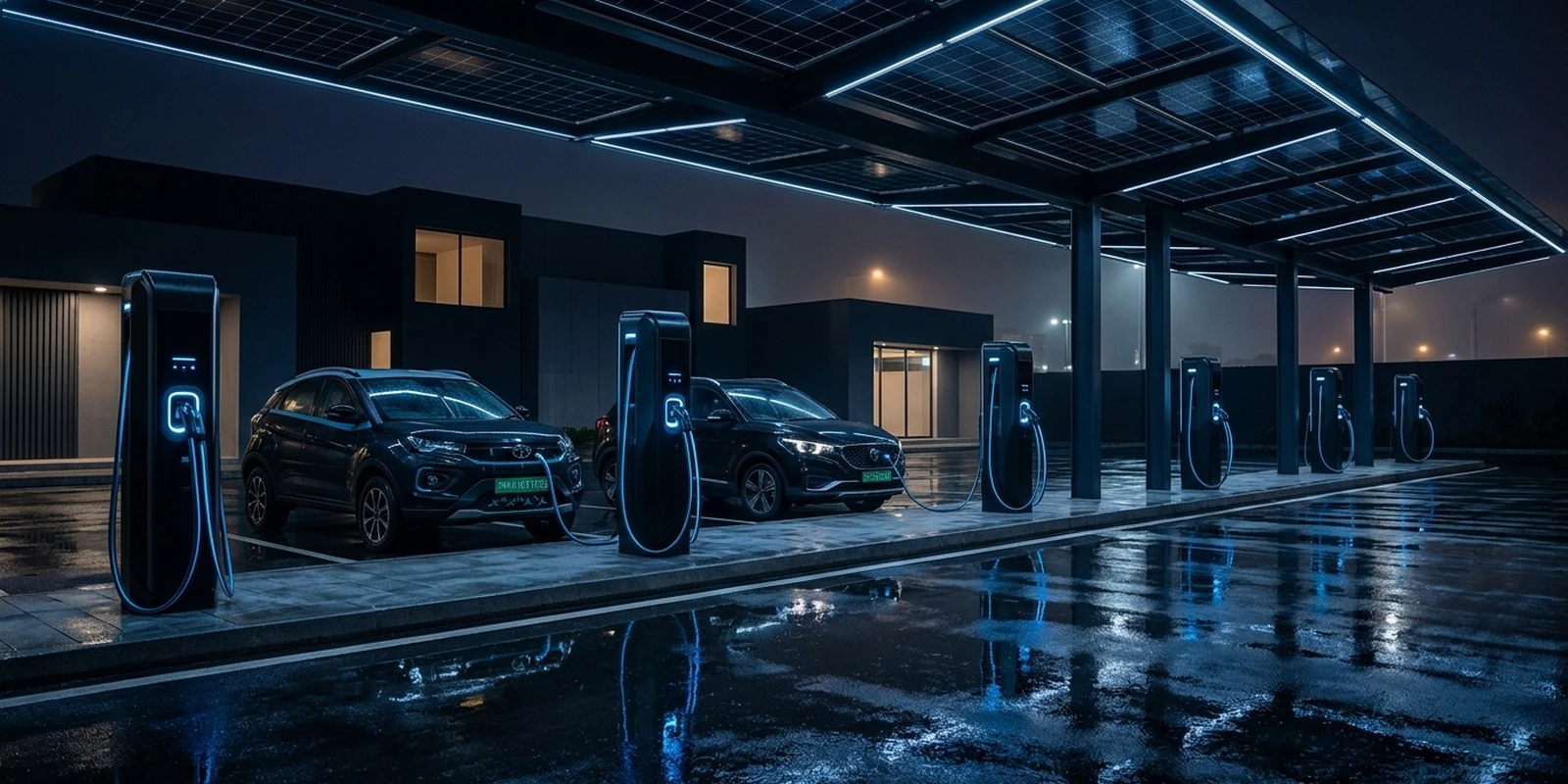
Rajasthan Opens 236 Public EV Charging Stations Under PM E-DRIVE
💡 Rajasthan EV Charging Tender: Key Highlights
- 236 public charging locations across 7 cities — roughly 700 DC chargers (a mix of 12 kW and 120 kW), plus flagship “carport” sites.
- ~₹100 crore total, split into 7 independently biddable city packages; a single bidder may take up to 4.
- Land-usage charge fixed at ₹1/kWh of electricity sold; bidders compete on a revenue share of the service charge — highest share (H1) wins each package.
- Driver service-charge ceiling: ₹11/unit in solar hours (9 AM–4 PM), ₹13/unit otherwise, until 31 March 2028.
- Pre-bid meeting 04 Aug 2026; online bids close 27 Aug 2026 (15:00) on eProc Rajasthan. 10-year O&M term, extendable by 5 years.
The Rajasthan EV charging tender is one of the most cleanly structured public-charging opportunities to open under PM E-DRIVE so far. On 28 July 2026, Rajasthan Renewable Energy Corporation Limited (RRECL) — a Government of Rajasthan undertaking — issued RfP RRECL/TN-03/2026-27, inviting Charge Point Operators to design, install, commission and run 236 public charging-station locations across seven cities: roughly 700 DC chargers and about ₹100 crore of estimated project value, carved into seven independently biddable city packages. If you operate, or plan to operate, a charging network in northern or western India, this is a mandate worth reading closely before the 27 August deadline.
What the Rajasthan EV Charging Tender Covers
The scope is full-lifecycle: design, installation, commissioning and 10-year operation & maintenance of public charging infrastructure at 236 locations spread across Jaipur, Udaipur, Kota, Ajmer, Alwar and Jodhpur, split into Category A and Category B sites. RRECL puts the hardware count at roughly 700 DC chargers — a mix of 12 kW DC units for slower, distributed points and 120 kW DC units for high-throughput corridors — alongside a set of flagship solar “carport” locations meant to double as demonstration sites.
The procurement sits under the PM E-DRIVE Scheme of the Ministry of Heavy Industries (MHI), which has earmarked ₹2,000 crore of its ₹10,900 crore outlay for public charging and set a national target of more than 72,000 chargers. Rajasthan is one of the states whose deployment proposals MHI has cleared. Practically, that means a two-body structure: MHI retains final authority over evaluation, approval and subsidy release, while RRECL runs the procurement and holds the contract. For a CPO, the important read is that the capital risk is heavily de-risked by scheme support — the competitive pressure sits almost entirely on the operating economics, not the build.
The 7 City Packages: Locations, Value and EMD
Each of the seven cities is a self-contained package with its own estimated value and bid security (EMD). MSMEs registered in Rajasthan pay 25% of the listed EMD; certain notified sick industries pay 50%.
| City package | Locations | Est. value | Bid security (EMD) |
|---|---|---|---|
| Jaipur I | 38 | ₹16.20 cr | ₹32,39,200 |
| Jaipur II | 38 | ₹14.67 cr | ₹29,33,900 |
| Udaipur | 32 | ₹14.66 cr | ₹29,31,700 |
| Kota | 22 | ₹9.48 cr | ₹18,96,000 |
| Ajmer | 40 | ₹16.07 cr | ₹32,14,800 |
| Alwar | 40 | ₹16.07 cr | ₹32,14,800 |
| Jodhpur | 26 | ₹12.62 cr | ₹25,23,400 |
| Total (7 packages) | 236 | ~₹100 cr | — |
Ajmer and Alwar are the largest by location count (40 each); the two Jaipur packages are the highest-value single-city plays. Because packages are priced and awarded separately, a bidder can build a portfolio strategy — concentrating in one metro, or spreading across cities to diversify utilisation risk.
How the Commercial Model Works
This is where the Rajasthan EV charging tender differs from a plain capex tender, and where CPOs should model carefully. Selection is single-stage, two-part bidding. The land-usage charge payable to the site owner is fixed at ₹1 per kWh of electricity sold — so bidders don’t compete on rent. Instead, each bidder quotes a revenue share on the MoP service-charge component (in ₹/kWh), and the highest revenue share (H1) wins each package. Winners lodge a performance security of 10% of the estimated package value.
What a CPO can actually charge drivers is capped. Until 31 March 2028, the service charge is ceiling-bound at ₹11/unit during solar hours (9 AM–4 PM) and ₹13/unit outside them, per MoP guidelines — on top of the pass-through electricity tariff. That ceiling, combined with a revenue-share bid, means margin is made or lost on two levers you control after go-live: utilisation and cost-to-serve. Winning aggressively on revenue share only works if you can hold uptime high and settle the shared revenue cleanly across every session — which is why disciplined payment and billing software and per-package reconciliation matter as much as the bid itself.
⏰ Key dates — time-sensitive
- 28 Jul 2026 (15:00): RfP available; online bid submission opens.
- 04 Aug 2026 (15:00): Pre-bid meeting.
- 07 Aug 2026 (15:00): Last date to submit pre-bid queries.
- 27 Aug 2026 (15:00): Last date for online bid submission.
How to Bid: Eligibility, Packages and Fees
The lead entity must be a charge point operator; JV or consortium bids are allowed provided the lead partner holds more than 51%. A single bidder may bid for a maximum of 4 packages, and cannot bid for both Jaipur I and Jaipur II — you must pick one. Bids are submitted online on the eProc Rajasthan portal (with updates also posted on the SPPP and RRECL websites), and a Class III digital signature certificate (DSC) is required to submit. Two charges apply on top of the EMD: a non-refundable RfP document cost of ₹2,950 (incl. 18% GST) and a RISL processing fee of ₹2,500.
Why Software Decides Which Bids Are Actually Profitable
A 10-year, multi-city O&M mandate is won on price but kept profitable on operations. Once the award lands, a CPO is running dozens of sites across up to four cities, under a fixed service-charge ceiling and a revenue-share obligation — the exact conditions where thin margins get eaten by downtime, manual reconciliation and idle high-power assets. Three capabilities decide the outcome. First, remote monitoring and uptime SLAs: a dead 120 kW charger in Ajmer that nobody notices for two days is pure lost revenue against a fixed-ceiling model. Second, dynamic pricing and power control — shifting load and pricing within the ₹11/₹13 solar-hour bands, and balancing a mixed 12 kW/120 kW fleet, is exactly what dynamic load management exists to do. Third, revenue-share settlement reconciled per package, so what you owe RRECL is auditable to the session.
This is the difference between a bid that is winnable and one that is operable at scale. Running 236 sites profitably under a government contract is a software problem long before it is a hardware one — which is why operators entering tenders like this increasingly build on a charging management system like YoCharge, white-labelled under their own brand, rather than stitching together per-city point tools. The platform that reconciles revenue share, holds uptime and prices within the ceiling across every package is what turns an aggressive H1 bid into a ten-year annuity instead of a ten-year liability.
Frequently Asked Questions
Source: RRECL RfP RRECL/TN-03/2026-27 — Rajasthan Renewable Energy Corporation Limited, 28 July 2026, via the BHEL PM E-DRIVE tenders portal (proposals PMEDRIVE/RRECL/P0290 & P0276).
Bidding a PM E-DRIVE package? Make sure it’s operable at scale.
YoCharge is the white-label CMS + eMSP platform CPOs use to run multi-city public networks — remote uptime monitoring, ceiling-aware dynamic pricing and per-package revenue-share reconciliation from one dashboard. See how it fits a tender like Rajasthan’s.
Get a Demo