
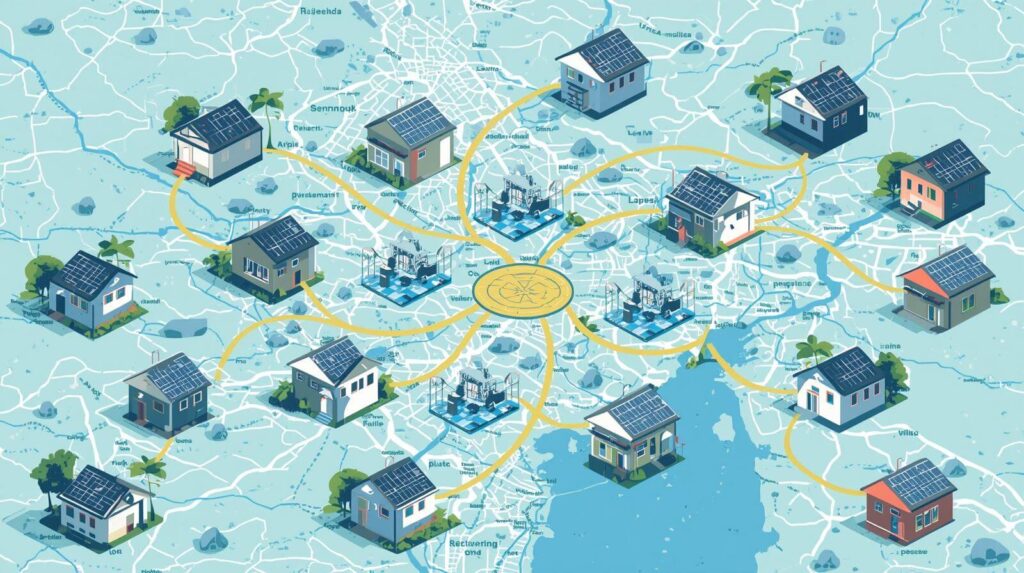
The Rajasthan Electricity Regulatory Commission (RERC) has introduced a groundbreaking regulatory framework through the Grid Interactive Distributed Renewable Energy Generating Systems (Third Amendment) Regulations, 2025, formally establishing Virtual Net Metering (VNM) as a transformative mechanism for distributed renewable energy adoption in the state[1]. This article provides a comprehensive analysis of the scope, opportunities, and implementation framework for Solar Virtual Net-Metering in Rajasthan, based on the official RERC regulations and contemporary regulatory practices.
Virtual Net Metering represents a paradigm shift from traditional net metering by enabling multiple consumers to benefit from a single centrally-located renewable energy generating system. Unlike conventional net metering that links one generation point to one consumer, VNM allows entire energy generated from a renewable system to be distributed proportionally among multiple consumer connections within the same distribution licensee’s area of supply[2].
This regulatory innovation addresses a critical gap in India’s distributed solar policy landscape by providing equitable access to clean energy benefits for consumers without adequate rooftop space, including apartment dwellers, multi-location businesses, and institutions.
1. Introduction and Background
1.1 Context and Regulatory Evolution
India has established an ambitious renewable energy target of 175 GW by 2025, with solar energy playing a central role in this transition[3]. While utility-scale solar projects have achieved grid parity, rooftop solar adoption has lagged considerably, particularly in urban areas where space constraints limit individual installation options. Rajasthan, as a state with exceptional solar potential (averaging 300+ sunny days annually), has proactively sought regulatory mechanisms to unlock this potential while ensuring inclusive participation across consumer categories[4].
The introduction of Virtual Net Metering in Rajasthan’s 2025 regulatory amendments addresses three fundamental challenges:
- Geographical barrier: Consumers without rooftop space cannot install their own systems
- Scale limitation: Individual installations may not achieve economies of scale
- Equity concern: Solar benefits remain concentrated among property owners, excluding apartment residents and renters.
1.2 Regulatory Framework
The regulatory framework governing Virtual Net Metering in Rajasthan comprises:
- Rajasthan Electricity Regulatory Commission (Grid Interactive Distributed Renewable Energy Generating Systems) (Third Amendment) Regulations, 2025[1]
- Central Electricity Authority (CEA) Technical Standards for Connectivity of Distributed Generation Resources Regulations, 2013
- Central Electricity Authority (Installation and Operation of Meters) Regulations, 2006
- Indian Electricity Rules, 1956
- Rajasthan Integrated Clean Energy Policy, 2024
These regulations establish a comprehensive governance structure ensuring technical feasibility, safety compliance, and equitable energy distribution mechanisms[1].
2. Definitional Framework and Scope
2.1 Virtual Net Metering Definition
As per Regulation 2.1(dd) of RERC regulations, Virtual Net Metering is formally defined as:
“An arrangement whereby entire energy generated / injected from a Renewable Energy System situated in single location or Battery Energy Storage System (BESS) charged through Renewable Energy System is exported to the grid from renewable energy meter/ gross meter and the energy exported is adjusted in more than one electricity service connection(s) of participating consumers located within the same distribution licensee’s area of supply”[1]
Key definitional elements:
- Single generation point with distributed credit mechanism
- Energy exported to grid (not consumed directly on-site)
- Proportional credit adjustment across multiple consumer accounts
- Geographic scope limited to single distribution licensee area
- Applicable to both renewable systems and BESS-charged arrangements.
2.2 Comparative Analysis: VNM vs. Traditional Net Metering
| Parameter | Traditional Net Metering | Group Net Metering | Virtual Net Metering |
|---|---|---|---|
| Number of consumer connections | One | Multiple (same consumer) | Multiple (different consumers) |
| Generation location | Consumer premises | Consumer premises | Single location (off-site/on-site) |
| Energy allocation mechanism | Single account settlement | Priority-based sequence | Proportional sharing ratio |
| Lead Consumer requirement | No | No | Yes (nodal point) |
| Applicable consumer categories | All | All | All |
| RESCO participation | Yes | Yes | Yes |
Table 1: Comparative Analysis of Net Metering Arrangements in Rajasthan.
2.3 Lead Consumer Responsibilities
The VNM framework introduces the concept of “Lead Consumer” as defined in Regulation 2.1(ff):
“The person who is himself a participating consumer and is nominated by other participating consumers under Virtual Net Metering for making all correspondence on their behalf with the Distribution Licensee”[1]
Mandated responsibilities of Lead Consumer:
- Shall be one of the participating consumers under VNM and signatory to Net Metering Agreement on behalf of participating consumers
- Act as nodal person for all correspondence with Distribution Licensee
- Communicate changes in Lead Person status in writing with approval from all participating consumers
- Manage sharing ratio changes and amendments to consumer list
- Serve as single point of contact for DISCOM communications
3. Eligibility Criteria and Consumer Categories
3.1 Consumer Eligibility Parameters
Virtual Net Metering is available to all consumer categories under the following conditions:
General eligibility requirements:
- Arrear status: Consumers with pending arrears with DISCOM are ineligible unless dispute is pending and disputed amount is deposited with DISCOM as per Section 56 of the Electricity Act, 2003[1]
- Payment history: Prior to connection, no pending electricity charges should exist
- Government connections: May be permitted conditional participation subject to DISCOM arrangements
- Geographic scope: All participating consumers must be within the same distribution licensee’s area of supply
3.2 Applicable Consumer Categories
VNM is explicitly applicable to the following consumer categories:
- Domestic consumers: Residential households, multi-unit apartment buildings, residential complexes
- Commercial consumers: Shops, offices, malls, commercial establishments
- Industrial consumers: Manufacturing units, industrial complexes, industrial parks
- Government consumers: Government buildings, institutions, public facilities
- Institutional consumers: Schools, colleges, hospitals, NGOs, religious institutions
- Agricultural consumers: Farmer associations, agricultural cooperatives
This broad applicability represents a significant policy advancement, as earlier net metering frameworks were sometimes restricted by consumer category[1].
3.3 Arrear Exemptions and Special Cases
The regulations provide specific exemptions:
- Government connections may be permitted conditional participation subject to DISCOM’s discretionary arrangements[1]
- Dispute resolution pathway allows consumers with disputed amounts to participate upon deposit with DISCOM
- No categorical discrimination in VNM eligibility based on consumer type.
4. Capacity, Locations, and Installation Framework
4.1 Capacity Specifications
The regulations establish clear capacity parameters for Virtual Net Metering systems:
| Parameter | Specification |
| Minimum capacity | >1 kW (more than one kilowatt) |
| Maximum capacity | 1 MW (one megawatt) |
| Cumulative limit | Not exceeding 100% of cumulative Sanctioned Load/Contract Demand of participating consumers |
| Individual consumer limit | Each consumer eligible up to its own Sanctioned Load/Contract Demand |
| Capacity conformity | Must comply with Rajasthan Electricity Regulatory Commission (Electricity Supply Code) Regulations, 2021 |
Table 2: Virtual Net Metering Capacity Framework
Special provision for contract demand consumers: Consumers with contract demand of 100 kW or more and up to 1 MW have the flexibility to choose either VNM/Group Net Metering OR Green Energy Open Access arrangements[1].
4.2 Installation Location Options
Virtual Net Metering systems can be installed at diverse locations, enabling significant flexibility for renewable system placement:
- Rooftop installations: Traditional rooftop solar systems on building structures
- Ground-mounted systems: Ground-based installations on open land
- Elevated structures: Installations on elevated platforms, canopies, parking structures
- Water bodies: Floating solar installations on ponds, lakes, reservoirs, water treatment plants
- Open land: Unbuilt land within the distribution area
- Balcony installations: Residential balcony-mounted systems
- Public land: With appropriate permissions from land authorities
This expanded location scope significantly increases viable installation sites beyond traditional rooftop constraints[2].
4.3 Ownership and Operational Models
Virtual Net Metering systems can be owned and operated through multiple models:
- CAPEX Mode – Self-owned: Consumer owns and operates the renewable energy system
- RESCO Mode: Renewable Energy Service Company (RESCO) owns and operates the system
- Utility-led Aggregator Mode: Distribution Licensee or its designated aggregator develops and operates the system
RESCO Model – Commercial Arrangements: The regulations explicitly provide that commercial arrangements between participating consumers and RESCO for system setup and operation are mutually agreed, with DISCOM having no role in such commercial terms[1]. Land owners may lease/rent rooftop or land space to RESCO on a mutual commercial basis.
5. Technical Feasibility and Approval Process
5.1 Technical Feasibility Assessment Framework
The RERC regulations establish a streamlined technical feasibility process to accelerate renewable energy adoption:
Standard process:
- Technical feasibility study completed within 15 days
- Outcome intimated to applicant within specified period
- Failure to complete study within stipulated time results in presumption of technical feasibility[1]
Deemed Feasibility Exemption:
Applications for renewable energy systems up to 10 kW capacity under Domestic category only, submitted under Net Metering or Virtual Net Metering or Group Net Metering arrangements, and complete in all respects, are deemed to have been accepted without requiring technical feasibility study. Commensurate enhancement of sanctioned load is automatically carried out by DISCOM[1].
Extended process for VNM/GNM:
- For existing consumers or systems already connected: 15-day feasibility study period[1]
- For new consumers or systems seeking fresh connectivity: 30-day feasibility study period[1]
- Connectivity grant timeline: 30 days from date of technical feasibility declaration[1]
5.2 Technical Feasibility Study Scope
Technical feasibility studies shall address:
- Distribution system adequacy at point of interconnection
- Transformer capacity availability and loading levels
- Reverse power flow management capability
- Power quality impact assessment
- Voltage fluctuation analysis
- Protection and coordination requirements
- Metering point identification
- Network reinforcement needs, if any.
5.3 Technical Standards Compliance
All virtual net metering systems must comply with:
- Central Electricity Authority (Technical Standards for Connectivity of Distributed Generation Resources) Regulations, 2013
- Central Electricity Authority (Grid Standard) Regulations 2010
- CEA (Measures Relating to Safety and Electricity Supply) Regulations 2010
- Indian Electricity Rules, 1956
- BIS/IEEE/IEC standards as applicable
- State-specific distribution code requirements.
6. Metering Infrastructure and Energy Accounting
6.1 Metering Configuration
Virtual Net Metering requires specific metering infrastructure as per Regulation 11 and CEA (Installation and Operation of Meters) Regulations, 2006:
| Meter Type | Purpose & Installation Point |
| Renewable Energy Meter (Solar Meter) | Measures total energy generated from RE system |
| Net Meter/Gross Meter | Measures net energy export to grid (entire generation) |
| Consumer Meters | Measure individual consumer consumption at each participating account |
| Data Recording Equipment | Capture voltage, frequency, power quality parameters |
Table 3: Virtual Net Metering Metering Infrastructure
Advanced Metering Infrastructure (AMI) requirements:
- Real-time data transfer capabilities to DISCOM systems
- Online monitoring and reporting functionality
- Digital billing software integration for energy credit distribution
- OPC 2.0a (or later, including OPC UA) compliance for SCADA systems[1]
6.2 Energy Accounting and Settlement Mechanism
The VNM energy accounting mechanism operates as follows per Regulation 12.6(A).13:
Energy credit distribution process:
- Proportional allocation: Energy generated from renewable system is credited to each participating consumer’s monthly electricity bill as per the ratio of procurement indicated in the agreement/MOU on stamp paper[1]
- Ratio-based settlement: Each consumer receives credits in proportion to their declared sharing ratio, enabling flexible allocation among participants
- Monthly billing cycle: Energy credits adjusted during regular monthly billing period of respective consumers
- Excess generation management: If adjusted quantum exceeds imported quantum during billing period, excess energy is purchased by DISCOM as per Regulation 12.6.1(a) rates[1]
- Crediting mechanism:
- Energy generated from RE system credited to each consumer’s account proportionally
- Credits reduce consumer’s billed units
- Monetary value: equivalent to applicable tariff rates for respective consumer categories
6.3 Time-of-Day (ToD) Compensation
For Time-of-Day consumers, special compensation rules apply per Regulation 12.6(A).13(d):
ToD settlement mechanism:
- Energy generated in any time block (peak/off-peak/normal) first compensated with consumption in corresponding time blocks of same billing cycle
- Surplus generation over consumption in any time block counted as off-peak hour credits
- Settlement sequence: from lowest tariff to highest tariff ToD block
- Enables optimization for consumers on differential tariff structures[1]
6.4 Annual Settlement and Credit Carry-Forward
End-of-year settlement provisions:
- Unadjusted credits from one billing period can be carried to subsequent months
- At financial year-end, remaining credits are settled through payment by DISCOM
- Payment subject to deduction of any pending dues of that service connection
- Credits cannot roll indefinitely; annual settlement ensures timely realization[1]
6.5 Disconnection and Credit Protection
Protection for disconnected connections:
If any participating consumer’s service connection is disconnected due to any legal reason, unadjusted units/remaining credits of that consumer shall be:
- Paid by DISCOM at end of financial year
- Subject to settlement of any pending dues of that consumer per Regulation 12.6.1(a)[1]
This ensures participating consumers receive due compensation even upon service disconnection.
7. Charge Structure and Regulatory Exemptions
7.1 Charge Exemptions for Domestic Consumers
Per Regulation 15.4, domestic category consumers under VNM (both self-owned and RESCO-owned) enjoy comprehensive exemption from all charges:
- Banking charges: Fully exempted
- Transmission charges: Fully exempted
- Transmission losses: Fully exempted
- Wheeling charges: Fully exempted
- Wheeling losses: Fully exempted
- Cross-subsidy surcharge: Fully exempted
- Additional surcharge: Fully exempted
This comprehensive exemption represents a major policy incentive to promote solar adoption among residential consumers[1].
7.2 Charge Structure for Non-Domestic Consumers – Self-Owned
Per Regulation 15.5, non-domestic category consumers with self-owned RE systems receive differentiated exemptions:
Systems installed on eligible consumer premises:
- Exemption: Banking charges, Transmission charges, Transmission losses, Wheeling charges, Cross-subsidy surcharge, Wheeling losses
- Applicable: None of the above charges apply
Systems installed at other location:
- Exemption: Banking charges, Transmission charges, Transmission losses, Cross-subsidy surcharge
- Applicable: Wheeling charges and losses at applicable voltage level rate (or 11 KV level if not determined)[1]
7.3 Charge Structure for Non-Domestic Consumers – RESCO-Owned
Per Regulation 15.6, RESCO-owned systems for non-domestic consumers have specific charge implications:
Systems installed on eligible consumer premises:
- Full exemption: Banking charges, Transmission charges, Transmission losses, Wheeling losses, Wheeling charges
Systems installed at other location:
- Exemption: Banking charges, Transmission charges, Transmission losses
- Applicable: Wheeling charges and losses at applicable voltage level
- Special provision: Cross-subsidy surcharge and additional surcharge at 50% of open access rates[1]
For consumer categories without determined surcharges:
- Provisional surcharge: Rs. 1.25/kWh applicable until revised by Commission[1]
Government connections exemption:
- No Cross Subsidy Surcharge or Additional Surcharge for Government connections under VNM/GNM (both self-owned and RESCO-owned)[1]
7.4 Battery Energy Storage System (BESS) Incentives
The regulations introduce progressive incentive structure for BESS integration:
BESS wheeling charge waivers per Regulation 15.7:
- 5% BESS capacity: 75% wheeling charge waiver
- 5-30% BESS capacity: Progressive exemption: 75% + (additional 1% per 1% capacity increase), capped at additional exemptions
- Beyond 30% BESS capacity: 100% wheeling charge exemption[1]
This incentive structure encourages battery integration for improved renewable energy utilization and grid stability.
7.5 Fee and Security Deposit Waivers
Per Regulation 15.8, domestic category consumers installing plants under Net Metering, Virtual Net Metering, and Group Net Metering arrangements receive:
- Application fee waiver: Fully waived
- Security deposit waiver: Fully waived
- Meter testing charges waiver: Fully waived
Validity: These waivers applicable until achievement of five lakh (500,000) houses target for rooftop solar installations in state, or as revised by State Government[1]
Note: Requirement of execution of connection agreement for domestic consumers also waived till achievement of five lakh house target[1].
8. Operational Framework and Agreements
8.1 Connection Agreement Requirements
All VNM implementations require formal Connection Agreements between participating consumers and DISCOM (or tripartite with RESCO in RESCO mode) as per Regulation 12.6(A).9:
Mandatory agreement elements:
- Eligibility confirmations and legal compliance acknowledgments
- Technical specifications and interconnection requirements
- Safety and protection standards
- Clearances and approvals documentation
- Access and disconnection rights
- Liability and indemnification clauses
- Energy metering, accounting, and settlement procedures
- Connection cost allocation
- Termination provisions
- Lead Consumer designation (for VNM)
- Applicable regulatory framework and governing law[1]
8.2 Application Procedure
Eligible consumers proposing VNM installation must:
- Application submission: File application in Model Form Annexure IV-C-1 with complete documentation[1]
- Required documents: Provide ID proofs, site ownership proof, EPC/RESCO credentials, consumer agreement
- Sharing ratio declaration: Submit agreement on stamp paper detailing each consumer’s procurement ratio
- Lead Consumer nomination: Identify and get consent from all participating consumers
- Technical feasibility review: 15-30 day review period depending on existing/new connection status.
8.3 Sharing Ratio Modification
Per Regulation 12.6(A).13(b) and Annexure IV-D provisions:
- Participating consumers have right to change sharing ratios once per financial year
- Minimum notice period: 2 months in advance to DISCOM
- Submission: Fresh agreement/MOU on stamp paper with revised consumer list
- Process: Equivalent to original VNM application process[1]
This flexibility allows adjustments in energy allocation based on changing consumer needs.
9. Regulatory Safeguards and Limitations
9.1 Open Access and Third-Party Sales Restrictions
Per Regulation 7.7, specific restrictions apply to VNM connections:
Open access availability:
- Restricted to wheeling of energy to beneficiary consumers/connections of same consumer
- Purpose: Distribution of energy among participating consumers only
Third-party sales prohibition:
- Prohibited under Net Metering, Group Net Metering, Virtual Net Metering arrangements
- Exception: RESCO model as specifically permitted in regulations
- Rationale: Ensure energy remains within defined consumer group[1]
9.2 Charges and Losses Levied on Beneficiary Consumers
Per Regulation 7.7, VNM beneficiary consumers shall be charged:
- Transmission losses: Applied to distributed quantum
- Other applicable charges: As per respective regulation provisions
- Rationale: Beneficiary consumers bear proportional share of distribution system costs[1]
9.3 Consumer Eligibility Restrictions
Transition restrictions from other arrangements:
Consumers previously opted for traditional Net Metering arrangement shall be allowed to enter GNM or VNM only after termination of existing connection agreement[1].
Conversely, consumers under Net Billing arrangement are not entitled for VNM or Group Net Metering under these Regulations[1].
9.4 Technical Compliance and Safety Standards
All VNM systems must strictly comply with:
- BESS technical standards per Annexure VII (if battery storage included)
- CEA Technical Standards for Connectivity of Distributed Generation
- IEC 62485-2, UL 1973, IEC 62933 standards (for BESS)
- Power quality standards per applicable CEA regulations
- Fire protection systems and thermal runaway characterization (for high-density BESS)
Non-compliance results in potential system disconnection[1].
10. Ownership Models and Commercial Arrangements
10.1 CAPEX Mode – Consumer Ownership
In CAPEX mode, participating consumers own and operate the renewable energy generating system:
Consumer responsibilities:
- Bear all setup costs including equipment, installation, metering, interconnection
- Maintain and operate system throughout its life (typically 25 years)
- Ensure ongoing safety and technical compliance
- Provide DISCOM access for monitoring and maintenance
- Comply with all regulatory and statutory requirements
Advantages:
- Full ownership and operational control
- Maximum long-term financial benefit
- Exemption from most charges (for domestic)
- Flexibility in system upgrades and enhancements.
10.2 RESCO Mode – Third-Party Ownership
In RESCO mode, a Renewable Energy Service Company owns, finances, and operates the system:
RESCO responsibilities:
- Conduct feasibility assessment
- Finance, procure, and install system
- Operate and maintain system
- Ensure performance and warranty compliance
- Pay DISCOM charges and connection costs
- Provide performance guarantees
Consumer benefits:
- Zero upfront capital investment
- Performance guarantees from RESCO
- Reduced financial and technical risks
- Access to professional operation
- Monetary payment of surplus energy per agreed rates
Commercial terms:
- Privately negotiated between RESCO and participating consumers
- DISCOM has no role in commercial arrangement
- Fixed PPA terms typically 25 years
- Energy purchased at rate specified in agreement[1]
10.3 Utility-Led Aggregator Model
Distribution Licensee or designated aggregator can develop and operate VNM systems:
Potential arrangements:
- DISCOM-owned renewable plants supplying multiple beneficiary consumers
- Professional aggregator platforms managing consumer groups
- Standardized tariff structures with regulatory oversight
Benefits:
- Professional management and monitoring
- Regulatory oversight ensuring consumer protection
- Simplified participation for consumers
11. Scope and Opportunities in Rajasthan
11.1 Market Potential and Customer Segments
Virtual Net Metering unlocks renewable energy access for previously excluded consumer segments:
High-potential customer groups:
- Residential apartment complexes: Multi-unit buildings without adequate rooftop space per unit
- Institutional consumers: Schools, colleges, hospitals, government buildings with distributed facilities
- Commercial real estate: Shopping malls, office parks with multiple leasehold occupants
- Industrial clusters: Manufacturing zones with multiple adjacent units
- Urban consumers: Apartment dwellers in cities unable to install individual rooftops
- Agricultural cooperatives: Groups of farmers sharing common solar installations
- Government institutions: Public facilities with multiple service connections
Market expansion estimate: Research indicates VNM can expand solar addressable market by 25-35% in urban areas by incorporating apartment residents and renters previously excluded from net metering benefits[3].
11.2 Economic Opportunities for Stakeholders
For consumers:
- Bill savings through proportional energy credits
- No upfront capital investment (in RESCO model)
- Reduced electricity tariff burden
- Environmental benefits of renewable energy participation
For distribution companies:
- Reduced distribution losses (generation closer to consumption)
- Improved demand-side management
- Support for Renewable Purchase Obligations (RPOs)
- Reduced peak demand pressure
- Enhanced customer satisfaction and retention
For developers and RESCOs:
- Expanded market opportunities beyond individual rooftop installations
- Access to non-rooftop installation sites (land, water bodies)
- Aggregation benefits leading to economies of scale
- Longer-term contracted revenue streams
- Growing demand from sustainability-focused institutions and businesses
For state and central governments:
- Acceleration toward 40 GW rooftop solar target (national)
- Progress toward Net Zero 2070 commitment
- Job creation in renewable installation and maintenance sectors
- Reduced coal-based generation requirement
- Improved energy independence and security.
11.3 Geographic and Sectoral Expansion Potential
Geographic expansion potential:
- All distribution circles of Rajasthan (JVVNL, AVVNL, JDVVNL areas)
- Urban agglomerations with high population density
- Institutional clusters in cities
- Industrial zones and business parks
- Agricultural belts for community solar initiatives
Sectoral expansion opportunities:
- Hospitality sector: Hotels, resorts, tourism facilities
- Healthcare: Hospital chains with multiple locations
- Education: School and college networks across state
- Manufacturing: Industrial clusters and SEZs
- Retail: Shopping mall chains with distributed properties
- Government: School, healthcare, administrative buildings.
11.4 Integration with Emerging Technologies
VNM framework enables integration with advancing technologies:
Battery Energy Storage System (BESS) integration:
- 75-100% wheeling charge waivers for BESS capacity (per regulatory provisions)
- Time-shifting of renewable generation for peak demand management
- Enhanced grid stability during solar intermittency periods[1]
Smart metering and IoT:
- Advanced Metering Infrastructure (AMI) enabling real-time monitoring
- Digital billing platform automation
- Predictive analytics for consumption and generation
- Consumer energy management dashboards
Blockchain and P2P trading:
- RERC framework explicitly provides pathway for blockchain-based P2P energy trading implementation (Regulation 19(A))[1]
- Direct consumer-to-consumer energy transactions (future implementation)
- Transparent and decentralized settlement mechanisms
Plug-and-play solar systems:
- RERC framework recognizes plug-and-play systems as separate category (Regulation 3.2(g))[1]
- Simplified installation and connection processes
- Reduced technical barriers to entry.
12. Regulatory Governance and Compliance Framework
12.1 Distribution Company Obligations
DISCOMs under VNM framework must:
- Non-discriminatory access: Offer VNM on non-discriminatory ‘first come first serve’ basis[1]
- Capacity transparency: Update distribution transformer level capacity availability yearly on website[1]
- Timely approvals: Complete technical feasibility within specified timeframes (15/30 days as applicable)[1]
- Meter installation: Install metering equipment within specified timeframes post-approval
- Connectivity: Grant connectivity within 30 days of technical feasibility declaration for VNM/GNM[1]
- Billing accuracy: Ensure accurate pro-rata energy credit allocation per approved sharing ratios
- Settlement process: Timely calculation and crediting of energy payments
- Regulatory compliance: Adhere to all CEA standards and RERC directives
- Consumer protection: Maintain dispute resolution mechanisms.
12.2 Consumer Obligations
Participating consumers must:
- Technical compliance: Ensure installation meets all CEA standards and Rajasthan Distribution Code requirements
- Safety measures: Install isolation devices (automatic and manual) per technical specifications[1]
- Approval compliance: Obtain requisite test certificates and approvals before commissioning
- Data provision: Furnish voltage, frequency, breaker/isolator status data to DISCOM as required[1]
- Online monitoring: Provide facilities for real-time operational data transfer[1]
- Grid coordination: Coordinate with DISCOM for maintenance and repair activities
- Agreement compliance: Adhere to connection agreement terms and DISCOM’s conditions of service
- No third-party sales: Restrict energy sales to beneficiary consumers only (unless RESCO-designated parties).
12.3 Regulatory Oversight and Enforcement
RERC enforcement mechanisms:
- Penalty provisions: Per Regulation 12.6(A).14, non-compliance results in liability for penalty as decided by Commission[1]
- System disconnection: DISCOM may disconnect non-compliant systems upon determination of safety/technical issues[1]
- Dispute resolution: Consumer grievances addressed through RERC framework
- Performance monitoring: BESS systems require continuous monitoring and reporting (Annexure VII)[1]
- Annual compliance reporting: DISCOMs required to report VNM installation and performance metrics to RERC.
13. Key Challenges and Mitigation Strategies
13.1 Identified Challenges
Technical challenges:
- Grid integration complexity with distributed generation
- Reverse power flow management and protection coordination
- Power quality maintenance with multiple injection points
- Metering accuracy and data integrity
- Real-time demand forecasting for intermittent solar generation
Commercial challenges:
- RESCO payment collection from consumers
- Energy credit valuation consistency across consumer categories
- Cost allocation fairness among participating consumers
- Shared liability management among multiple parties
Regulatory challenges:
- Inter-state transmission for energy export (if applicable)
- RPO compliance for surplus energy purchased by DISCOM
- Cross-subsidy surcharge determination for different consumer categories
Operational challenges:
- Lead Consumer coordination with multiple participating consumers
- Sharing ratio change management during financial year
- Disconnection procedures with multiple beneficiaries
- Consumer grievance resolution complexity.
13.2 Proposed Mitigation Strategies
Technical solutions:
- Advanced metering infrastructure (AMI) with real-time monitoring capability
- Automated protection relays and intelligent inverters
- Continuous power quality monitoring systems
- Forecasting algorithms for solar generation and consumption patterns
Commercial arrangements:
- Standardized RESCO contracts approved by RERC
- Transparent tariff determination by Commission
- Third-party auditing of billing accuracy
- Consumer education on VNM benefits and mechanics
Regulatory mechanisms:
- Graduated implementation with pilot zones
- Regular review of charge structures (annual/biennial)
- Consumer complaint redressal through RERC
- DISCOM performance benchmarking
Operational improvements:
- Digital platforms for lead consumer management
- Automated sharing ratio change processing
- Standardized disconnection protocols
- Consumer helplines and grievance management systems.
14. Comparison with Other States’ Frameworks
14.1 International Best Practices
United States – Massachusetts Model:
- Pioneering jurisdiction for VNM implementation
- Allows residential consumers to jointly own solar systems
- Market net metering credits allocation system
- Minimum reliability charge offsetting grid maintenance costs[3]
- Subscription-based participation enabling low-income community access.
Key learnings for Rajasthan:
- Emphasis on joint ownership mechanisms
- Community-based solar models
- Credit allocation transparency
- Low-income consumer inclusion.
14.2 Other Indian States
Delhi (DERC):
- Group Net Metering and Virtual Net Metering Guidelines, 2019
- Similar proportional credit allocation mechanism
- RESCO ownership model permitted
- Consumer category-based charge differentiation[1]
Key differences in Rajasthan’s approach:
- Deemed feasibility exemption for domestic ≤10 kW systems
- Comprehensive charge waiver for domestic category
- BESS integration incentives (75-100% wheeling charge waiver)
- Explicit pathway for P2P trading and plug-and-play systems
- Lead Consumer governance framework
- Unified tariff application across all consumer categories (except surcharges).
15. Implementation Roadmap and Timeline
15.1 Phase-wise Implementation Strategy
Phase 1 – Foundation (January – March 2025):
- DISCOM staff training on VNM regulations
- Digital billing system upgrades for pro-rata credit allocation
- Metering infrastructure procurement and installation protocols
- Consumer awareness campaigns
- Model agreement finalization
Phase 2 – Pilot Rollout (April – September 2025):
- Pilot implementations in 2-3 selected distribution zones per DISCOM
- 100-500 consumer groups targeting diverse segments
- Process optimization and feedback collection
- Performance monitoring and reporting
Phase 3 – Scale-up (October 2025 – December 2026):
- Expansion to all distribution zones
- Simplified digital application platforms launch
- Enhanced consumer support infrastructure
- Regulatory review and amendments if needed
- Integration with state government schemes (Rajasthan Integrated Clean Energy Policy targets)
Phase 4 – Technology Integration (2026-2027):
- BESS-integrated VNM systems scaling
- P2P trading pilot implementation
- Plug-and-play system standardization
- Smart metering full deployment.
15.2 Key Performance Indicators (KPIs)
Installation metrics:
- Number of VNM consumer groups registered
- Total VNM capacity installed (MW)
- Average system size and consumer group size
- Distribution across consumer categories
Operational metrics:
- Average time for technical feasibility approval
- Connectivity grant cycle time
- Consumer billing accuracy (>99% target)
- Energy credit distribution timeliness
Adoption metrics:
- Domestic consumers participation rate
- Non-domestic consumer adoption trend
- RESCO vs. self-owned capacity ratio
- Urban vs. rural participation distribution
Financial metrics:
- Consumer bill savings realization
- DISCOM loss reduction in VNM zones
- Developer return metrics.
16. Conclusion and Future Outlook
Virtual Net Metering represents a fundamental shift in distributed renewable energy policy in Rajasthan, transitioning from location-based individual system ownership to flexible collective energy sharing arrangements. The 2025 regulatory framework established by RERC demonstrates comprehensive legal, technical, and commercial framework development that addresses the complex multi-stakeholder dynamics inherent in virtual metering arrangements[1].
16.1 Key Achievements of Rajasthan’s VNM Framework
- Inclusive participation: All consumer categories (domestic, commercial, industrial, government) eligible for VNM benefits, eliminating categorical barriers
- Flexible implementation: Multiple ownership models (self-owned, RESCO, utility-led aggregator) accommodate diverse stakeholder preferences
- Aggressive incentives: Comprehensive charge waivers for domestic consumers and progressive BESS incentives accelerate adoption
- Technical clarity: Streamlined feasibility processes (deemed approval for ≤10 kW domestic systems) reduce adoption barriers
- Robust governance: Lead Consumer framework and detailed regulatory provisions ensure operational transparency.
16.2 Anticipated Impact on Rajasthan’s Renewable Energy Landscape
Short-term impacts (2025-2026):
- Acceleration in domestic solar adoption, particularly in apartment buildings and urban areas
- 500-1000 MW expected VNM capacity additions across state distribution zones
- Enhanced consumer awareness of renewable energy economics
- DISCOM implementation capacity building
Medium-term impacts (2026-2028):
- Expansion to 1500-2000 MW cumulative VNM capacity
- Significant participation from commercial and industrial sectors
- Integration of BESS systems with wheeling charge incentives
- Emerging RESCOs and aggregator platforms
- Gradual reduction in distribution losses in VNM zones
Long-term impacts (2028-2030):
- VNM becoming mainstream renewable energy access mechanism alongside individual net metering
- Technical standards maturation and international best practice adoption
- Integration with P2P trading and blockchain platforms
- Contribution of 3000-4000 MW to Rajasthan’s renewable energy target
- Significant progress toward state’s Net Zero 2070 commitment[1]
16.3 Alignment with National and State Objectives
VNM implementation directly supports:
- National targets: Contribution to 40 GW rooftop solar target (India 2025 goal)
- Decarbonization: Advancement toward India’s Net Zero by 2070 commitment[2]
- State policy: Alignment with Rajasthan Integrated Clean Energy Policy 2024 objectives
- Inclusive energy transition: Extension of renewable energy benefits beyond property owners to apartment residents and renters
- Economic development: Job creation in renewable installation, operation, and maintenance sectors
- Grid modernization: Support for advanced metering infrastructure and grid digitalization.
16.4 Sustainability and Equity Considerations
Virtual Net Metering embodies principles of energy justice by:
- Democratizing renewable energy access: Extending benefits beyond rooftop-owning property owners to diverse consumer segments
- Reducing energy cost burden: Especially for apartment residents and renters previously unable to access net metering
- Environmental equity: Equal participation in carbon reduction benefits across economic strata
- Technology accessibility: Lower barriers to entry through RESCO ownership and community-based models
- Grid equity: Proportional cost-sharing among beneficiary consumers for distribution infrastructure.
16.5 Future Regulatory Evolution
Expected regulatory developments:
- P2P trading implementation: Blockchain-based peer-to-peer energy trading among VNM beneficiaries (as noted in Regulation 19(A))
- Plug-and-play standardization: Development of simplified installation standards for non-professional installers
- Dynamic tariff integration: Real-time pricing mechanisms reflecting avoided costs and grid conditions
- Cybersecurity frameworks: Protection of digital billing systems and real-time monitoring infrastructure
- Cross-state energy exchange: Potential inter-state transmission provisions for large VNM aggregations.
Download Report
The Scope of Solar Virtual Net-Metering in Rajasthan provides a comprehensive analysis of the scope, opportunities, and implementation framework for Solar Virtual Net-Metering in Rajasthan, based on the official RERC regulations and contemporary regulatory practices.
References
[1] Rajasthan Electricity Regulatory Commission. (2025, December 03). Grid Interactive Distributed Renewable Energy Generating Systems (Third Amendment) Regulations, 2025. State Electricity Regulatory Commission, Jaipur. – Download PDF
[2] Saurenergy. (2025, October 13). RERC Boosts Distributed Solar Adoption with Virtual Net Metering and Group Net Metering. Retrieved from https://www.saurenergy.com/solar-energy-news
[3] Rajasthan Launches Virtual & Group Net Metering for Solar Power. Retrieved from https://yellowhaze.com/rajasthan-introduces-virtual-group-net-metering-guidelines-for-solar-power/
[4] Case Study on Virtual Net Metering. (2023). PM Surya Ghar Muft Bijli Yojana Knowledge Portal. Retrieved from https://solarrooftop.pmsuryaghar.gov.in