
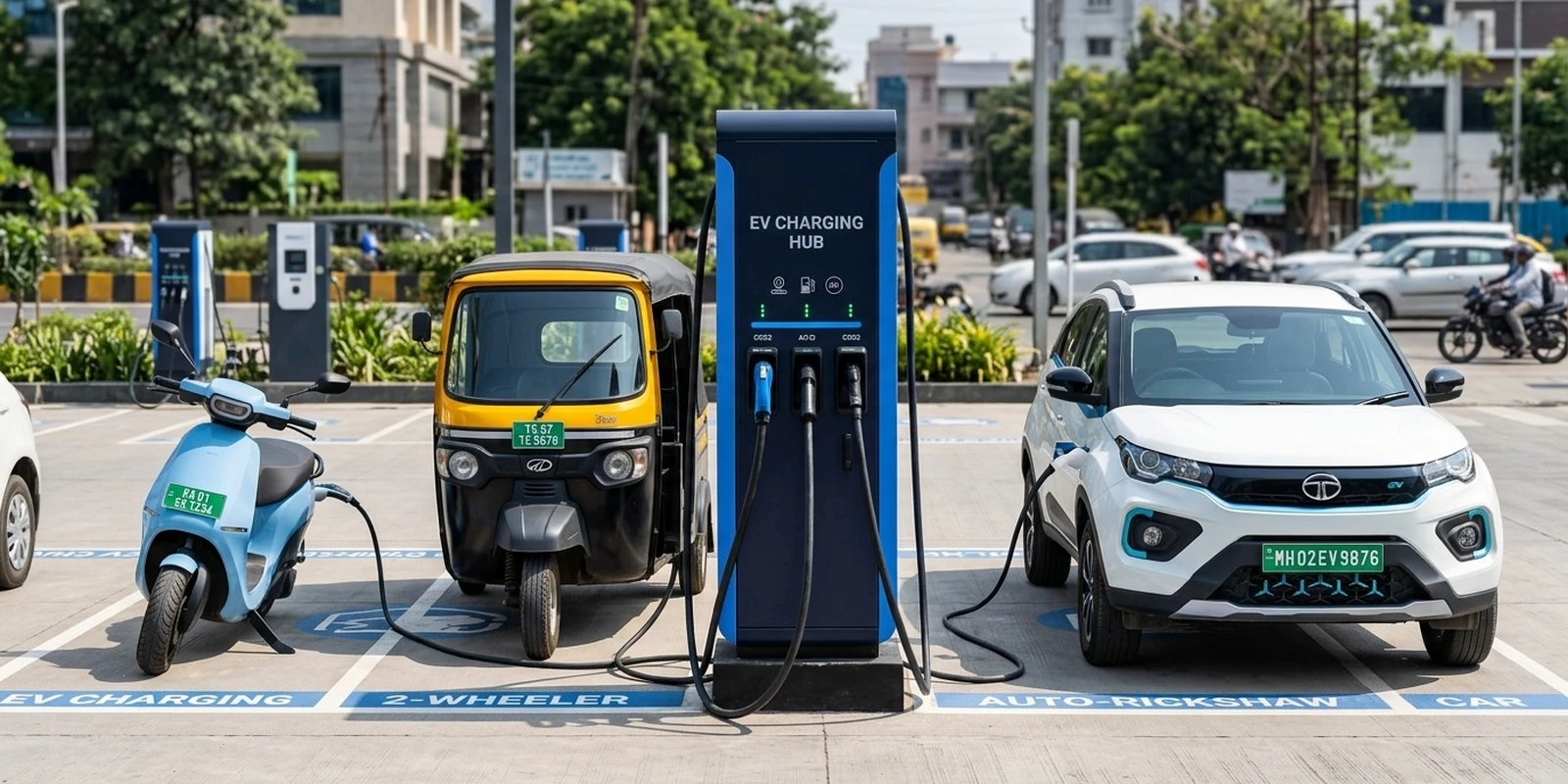
One Charger. Every EV. Made In India.
- The Technology Development Board (DST) is funding RoadGrid India Pvt Ltd’s Indore facility to manufacture a patented Universal EV Charger at commercial scale.
- One unit runs a 140 kW dual DC gun (CCS2 + Type 6) plus AC charging — serving 2-wheelers, 3-wheelers, passenger cars, and commercial EVs from a single footprint.
- Manufacturing scope is fully in-house: power electronics, thermal management, embedded software, communication modules, metering, enclosure fabrication, testing and calibration.
- RoadGrid, founded in 2020 and already running 300+ live chargers across Indore and Navi Mumbai, raised a ₹12 crore Pre-Series A round in January 2026.
- Stated policy goal: reduce import dependence on charging power electronics under Aatmanirbhar Bharat.
- Roadmap includes scaling to ultra-fast charging and integrated energy-storage systems on the same platform.
Every CPO running a mixed-vehicle-category network already knows the problem this solves. A universal EV charger — one hardware unit that can serve two-wheelers, three-wheelers, passenger cars and commercial fleets — has been more roadmap slide than deployed reality in India’s charging market, because the country runs on two separate DC connector standards for different vehicle classes. That is now changing with government money behind it: the Technology Development Board (TDB), under the Department of Science & Technology, has extended financial assistance to Indore-based RoadGrid India Private Limited to build a manufacturing and assembly facility for commercial production of its patented Universal EV Charger.
For CPOs, eMSPs and hardware buyers, the interesting part isn’t the funding line item — it’s the design decision. One charger, two DC guns, one AC port, four vehicle categories. That’s a direct answer to a sourcing and site-planning headache that shows up on every mixed-fleet deployment in the country.
Inside The Universal EV Charger: What RoadGrid’s Hardware Actually Does
Strip away the press-release language and RoadGrid’s charger is a straightforward answer to a hardware-sourcing problem. The unit packs a 140 kW dual DC gun — one CCS2 connector and one Type 6 (the DC connector standard India uses for light electric vehicles, defined under IS 17017 Part 2 Section 6) — plus a separate AC charging port on the same enclosure.
In plain operational terms:
- CCS2 gun — DC fast-charges passenger EVs and commercial four-wheelers, the standard India has mandated for four-wheeler DC charging.
- Type 6 gun — DC-charges electric two-wheelers and three-wheelers (scooters, e-rickshaws), the light-EV connector standard most Indian LEVs ship with today.
- AC port — adds slower, overnight charging on the same hardware, useful for depot and residential-adjacent use cases without needing a second unit.
The operational payoff is footprint, not just novelty. A site that today needs one CCS2-only DC charger for cars and a separate Type 6 unit for two/three-wheelers can run both categories off one cabinet, one grid connection, and one civil-works footprint. For a CPO pricing out a new site — land, conduit, transformer capacity, installation labor — collapsing two chargers into one is a capex and space line item, not just a technical curiosity.
The Hardware Fragmentation Problem CPOs Already Live With
India’s EV charging hardware market is fragmented by design, not accident. Four-wheelers charge on CCS2. Two- and three-wheelers charge on Type 6 (with Type 7/LECCS emerging as the longer-term light-EV standard). That split exists for good technical reasons — light EVs don’t need CCS2’s voltage and cost overhead — but it leaves CPOs running mixed-category networks with a real operational tax.
A CPO serving a corporate campus with employee two-wheelers, a delivery fleet’s e-rickshaws, and visitor passenger EVs today typically needs a separate charger per category — separate hardware SKUs to stock spares for, separate footprints at every site, separate utilization curves to manage (a Type 6 unit idle while the CCS2 queue backs up, or vice versa). None of that shows up in a single-category pilot; it shows up the moment a network scales across segments.
A charger that serves both connector families from one cabinet doesn’t eliminate that complexity, but it does compress it — one hardware relationship, one spares inventory line, one utilization pool per site instead of two. That’s the practical case for calling this an interoperable EV charger, distinct from calling it merely a “new charger model.”
Universal EV Charger Manufacturing: The Government Backing And Import-Substitution Angle
The Technology Development Board’s involvement matters for a reason beyond the funding amount itself (which TDB has not disclosed publicly). TDB assistance is specifically earmarked for setting up a manufacturing and assembly facility — not R&D, not a pilot. The scope covers the full stack of what it takes to build charging hardware domestically: power electronics, thermal management systems, embedded software, communication modules, metering systems, control hardware, enclosure fabrication, and final quality testing and calibration. The project also has scalability designed in for future ultra-fast charging and integrated energy-storage systems — so this isn’t a one-SKU bet.
RoadGrid itself isn’t a paper company riding a government grant. Founded in 2020, the firm already operates a mix of hardware manufacturing and a Charging-as-a-Service network — public deployments in Indore and Navi Mumbai that reportedly run into the hundreds of live chargers, alongside partnerships with distribution utilities and fleet operators. It closed a ₹12 crore Pre-Series A funding round in January 2026 to scale that network and its OEM charger business. The TDB facility is the next step in that trajectory — moving from assembling chargers to owning the manufacturing capacity behind them.
For CPOs and hardware buyers, that’s the supply-chain-resilience angle worth tracking. A meaningful share of India’s charging power electronics — the DC-DC converters, control boards, and power modules inside a fast charger — is still imported, which exposes CPO hardware sourcing to import lead times, currency swings, and tariff risk on every large deployment. A credible domestic manufacturer with full in-house assembly reduces that exposure the same way a second qualified supplier reduces any procurement team’s risk — regardless of how the “Aatmanirbhar Bharat” framing lands. TDB’s stated goals — import substitution in power electronics and a stronger domestic charging-infrastructure ecosystem — are policy language for a sourcing decision CPOs already have to make.
What It Means: Hardware Interoperability Is The Other Half Of The Roaming Story
CPOs and eMSPs have spent the last few years solving interoperability on the software side — OCPP for talking to any charger regardless of manufacturer, OCPI for letting drivers roam across networks on one app. A universal charger is the hardware-layer version of the same problem: one physical asset that doesn’t force a network into vehicle-category silos the way single-connector hardware does.
The two layers only pay off together. A dual-gun charger sitting on a closed, single-vendor management system still locks a CPO into that vendor’s roadmap and pricing. Paired with multi-vendor charger support at the software layer and interoperable charging across networks at the roaming layer, hardware-level interoperability turns into something a network can actually operate at scale — hardware sourcing that isn’t locked to one connector standard, running on YoCharge’s charging management platform, feeding a roaming network drivers can use across operators. That’s the full stack CPOs expanding into mixed-vehicle-category or multi-city deployments are actually assembling, one layer at a time — and domestic hardware manufacturers building to that stack matter as much as the software vendors do.
None of this is guaranteed at the volumes TDB’s language implies — facility funding is an input, not a shipped product. But for CPOs weighing hardware roadmaps for 2026-27 mixed-category deployments, a domestically manufactured, dual-standard charger backed by a government production mandate is a live option to evaluate now, not a hypothetical for later.
Frequently Asked Questions
What CPOs and hardware buyers are asking about RoadGrid’s universal EV charger
Source: Technology Development Board, Department of Science & Technology, Press Information Bureau, Government of India (PRID 2292264). Technical connector-standard context: Type 6 connector, Wikipedia.
Run A Mixed-Hardware Network Without The Operational Tax
Whatever hardware mix ends up on your sites — universal chargers, single-connector units, or a legacy fleet of both — YoCharge’s EV-CMS runs them from one dashboard with OCPP multi-vendor support and OCPI roaming built in.