
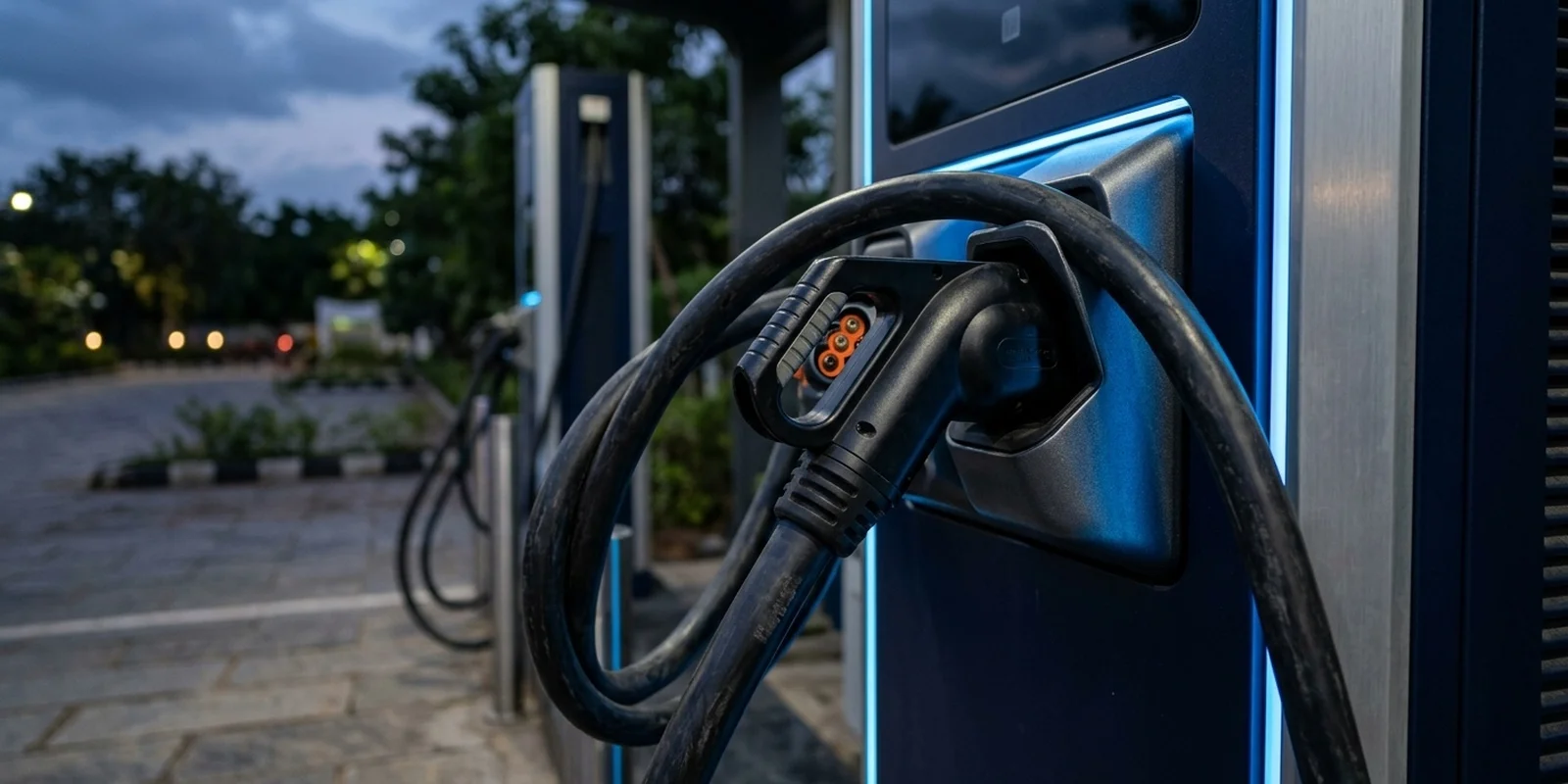
India’s First EV Charging Cable Standard: IS 19967:2026
💡 EV Charging Cable Standard India: Key Highlights
- IS 19967:2026 is a dedicated Indian Standard for EV charging cables, established by BIS on 14 October 2026 (World Standards Day).
- It covers flexible cables rated up to 1,100 V AC and 1,500 V DC, across AC charging Modes 1–3 and DC Mode 4.
- Scope per BIS: construction, insulation, thermal management and testing for cables working in demanding outdoor conditions.
- Not yet stated: mandatory status, an enforcement date, or a certification (QCO) requirement. Treat it as a procurement benchmark until a primary source says otherwise.
- For CPOs, the practical change is in tenders: ask for cable test evidence against IS 19967, a cable rating that matches charger output, and replacement terms.
India now has an EV charging cable standard of its own. On 14 October 2026, the Bureau of Indian Standards (BIS) released IS 19967:2026, Cables for Electric Vehicle Charging Systems, one of seven new Indian Standards announced at the national World Standards Day event in New Delhi. It is the first EV charging cable standard India has written specifically for the lead that connects a charger to a vehicle, the part drivers handle, drop, drive over and leave in the sun.
This post is written for charge point operators (CPOs), charger procurement leads, site hosts and charger OEMs. It covers what the standard includes, why the cable matters for uptime and margin, what is still unconfirmed, and what to put in your next tender or vendor quote.
What India’s EV Charging Cable Standard Covers
According to the PIB release of 14 October 2026, IS 19967:2026 sets out construction, insulation, thermal management and testing protocols for flexible charging cables. The cables are rated up to 1,100 V AC or 1,500 V DC and built for demanding outdoor conditions. A BIS notice dated 12 October 2026 gives the full title as Charging Cables for Electric Vehicles of Rated Voltages up to and Including 1 100 V a.c. or up to and Including 1 500 V d.c., with 14 October as its date of establishment.
The draft that BIS’s Power Cables Sectional Committee (ETD 09) circulated for public comment in January 2025 was split into four sections. Those sections follow the same lines as the international IEC 62893 charging-cable series. The final text may differ from the draft, so treat this split as a guide until you have the published standard.
| Draft section | Covers | Where you meet it |
|---|---|---|
| Section 1 | General requirements and test methods | Applies to every cable type below |
| Section 2 | AC charging, Modes 1–3 | Portable leads, wallbox and AC public charger cables |
| Section 3 | DC Mode 4, no thermal management system | Conventional DC fast chargers, e.g. 60–120 kW CCS2 |
| Section 4 | DC Mode 4, with a thermal management system | Actively cooled cables on high-power DC chargers |
The draft also set a maximum conductor temperature of 90 °C, the same ceiling the IEC series uses. Two terms are worth knowing. Mode 4 is DC charging, where the charger converts AC to DC itself and the cable is permanently attached to it. Thermal management means the cable is actively cooled, usually by liquid, so it can carry high current without the conductor overheating.
Why The Charging Cable Matters To A CPO’s Uptime And Margin
On a public site the cable is the most handled part of the charger. It is dragged across concrete, crushed under wheels, flexed thousands of times and exposed to UV, monsoon rain and summer heat. The charger cabinet sits still, but the cable is constantly being moved.
The electrical stress grows quickly with power. Current equals power divided by voltage, so a 240 kW session on a 400 V vehicle draws about 600 A, while the same session on an 800 V vehicle draws about 300 A. Resistive heating in the conductor scales with the square of the current, so doubling the current means roughly four times the heat. That is why high-power cables either get thicker and heavier or need active cooling, and why Section 4 of the draft exists.
For India the range is no longer theoretical. PM E-DRIVE has approved 8,147 public chargers, and its state tenders specify CCS-II chargers from 60 kW to 240 kW, plus 240–500 kW units for buses and trucks. Those tenders also carry uptime terms. Telangana’s tender sets a minimum of 95% monthly uptime per charger, and a single damaged cable takes a gun out of service just as surely as a failed power module does.
What Is Not Yet Known: Mandatory Status And Timelines
The release states the scope and voltage ratings of IS 19967:2026. It does not say the standard is compulsory, give an enforcement date, or require BIS certification of charging cables. The BIS establishment notice does not mention any of these either.
In India, a published standard usually becomes legally binding for a product only when the relevant ministry notifies a Quality Control Order (QCO) that names it. As of 20 October 2026 we have found no QCO covering IS 19967, and we are not assuming one is coming or when. Until a primary source says otherwise, read India’s EV charging cable standard as a national benchmark that buyers can specify, not as a market-entry rule. Check the BIS standards portal for the standard’s text and any later amendments.
What To Ask For In Charger Tenders And Vendor Quotes
A CPO does not need to wait for a mandate to use the standard. A specification is only as strong as the evidence behind it, and IS 19967 gives procurement teams a named Indian reference to ask for. Five clauses are worth adding now.
The last clause is where cable quality becomes something you can measure. When chargers report faults through OCPP-compliant charging software, temperature-limit trips and repeated session derates on one gun can be tracked over time. That kind of remote charger monitoring turns a cable that is failing slowly into a planned replacement rather than an outage counted against your SLA.
How It Fits With IS 17017 And PM E-DRIVE Tenders
IS 19967 adds to the existing framework rather than replacing it. The IS 17017 series of BIS standards for EV chargers still governs the charging system and its connectors, and PM E-DRIVE tenders already refer to it. CCS-II chargers, for example, are specified under IS 17017-2-3. IS 19967 now covers the cable between the charger and the connector.
For operators bidding on schemes like Odisha’s 692-charger PM E-DRIVE tender, this changes how risk is spread across the contract. Over a 10-year term, the operator, not the charger supplier, carries the uptime obligation. Writing the cable standard into vendor contracts moves some of that risk back to the supplier. Running a mixed fleet from several suppliers is workable for the same reason: when every vendor tests to the same specification, hardware-agnostic charging is easier to manage.
The same BIS release also published IS 19891:2026 for pedal-assisted e-cycles (EPACs), covering units up to 0.25 kW with a 25 km/h cut-off. That standard matters to light-mobility and delivery fleets rather than to charger buyers.
Frequently Asked Questions
IS 19967:2026 and EV charging cable procurement in India
Source: Quality Infrastructure, Clean Energy and Consumer Safety Take Centre Stage at the National Celebration of World Standards Day 2026 — Ministry of Consumer Affairs, Food & Public Distribution (PIB Delhi), 14 October 2026 (PRID 2323467) | Bureau of Indian Standards establishment notice, 12 October 2026 (Ref. HQ-PUB013/1/2020-PUB-BIS (1616)).
Run A Mixed-Vendor Charger Network From One Platform
YoCharge’s charging management platform is charger-agnostic. It onboards OCPP chargers from multiple OEMs, surfaces the faults they report, including over-temperature and connector errors, and tracks uptime per connector against your tender SLAs.
What happens next?
- Review of your charger mix and vendor list
- Hardware-compatibility check for new procurements
- Onboarding plan for fault monitoring and uptime reporting
- Live demo on your own use case
Talk To Sales