
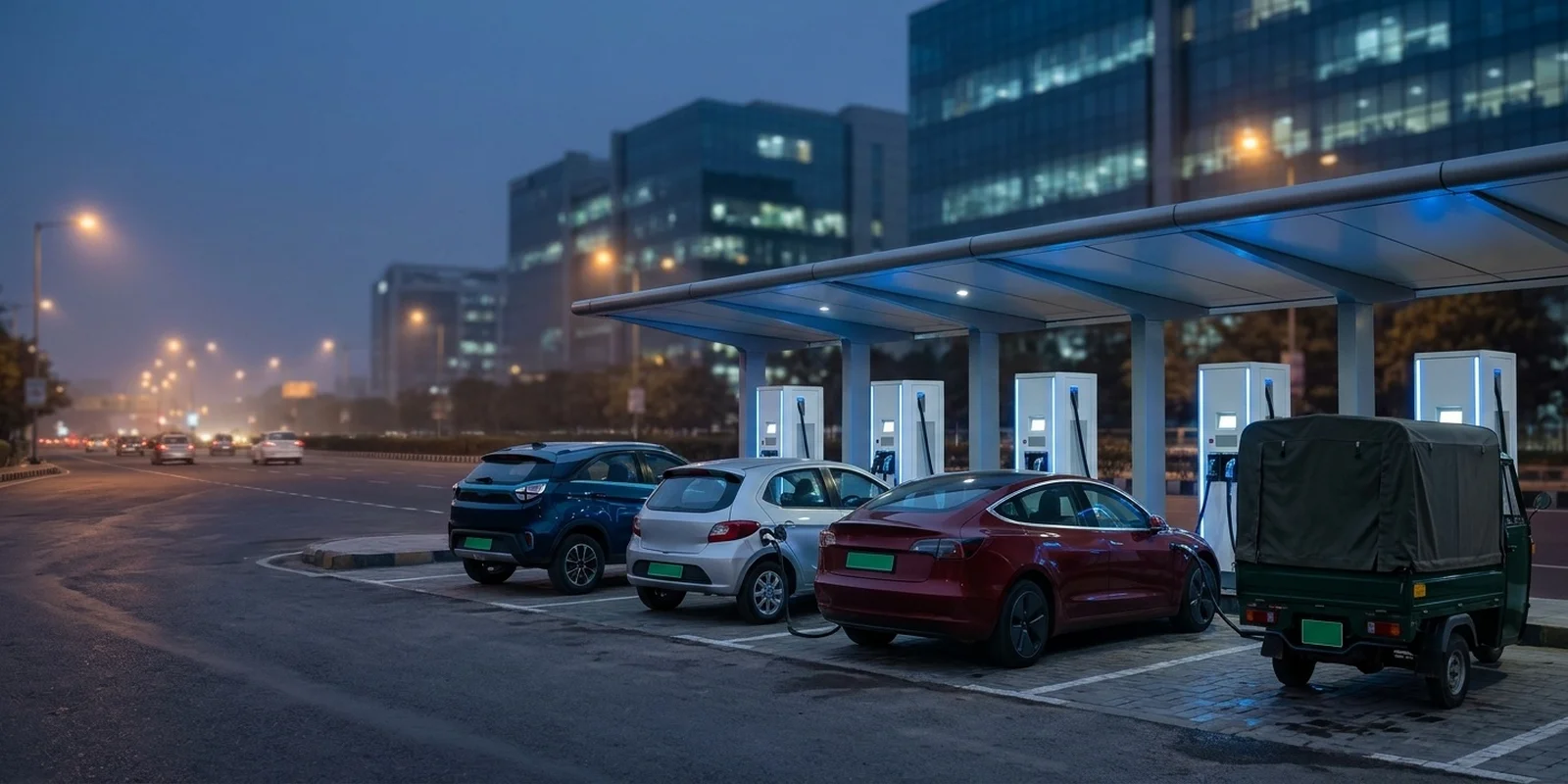
Delhi NCR EV Charging Infrastructure: 12.94 Lakh EVs, Only 16,785 Charging Points
Delhi NCR EV charging infrastructure: CAQM tells the Supreme Court 12.94 lakh EVs share 16,785 charging points, 89% in Delhi. What it means for CPOs.

Delhi-NCR: 12.94 Lakh EVs, 16,785 Charging Points
Stated in CAQM’s status report to the Supreme Court
- 12.94 lakh EVs, 16,785 charging points across Delhi and the NCR districts of UP, Haryana and Rajasthan, per CAQM’s status report to the Supreme Court.
- Delhi holds 88.85% of the points (14,913, as of 31 October 2026) but only about 53% of the EVs (derived).
- The ring is the gap: about 326 EVs per point outside Delhi against about 46 inside it (derived).
- Rajasthan’s NCR districts have 22 points for 44,987 EVs; UP’s have 565 for 3,47,587.
- CAQM wants the other NCR states to revise their EV policies and add battery swapping and used-battery management.
Delhi NCR EV charging infrastructure has a geography problem, not just a volume problem. In a status report to the Supreme Court, the Commission for Air Quality Management (CAQM) counted 12.94 lakh electric vehicles across Delhi and the NCR districts of Uttar Pradesh, Haryana and Rajasthan, served by 16,785 charging points. Delhi alone holds 14,913 of those points, or 88.85%, for 6,83,251 EVs as of 31 October 2026. The remaining 6.11 lakh EVs in the ring around the capital share 1,872 points between them (derived).
This analysis is written for charge point operators (CPOs) planning NCR expansion, for property owners and dealerships now expected to host chargers, and for fleet operators facing Delhi’s 2027 registration mandates. The regional average of about 77 EVs per charging point (derived) hides a spread from roughly 46 in Delhi to more than 2,000 in Rajasthan’s NCR districts.
What CAQM Told The Supreme Court
The figures were first reported by The Hindu and carried by Autocar Professional and AIR News on 25 November 2026. They sit inside a wider CAQM filing on vehicular pollution, in which the Supreme Court observed that a considerable share of Delhi’s pollution comes from vehicles entering from neighbouring NCR states. That is the hinge of the charging story: an EV registered in Noida or Gurugram that cannot charge near home or work is a weaker substitute for the petrol or CNG vehicle it was meant to replace.
CAQM advised the other NCR states to revise their EV policies. It also said the region needs infrastructure beyond public charging: battery-swapping facilities and systems to manage and dispose of used batteries. The ask is not new. In a December 2025 affidavit, CAQM had already urged states to set explicit electrification timelines for two-wheelers, three-wheelers, cars, buses and commercial vehicles.
The same report shows how slowly the old fleet is leaving: of 25,43,679 end-of-life vehicles still active across the four regions, only about 1.86 lakh, just over 7%, were scrapped or moved out between January and October 2026.
Delhi NCR EV Charging Infrastructure, State By State
Put EVs and charging points side by side and the imbalance is plain. Delhi has just over half the region’s EVs but almost nine in ten of its charging points.
Share of the region
Where the EVs are, and where the charging points are
Share of EVs* (derived)Share of charging points (stated)
| Region (NCR part) | EVs | Charging points | Share of EVs* | Share of points | EVs per point* |
|---|---|---|---|---|---|
| Delhi | 6,83,251 | 14,913 | 52.8% | 88.85% | ≈46 |
| Uttar Pradesh (NCR) | 3,47,587 | 565 | 26.9% | 3.37% | ≈615 |
| Haryana (NCR) | 2,18,530 | 1,285 | 16.9% | 7.66% | ≈170 |
| Rajasthan (NCR) | 44,987 | 22 | 3.5% | 0.13% | ≈2,045 |
| Delhi-NCR total | 12,94,355 | 16,785 | 100% | 100% | ≈77 |
EV and charging-point counts as stated in CAQM’s status report to the Supreme Court, via The Hindu, Autocar Professional and AIR News (Delhi’s figures are as of 31 October 2026). *Share of EVs and EVs per point are derived: YoCharge’s calculation from those stated counts.
Uttar Pradesh’s NCR districts, which cover Noida, Greater Noida and Ghaziabad, carry about 27% of the region’s EVs on 3.37% of its points, roughly 615 EVs per point (derived). Haryana’s NCR districts, including Gurugram and Faridabad, sit at about 170 (derived). Rajasthan’s NCR districts around Alwar have 22 points for 44,987 EVs. That is closer to having no public network at all than to having a thin one. Outside Delhi, the average is about 326 EVs per point, seven times Delhi’s ratio (derived).
EVs per charging point
One charging point per 46 EVs in Delhi, one per 2,045 in Rajasthan’s NCR districts
Why Delhi Is Ahead
Delhi has run a dedicated EV policy since 2020, and its three DISCOMs (BRPL, BYPL and TPDDL) have led the public charging rollout. Officials put the city’s count at more than 10,000 points at the end of June 2026, according to The Pioneer. CAQM’s 14,913 four months later may not use an identical definition, but the direction is clear.
The Delhi Electric Vehicles Policy 2026, notified on 30 June and in force until 31 March 2030, turns that momentum into institutions. Delhi Transco Limited (DTL) is the nodal agency for public charging and battery swapping. It must aggregate demand and load requirements, run a single-window clearance for charge point operators, and notify service-level benchmarks for performance, uptime and reliability. Urban local bodies must identify land parcels for public charging. Every OEM must also ensure at least one public charging station per authorised dealer, with at least three points for two- and three-wheelers and two for four-wheelers.
The policy also creates demand. Only electric L5 three-wheelers and N1 goods carriers can be newly registered in Delhi from 1 January 2027, and only electric two-wheelers from 1 April 2028. School bus fleets must reach a 30% electric share by March 2030. The charging target reported at notification is more than 30,000 points, and officials have also cited 32,000 by 2030. From 14,913, that means roughly 15,000 to 17,000 more points in about 40 months, or around 380 to 430 a month (derived).
Delhi EV Policy 2026
The dates that drive charging demand
- 30 Jun 2026Policy notifiedDelhi Electric Vehicles Policy 2026
- 1 Jul 2026Policy in forceCharging rollout under DTL as nodal agency
- 1 Jan 2027Electric-only registrationNew L5 three-wheelers and N1 goods carriers
- 1 Apr 2028Electric-only registrationNew two-wheelers
- 31 Mar 2030Policy runs toSchool bus fleets at a 30% electric share
Read The Denominators Before You Compare
One caution before anyone builds a business case on Delhi NCR EV charging infrastructure data. CAQM’s counts cover only the NCR districts of Uttar Pradesh, Haryana and Rajasthan. State-wide counts use a different, much larger base.
For example, Inc42 cited 1,989 public charging stations across all of Uttar Pradesh in March 2025, about one per 190 vehicles. That is a state-wide figure, measured in stations rather than points, at an earlier date. It cannot be set against CAQM’s 565 NCR points, or added to them. A station can also host several charging points, so “stations” and “points” are not interchangeable. Compare like with like, or the gap looks smaller or larger than it really is.
What Has To Happen Next
NCR states need policies with dates
Closing the Delhi NCR EV charging infrastructure gap starts with policy. Delhi’s lead comes from a policy with deadlines, a nodal agency and enforcement. CAQM is now asking Uttar Pradesh, Haryana and Rajasthan to match that with timelines of their own. Without them, the NCR districts stay a market where EVs grow faster than charging does.
Land and power connections
Most delays come from sites and grid connections, not charger hardware. Delhi’s answer is DTL aggregating load and running single-window approvals. In Haryana, an ICCT policy brief (September 2026) finds that group housing is where most residential charging will happen. Yet state regulations do not clearly recognise community charging. A charger in a housing complex there would pay a non-domestic tariff of ₹5.80–6.60 per kWh, while public stations pay ₹7.05 per kWh. The Ministry of Power’s 2024 charging guidelines set the national framework, but states still decide tariffs, approvals and land. Where the connection is fixed, dynamic load management lets more chargers share it.
Battery swapping and end-of-life batteries
CAQM explicitly asks for swapping networks and formal handling of used batteries. Delhi’s own registration mandates start with three-wheelers, light goods carriers and two-wheelers, and many of those vehicles run commercial shifts. For those users, a swap station can matter as much as a charger.
Utilisation, uptime and interoperability
For CPOs, adding points is only half the job. A charger that is offline, or that a driver cannot find or pay at, does nothing for the ratio. Delhi will soon publish uptime benchmarks. Commuters cross state lines every day, so a driver from Noida should not need a separate app to charge in Gurugram. OCPI roaming integration lets one app or RFID card work across networks, as our explainer on charging roaming and interoperability sets out.
What It Means For CPOs, Site Hosts And Fleets
- CPOs: Delhi will be crowded, but the market in Noida, Ghaziabad, Gurugram, Faridabad and Alwar is under-served. There are about 326 EVs per point outside Delhi (derived). Winners will prove uptime and utilisation site by site, the numbers benchmarks and site hosts will ask for.
- Dealerships and property owners: Delhi’s dealer mandate makes every authorised EV showroom a charging site. Malls, offices and housing societies in the ring can earn from the same demand, once tariff and approval rules for community charging are clear.
- Fleets: e-only registration for L5 three-wheelers and N1 goods carriers from January 2027 will push more commercial EVs onto the road. Many of them will be based or registered outside Delhi. Depot and en-route charging in the NCR districts will decide whether those fleets can run full shifts.
Building Delhi NCR EV charging infrastructure across four jurisdictions brings four sets of approvals, tariffs and charger fleets. That is where YoCharge’s charging management platform fits. It runs mixed charger fleets from one dashboard, reports uptime and utilisation by site and connects networks through an EV roaming network so drivers are not locked out at a state border.
Delhi NCR EV Charging Infrastructure: Frequently Asked Questions
Source: Autocar Professional, “Delhi-NCR EVs Face Charging Shortage: The Hindu” — Eshisha Java, 25 Nov 2026, reporting The Hindu on CAQM’s status report to the Supreme Court | AIR News, 25 Nov 2026 | Delhi Electric Vehicles Policy 2026 — Delhi Gazette Extraordinary No. 169, 30 Jun 2026.
Launch your own branded charging network on YoCharge: one platform for every charger, uptime and utilisation reporting by site, and OCPI roaming so drivers from Delhi, Noida and Gurugram can charge on your points from day one.
Talk to Sales